
An aqueduct is easy to admire from far away. Arches stride across valleys, water arrives where gravity seems to have been persuaded into civic service, and a city appears to drink from stone. But Roman water did not become trustworthy because arches were beautiful.
Roman aqueduct inspectors made water trustworthy because supply depended on oversight before the fountain. Channels had to be cleared, leaks noticed, pipes measured, reservoirs managed, illegal taps resisted, and public confidence renewed through practical attention.
Frontinus treated water as an office, not a miracle
Frontinus tells us he approached the water supply as an administrative responsibility requiring knowledge. That matters because it pulls our attention away from the postcard view of arches and toward the daily work that made water reliable.
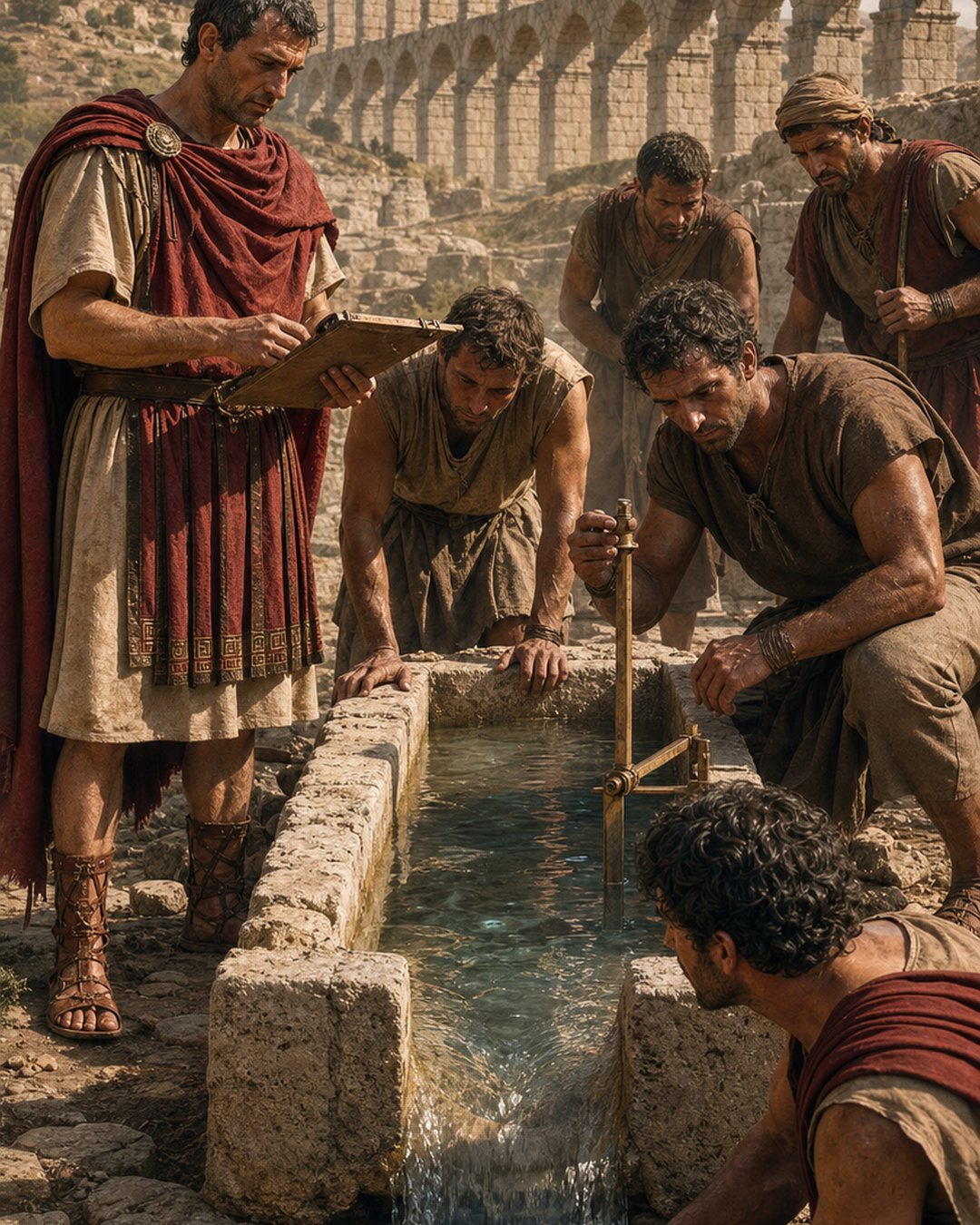
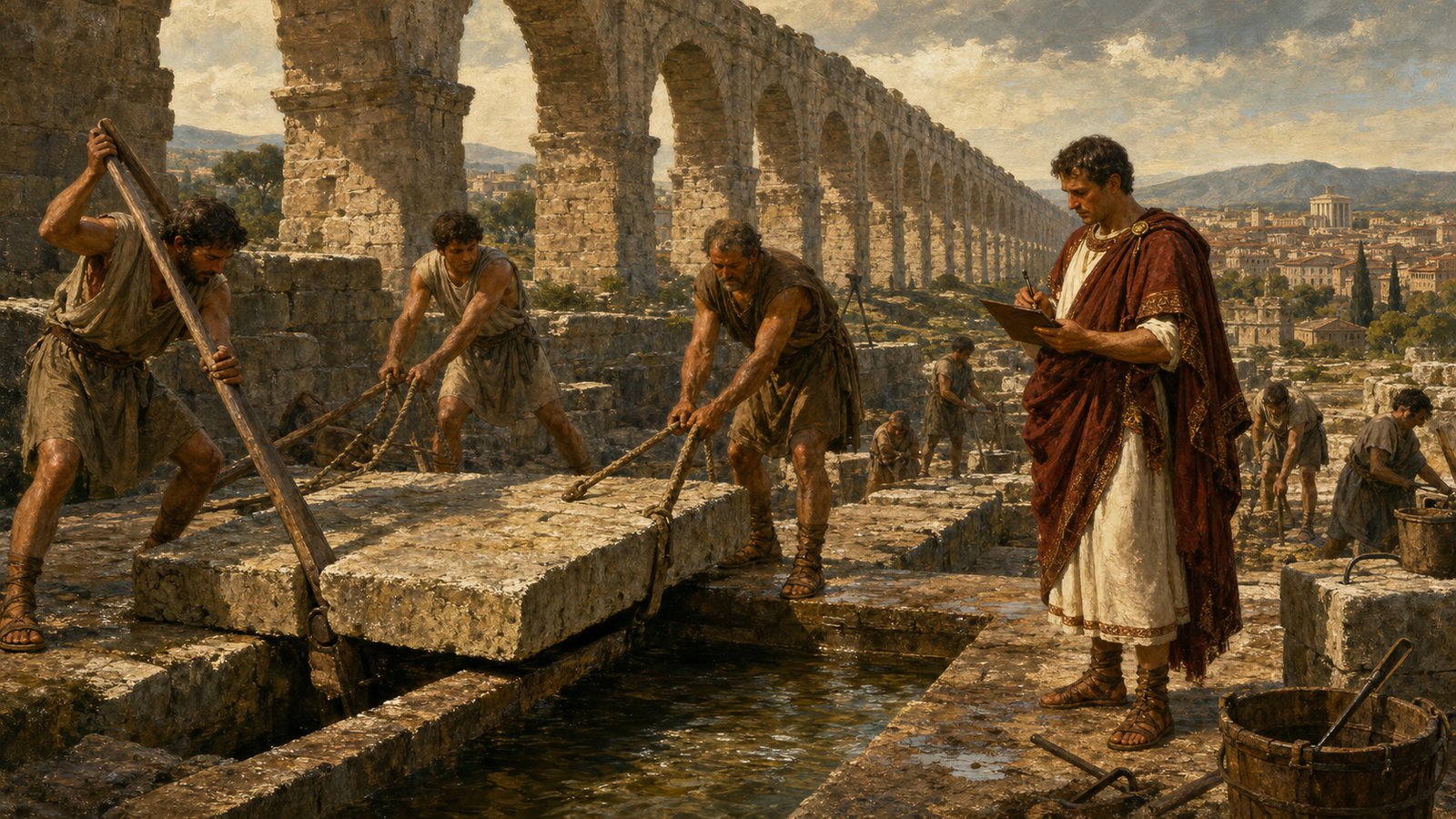
Imagine the scene upstream: a stone cover lifted, cold water moving in a channel, a worker crouched with tools, an official checking a tablet while arches fade into the distance. Trust begins before the crowd sees a fountain.
The aqueduct had to be inspected as a route
Aquaeductus describes more than an impressive line of masonry. It was a route of water, gradient, channel, protection, repair, and risk. If one section failed, the public miracle could become a public problem.
This connects with Roman street fountains. The fountain made water socially visible, but the channel made that visibility possible. Users trusted what they could see because someone watched what they could not.
Reservoirs turned flow into allocation
Castellum, the distribution reservoir, shows that water was not simply delivered; it was divided. Allocation required points where flow could be received, measured, redirected, and disputed.
Those points made politics physical. A reservoir or division box could decide which neighborhood, bath, fountain, or private privilege received water. Trust depended on the belief that such divisions were supervised.
Pipes made fraud and leakage visible to officials
Fistula, the pipe, reminds us that infrastructure has small vulnerable parts. An unauthorized outlet, a damaged pipe, a blocked channel, or an altered opening could change the public supply.
Inspection made these problems concrete. Fraud was not only moral language; it could appear as a hole, a pipe, a trickle, a missing measure, or a suspicious flow where records said it should not be.
The fountain was the final proof, not the whole system
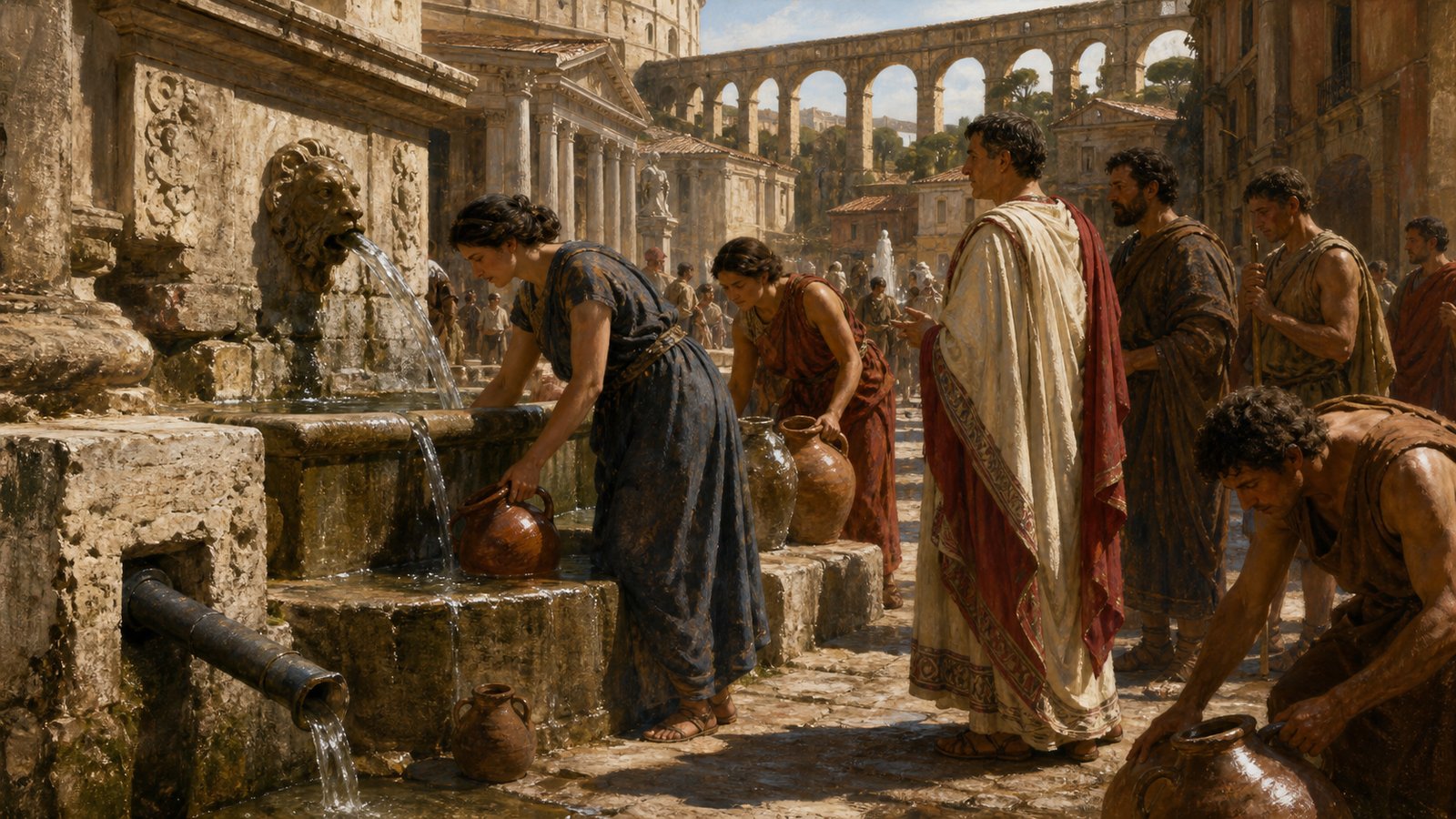
At the public fountain, citizens saw jars filling, animals drinking, children waiting, and neighbors measuring daily life around water. But the reliability of that scene rested on work performed elsewhere.
Aqueduct inspectors made water trustworthy by connecting visible abundance to hidden discipline. Rome’s water system was a monument only because maintenance, records, routes, and officials kept making the monument true.
The distinction matters because monuments can deceive our memory. We see surviving arches and imagine a system that worked by grandeur alone. Ancient users would have known the more practical truth: water is trusted when it arrives again tomorrow.
Repetition created confidence. A household did not need to understand every gradient to know whether the fountain flowed. Daily reliability made engineering feel like civic order. Breakdowns made the same engineering feel like neglect.
Inspection therefore had a public emotional role. It reduced uncertainty. When officials and workers could identify channels, repairs, and rights of use, the city could believe that water was governed rather than accidental.
The curator’s office also made responsibility easier to locate. If water failed, someone could be blamed, questioned, or expected to act. Administration turned a technical problem into a civic obligation.
This did not remove inequality. Some users had better access, private connections could distort supply, and powerful households could press claims that ordinary residents could not. Trust in Roman water always lived beside privilege.
Yet even privilege had to pass through physical systems. Pipes, reservoirs, channels, and measures made favoritism concrete. That meant abuse could be hidden, but it also meant abuse sometimes left a trace.
Frontinus matters because he reveals a Roman anxiety behind the confidence. Water supply had to be known in detail: sources, lengths, volumes, branches, repairs, and misuses. Confidence required record-keeping as well as stone.
The workers in the channel belonged to the public story as much as the arches did. Their labor kept sediment, damage, and collapse from turning imperial pride into dry basins. The most important part of an aqueduct might be the part someone cleaned before dawn.
A fountain queue shows the social stakes. People waiting with jars were not admiring engineering as a luxury. They were depending on it for cooking, washing, trade, animals, and the rhythms of neighborhood life.
Water also made politics intimate. A road could be admired from a distance, but water entered bodies, homes, baths, workshops, and streets. When supply faltered, public administration reached into ordinary discomfort immediately.
The system’s trustworthiness therefore came from a chain. Source, channel, reservoir, pipe, fountain, user: each link had to hold well enough for the final scene to look effortless.
Roman aqueduct inspectors made water trustworthy by making that chain inspectable. The city could not see every channel at once, but it could sustain offices, records, and repair routines that connected hidden flow to public use.
The visible fountain was almost a promise: the water you see here has survived a journey through terrain, masonry, gradients, human interference, and official oversight. Every filled jar silently depended on that promise being kept.
The promise also had enemies. Roots, cracks, theft, sediment, careless repairs, and private ambition could all interrupt the system. Trust had to be defended against both nature and people.
That defense made inspectors central to the meaning of the aqueduct. They translated monumental engineering into daily reliability, and daily reliability was what made users believe the city had mastered water rather than merely displayed stone.
The channel inspection scene is therefore as Roman as the arch. It shows the empire not at its most spectacular, but at its most operational: officials, laborers, tablets, tools, and water moving through a system that must be kept honest.
This operational side also explains why water supply could become a measure of good government. A ruler or city that let channels fail did not merely lose elegance. It lost credibility at the fountain, where ordinary people judged public order by the flow into their jars.
Roman water became trustworthy when the invisible route could be tied to visible responsibility. The aqueduct’s beauty brought admiration, but its inspection brought belief.
In the end, the most important question was not whether Rome could build arches. It was whether Rome could keep water moving through them, fairly enough and regularly enough, that the crowd at the fountain treated the flow as public fact rather than lucky accident.
The inspector also made time visible. A channel could look healthy in one season and fail in another; sediment, frost, plants, pressure, and unauthorized cuts did their work slowly. Regular inspection turned water supply from a single achievement into a continuing civic habit.
That habit mattered to people who would never see the source. When a woman filled a jar or a workshop drew water for the day, she depended on decisions made far upstream. The trust at the basin was therefore borrowed from the unseen discipline of the route.
This is why aqueduct inspection belongs in the same story as Roman records and public notices. Infrastructure became credible when it could be described, checked, repaired, and made answerable. The flowing fountain was the visible ending of a chain of supervision.
Sources & Further Reading
- Frontinus, De Aquis
- Smith Dictionary, Aquaeductus
- Smith Dictionary, Castellum
- Smith Dictionary, Fistula
- Smith Dictionary, Curator