
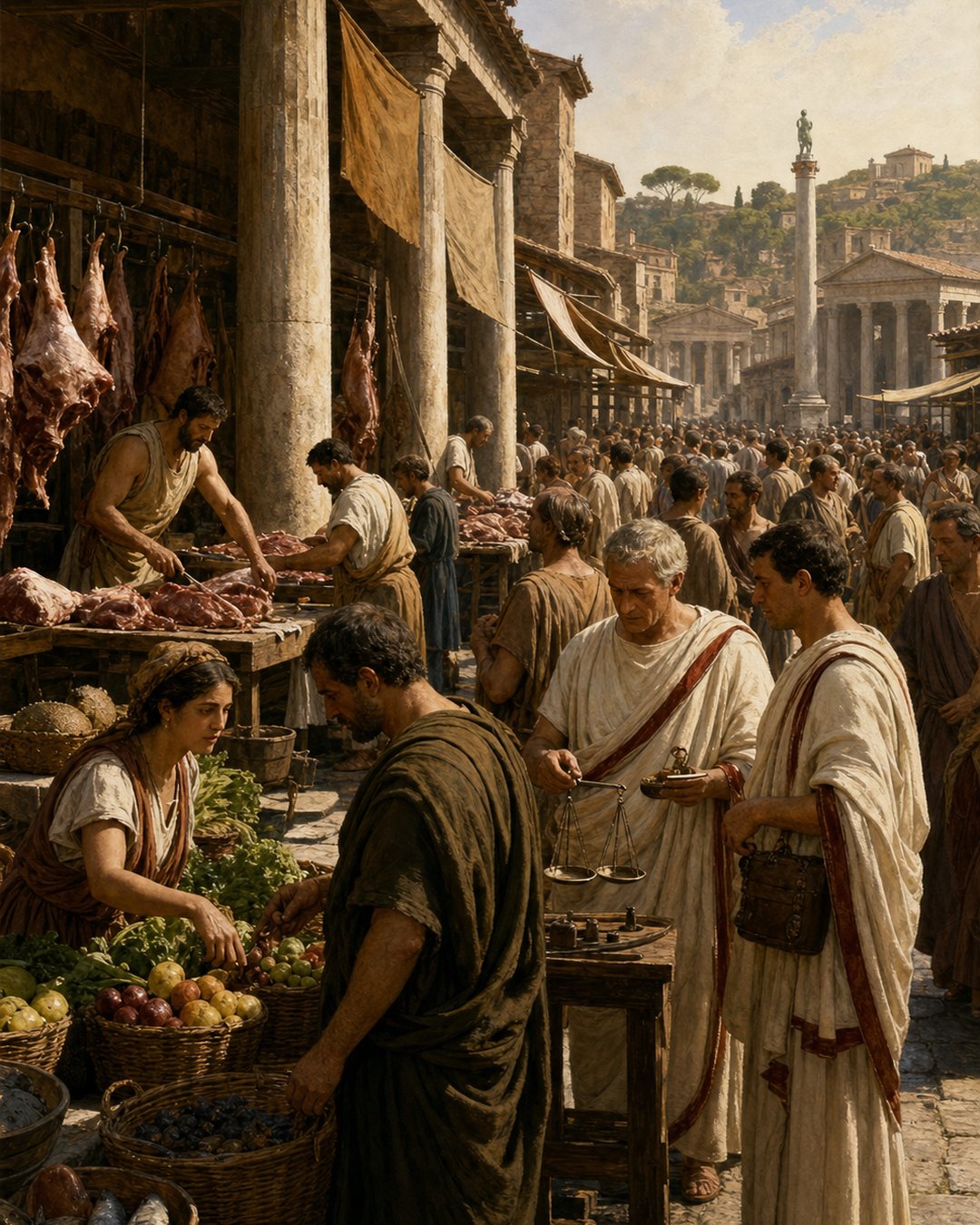
A market day begins with practical things: baskets, animals, meat, vegetables, coins, measures, and the awkward work of getting goods into town. But practical gathering has a way of becoming public life.
Roman market days made rural news public because they turned repeated trade into repeated contact. The nundinae brought sellers, buyers, officials, prices, rumors, and obligations into the same visible rhythm.
Nundinae gave contact a calendar
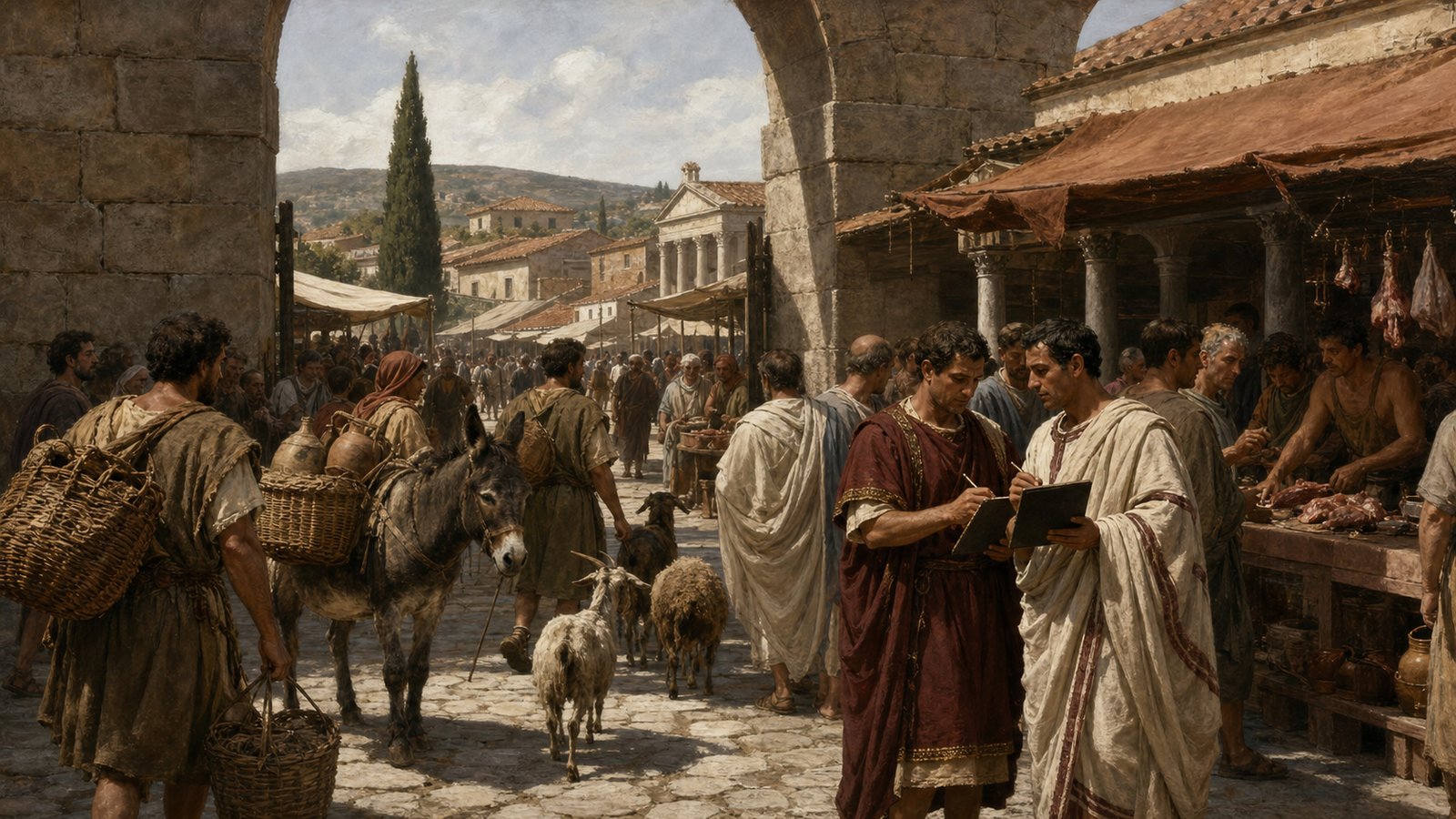
Nundinae were recurring market days, and recurrence is the key. A single crowded morning can spread news, but a predictable cycle teaches people when information will arrive and where they should stand to receive it.
Imagine the mini-scene: country sellers entering before the heat, baskets balanced against the hip, animals complaining near the gate, officials watching measures, and townspeople leaning in to ask what the roads, farms, and neighboring villages are saying.
The macellum made food trade visible
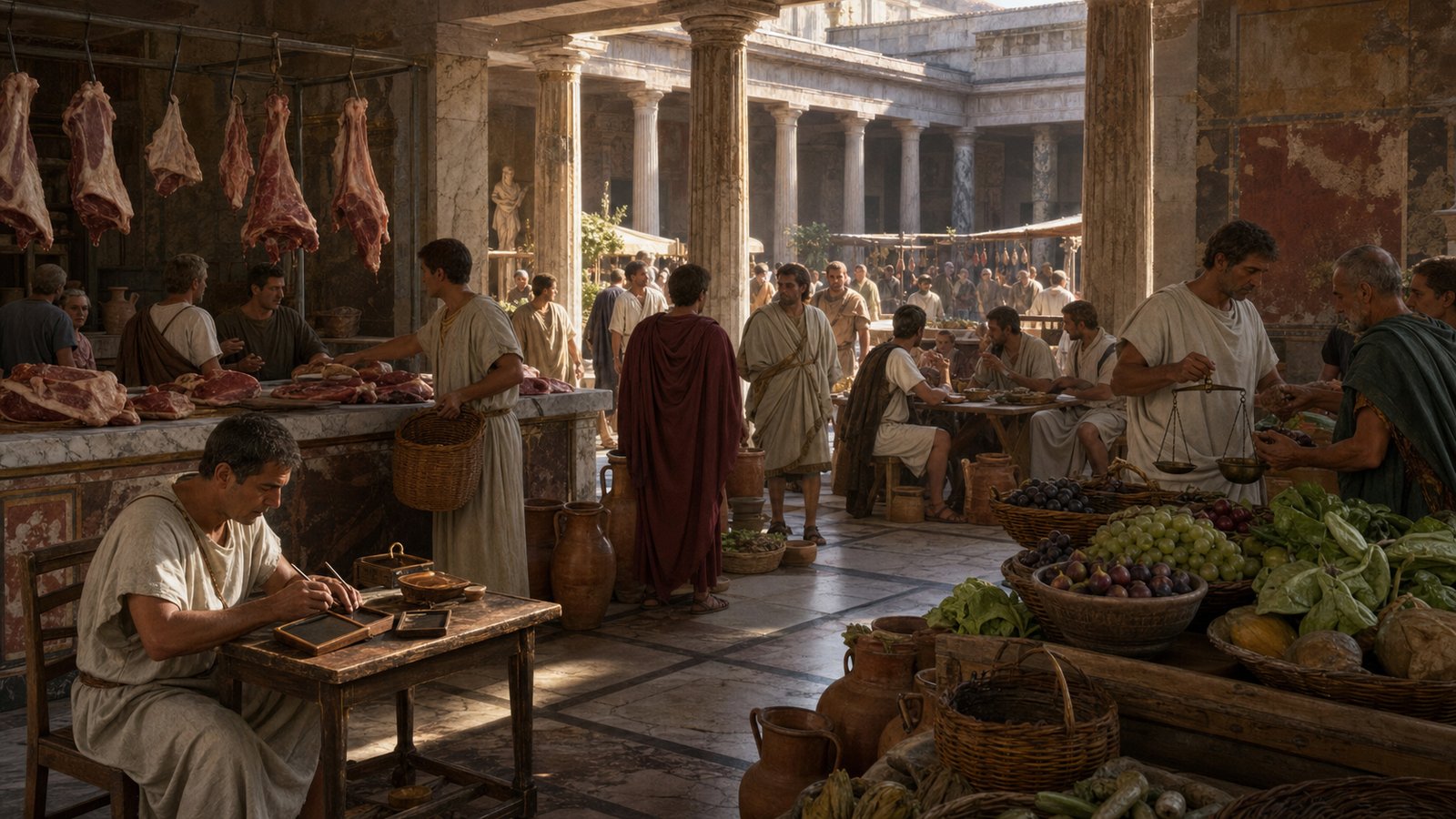
A macellum concentrated food commerce in recognizable space. Stalls, counters, smells, hooks, baskets, and public measures made the exchange of food something other people could watch and judge.
This connects with Roman market weights. Trade became more public when quantities could be measured, disputed, and defended in front of others.
The forum edge turned buying into public conversation
Forum space mattered because buying and selling did not float apart from civic life. A person who came for food could hear a notice, meet a patron, learn a price, find a witness, or carry a rumor home.
The result was not a newspaper. It was a human relay: voices, prices, warnings, jokes, complaints, and practical knowledge moving through bodies already gathered for trade.
Weights and measures made argument possible
Pondera and mensura remind us that market trust depended on objects. A claim about fairness becomes sharper when a weight, scale, or measure can be shown to other people.
Small objects changed the mood of a dispute. Instead of accusing someone in the abstract, a buyer could point to the measure, the scale, the quantity, or the official who was supposed to make exchange believable.
Rural news became public through repetition
Market day made the countryside periodically visible to the town. Harvest conditions, road trouble, animal disease, tax pressure, prices, marriages, rumors, and political unease could all travel with goods.
Roman market days made rural news public because they joined necessity to attention. People had to come for trade, and once they gathered, information came with them.
The market was therefore more than an economic scene. It was a communication system built from ordinary need. People did not have to gather for news in order for news to spread; they gathered for food and brought news along.
This helped connect town and countryside without making them the same. Rural sellers arrived with knowledge that townspeople lacked, while urban buyers carried expectations, coins, gossip, and administrative pressure back toward the countryside.
The sensory world mattered. Smell, noise, flies, animals, shouting, touching, weighing, and bargaining gave information a physical setting. News arrived with mud on sandals and produce in baskets.
Regularity also reduced uncertainty. If someone needed to meet a debtor, hear prices, look for labor, or ask about a road, market day offered a predictable chance. The calendar made contact easier to plan.
Officials could use the same rhythm. A market crowd was useful for notices, inspection, measurement, and the quiet observation of who was present, absent, prosperous, or struggling.
That did not mean the market was peaceful. Crowds create friction. A disputed measure, spoiled food, aggressive bargaining, or a rumor about shortage could turn commerce into public anger.
The macellum’s visibility made confidence possible and conflict sharper. People could see food, but they could also see inequality, scarcity, and suspected cheating. Public trade exposed both supply and tension.
Rural news traveled especially well because it was attached to practical decisions. A bad road mattered to the seller with a cart. A low price mattered to the farmer. A rumor about officials mattered to anyone weighing whether to come next time.
The market day also created memory. People remembered who sold fairly, who exaggerated, who had fewer goods than usual, who arrived late, and who seemed anxious. Repetition turned observation into reputation.
This is why small recurring institutions matter. They create habits of gathering that can carry far more than their official purpose. A market sells goods, but it also distributes attention.
For Rome, such attention helped make territory legible from below. Not every piece of news passed through a magistrate. Much of it moved through trade, appetite, curiosity, and complaint.
Roman market days made rural news public by giving information a route it could travel without needing a formal messenger. The cart brought goods, the seller brought stories, the measure brought dispute, and the crowd made everything harder to keep private.
Market day also made absence meaningful. A seller who usually came with baskets and did not appear might start a conversation before anyone knew the reason. Repetition gave people a baseline from which change could be noticed.
Prices carried news in compressed form. A higher price could hint at shortage, bad weather, blocked roads, fear, or simple opportunism. Buyers might argue over coins, but they were also arguing over what conditions outside town had become.
The official with a measure belonged inside that information system. His presence suggested that trade was not purely private. The public had an interest in whether quantities were honest and whether a crowded morning remained believable.
Gossip traveled because it was useful. A rumor about a road, a tax collector, a harvest, a death, or a magistrate could affect where people went next, whom they trusted, and what they expected on the next market day.
The macellum concentrated more than goods. It concentrated attention. People looked at stalls, but they also watched faces, supplies, disputes, and the tiny signals that told them whether the day felt normal or strained.
By evening, the news did not stay in town. Sellers carried urban talk back along roads and lanes, while buyers carried rural hints into households and workshops. The market rhythm sent information outward again.
The recurring crowd also let people compare one market day with another. More empty stalls, smaller animals, fewer baskets, or unusually tense bargaining could become evidence before anyone wrote a report.
That comparison made the market a practical memory device. People remembered last week’s prices, last month’s abundance, and the usual faces at the stalls. Change became visible because routine had taught the town what normal looked like.
Trade also turned strangers into sources. A farmer from one district, a mule driver from another road, and a town buyer with relatives elsewhere could all contribute fragments that made the wider countryside feel present.
The market day therefore sat between economy and politics. It did not need speeches to matter. By gathering hunger, money, measures, complaints, and curiosity, it gave Roman public life one of its most regular listening posts.
Its strength was ordinary repetition: every return of the market made private information easier to overhear, test, repeat, and carry away.
Sources & Further Reading
- Smith Dictionary, Nundinae
- Smith Dictionary, Macellum
- Smith Dictionary, Forum
- Smith Dictionary, Pondera
- Smith Dictionary, Libra