
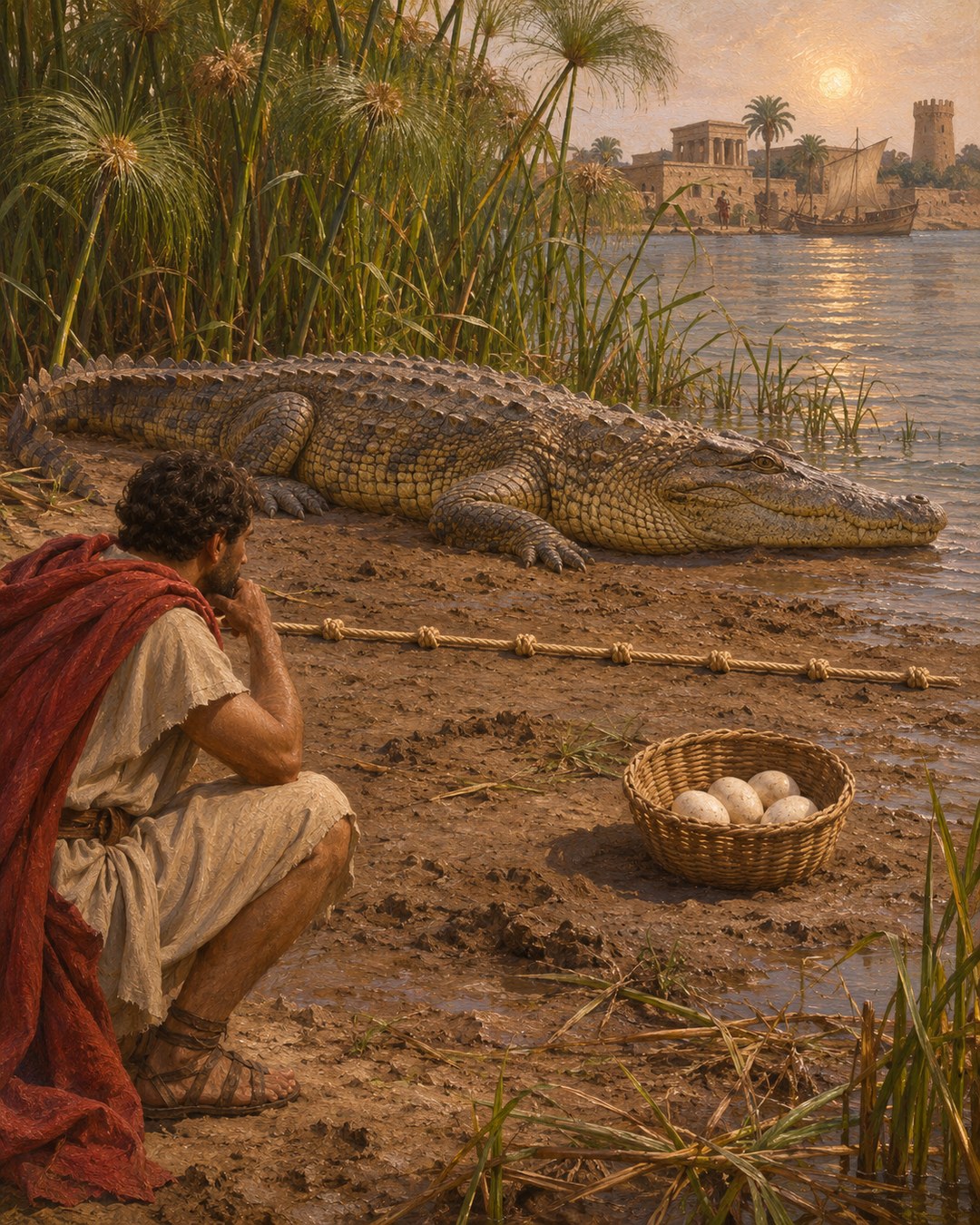
Pliny the Elder introduces the crocodile as a creature of two territories. It is dangerous on land and in water, equipped for the riverbank as much as the river. Then his description begins to move like a naturalist’s inspection: mouth, tongue, teeth, size, eggs, claws, skin, daily rhythm. The result is not a modern zoological profile. Some of its most memorable claims are wrong. Yet the order of the evidence reveals how a Roman compiler tried to turn a distant animal into something his readers could picture.
The crocodile in Natural History 8.37 is built from hard details and dramatic stories. Its teeth interlock “like those of a comb.” Its eggs are compared with a goose’s. Its body supposedly exceeds eighteen cubits. It sleeps by the Nile while a small bird cleans its mouth, leaving an opening for an ichneumon to attack. Observation, travellers’ lore and inherited authority sit side by side, without the clean boundary a modern field guide would demand.
The Mouth Becomes the First Measuring Tool
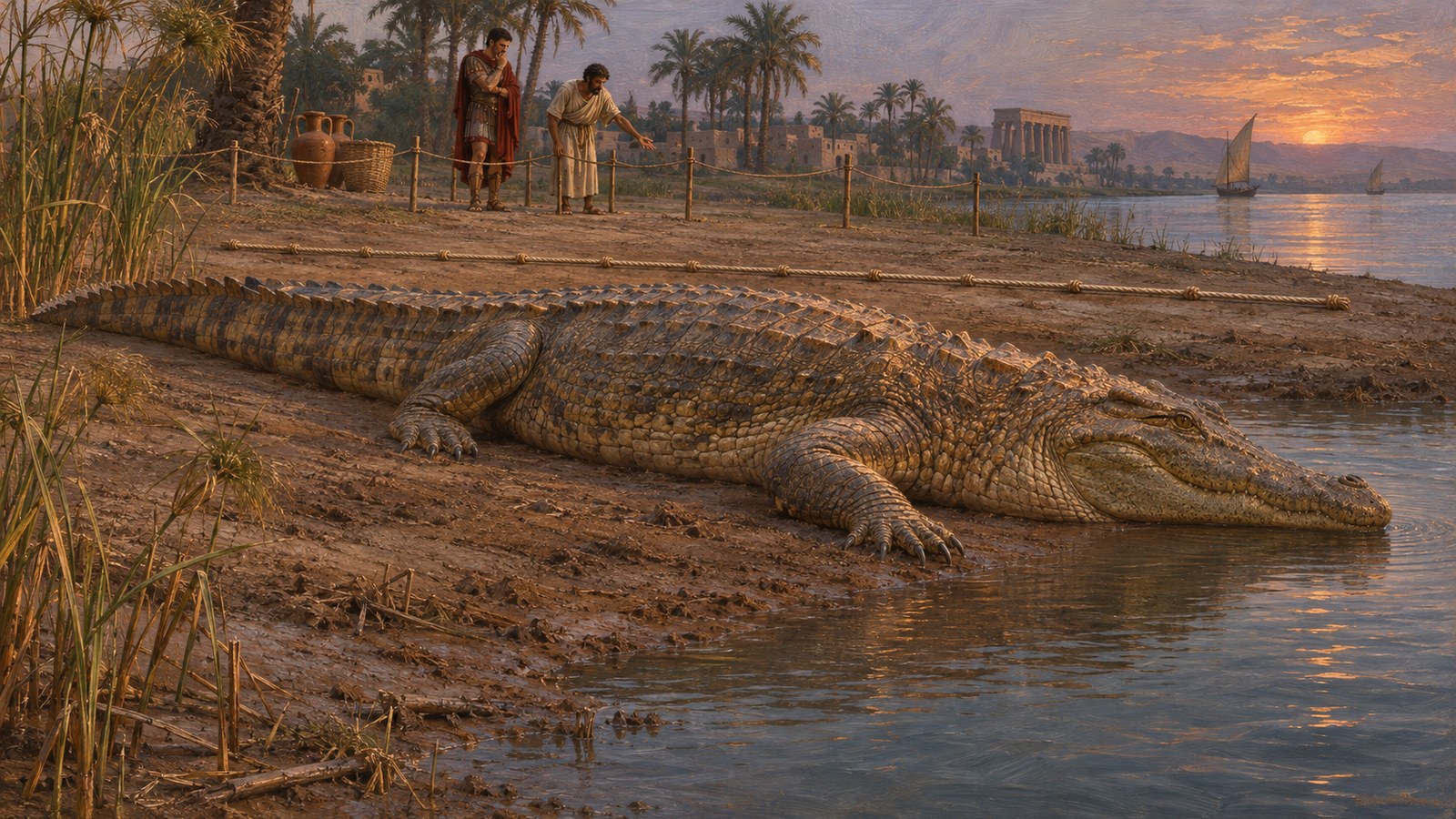
Pliny starts with anatomy because the bite is the animal’s most immediate danger. He describes rows of teeth that fit into one another like a comb. The comparison is economical and physical. A reader who had never stood beside the Nile could still imagine alternating points closing together. It turns fear into a piece of geometry.
The tongue receives similar attention. Pliny says the crocodile is the only land animal that cannot use its tongue. The translator’s note attached to the passage sharpens the idea: the tongue is flat and attached to the lower jaw, so its movement is restricted. That observation contains a recognisable anatomical core, even if Pliny expresses it as an absolute.
His next statement is the famous trap. He says the upper jaw moves when the crocodile bites. The nineteenth-century commentary printed with the translation explicitly calls that account incorrect and explains why it may have seemed convincing from the animal’s head shape. The error matters because it shows the danger of translating an appearance into a mechanism. Pliny had a striking report, a plausible visual impression and the support of earlier writers. None of those guaranteed that the joint had been understood.
Eighteen Cubits Beside a Goose Egg
From the mouth, Pliny changes scale. He says crocodiles commonly exceed eighteen cubits in length, then immediately turns to eggs about the size of a goose’s. Whether each number would survive modern measurement is less important here than the deliberate contrast. A large river predator begins in an object small enough to hold. Pliny openly marvels that no other animal reaches such bulk from so small a beginning.
The egg is also placed on a working river map. According to the passage, the female deposits eggs beyond the highest reach of the Nile’s flood. Nesting becomes a claim about foresight: the animal somehow reads the boundary of water that has not yet arrived. The detail binds reproduction to the river’s seasonal movement rather than treating it as an isolated biological fact.
For a Roman reader, the Nile was not simply scenery. Its rise determined fields, routes and settlement rhythms. Pliny’s crocodile belongs to that calendar. The animal’s life is described through the same moving edge of land and water that shaped human activity. That is why the egg-laying detail does more than decorate the account. It makes the creature legible through place.
Claws, Skin and a Twenty-Four-Hour Riverbank
Pliny next inventories armour. The crocodile has claws and a skin that he calls proof against blows. This is the vocabulary of defence, but it is also a tactile description. The reader is asked to imagine a body with points at its feet and a surface difficult to penetrate. The creature’s danger lies not just in the mouth; its whole exterior seems made to resist.
Its day is divided between environments. Pliny says it spends daylight on land and night in the water, choosing each place for warmth. The explanation may be too tidy, but the pattern gives the animal a schedule. At noon it lies on the bank. After dark it returns to water that retains heat. A remote beast becomes easier to remember once it has a daily routine.
This attention to timing connects the crocodile with other animals in Pliny’s books. His account of how asp venom required a wound also moves from a frightening reputation to a physical condition. His report on beavers and the Black Sea trade similarly ties an animal to a specific landscape and human use. The method is cumulative: body, behaviour, place and consequence are assembled into a memorable file.
The Little Bird Inside the Crocodile’s Mouth
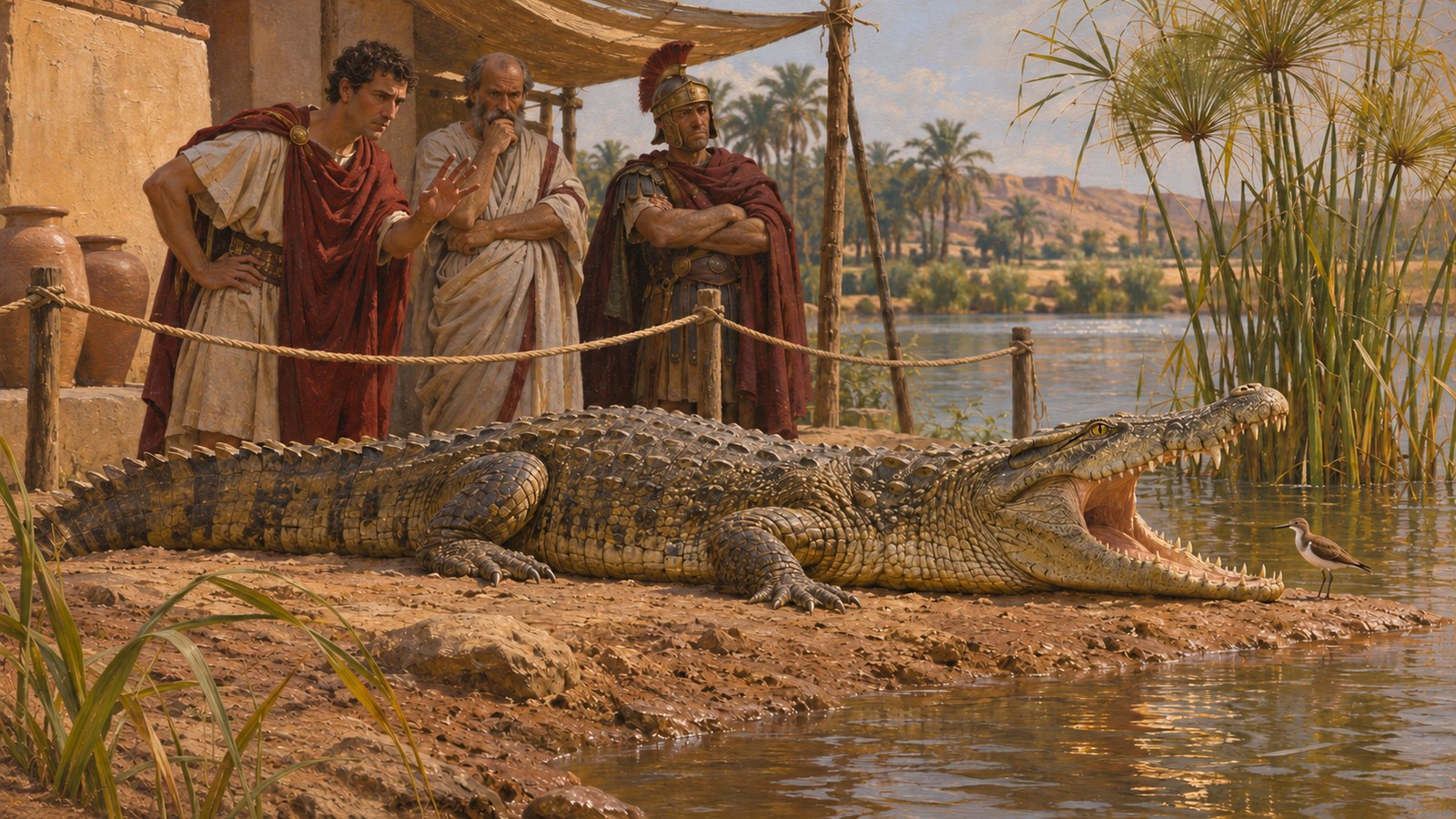
The scene then becomes theatrical. A crocodile eats fish and sleeps on the bank with food left in its mouth. A small bird called the trochilus in Egypt approaches for a meal. Pliny describes a sequence: it cleans the outside of the mouth, then the teeth, then the inside. The crocodile opens wider because the cleaning sensation is pleasurable.
Every beat gives the scene the logic of cooperation. The bird gains food. The crocodile gains relief. The order of outside, teeth and inside makes the report sound observed rather than merely repeated. A small creature enters the dangerous space created by the larger animal’s bite, yet survives because both benefit.
The translation’s commentary links this tradition to earlier ancient descriptions and suggests leeches in the throat as the possible nuisance being removed. That does not turn the whole story into a verified modern observation. It does show how later readers tried to locate a physical circumstance beneath the polished anecdote.
Pliny’s version also demonstrates why vivid behavioural stories travel so well. Teeth compared with a comb provide a still image. The trochilus provides action, suspense and scale. The tiny bird walks where the large predator’s prey would never willingly go. Once written in that form, the scene is difficult to forget—and difficult not to repeat.
The episode does not end with cleaning. Pliny says the crocodile falls asleep under the pleasant sensation. An ichneumon sees the opportunity, darts down its throat “like an arrow” and eats its intestines. The cooperative interlude becomes a sudden invasion. In narrative terms, the supposedly invulnerable hide is bypassed through the open mouth.
The translator’s note says that ancient naturalists broadly accepted the account but that later authorities questioned it. That disagreement is essential. Pliny preserves more than animal behaviour; he preserves a chain of confidence. A claim could circulate because respected predecessors reported it, because its mechanism sounded ingenious and because its story explained how a smaller animal might defeat an armoured giant.
Read carefully, the chapter is therefore not a list to be sorted into “facts” and “myths” and then forgotten. It is evidence for the way knowledge was packaged. Precise-looking measurements, familiar comparisons, bodily inspection and dramatic encounters all carried persuasive force. A report could be partly grounded, partly mistaken and still feel coherent.
The Crocodile Is Also a Portrait of Roman Knowledge
Pliny never visited every landscape contained in his encyclopaedia. His project depended on collecting. He names no individual witness in this short chapter, but the accompanying commentary points back to Herodotus, Aristotle and other ancient writers. The crocodile reached Roman readers through layers of description, selection and translation long before it reached the page as a single creature.
That layered origin explains the chapter’s strange strength. The teeth, egg and river boundary make the animal concrete. The moving upper jaw reveals how confidently a visible effect could be misread. The trochilus and ichneumon show how a behavioural tale could become more elaborate as it travelled. Pliny does not hide these kinds of material from one another. He builds with all of them.
The most useful way to read his crocodile is to keep both reactions at once. The chapter contains genuine attention to anatomy, habitat and daily rhythm. It also contains mechanisms that inspection and later zoology would reject. Roman natural history was neither empty fantasy nor modern science in an earlier costume. It was a disciplined attempt to organise a world whose evidence arrived unevenly.
By the end, the crocodile has become more than a dangerous animal. It is a test of how knowledge closes its jaws. A comb of teeth, an eighteen-cubit body, a goose-sized egg and a bird stepping into an open mouth all fit together with satisfying force. The fit is memorable. It is not always true.
Sources
Pliny the Elder, Natural History, 8.37, with the notes to the Bostock and Riley translation.