
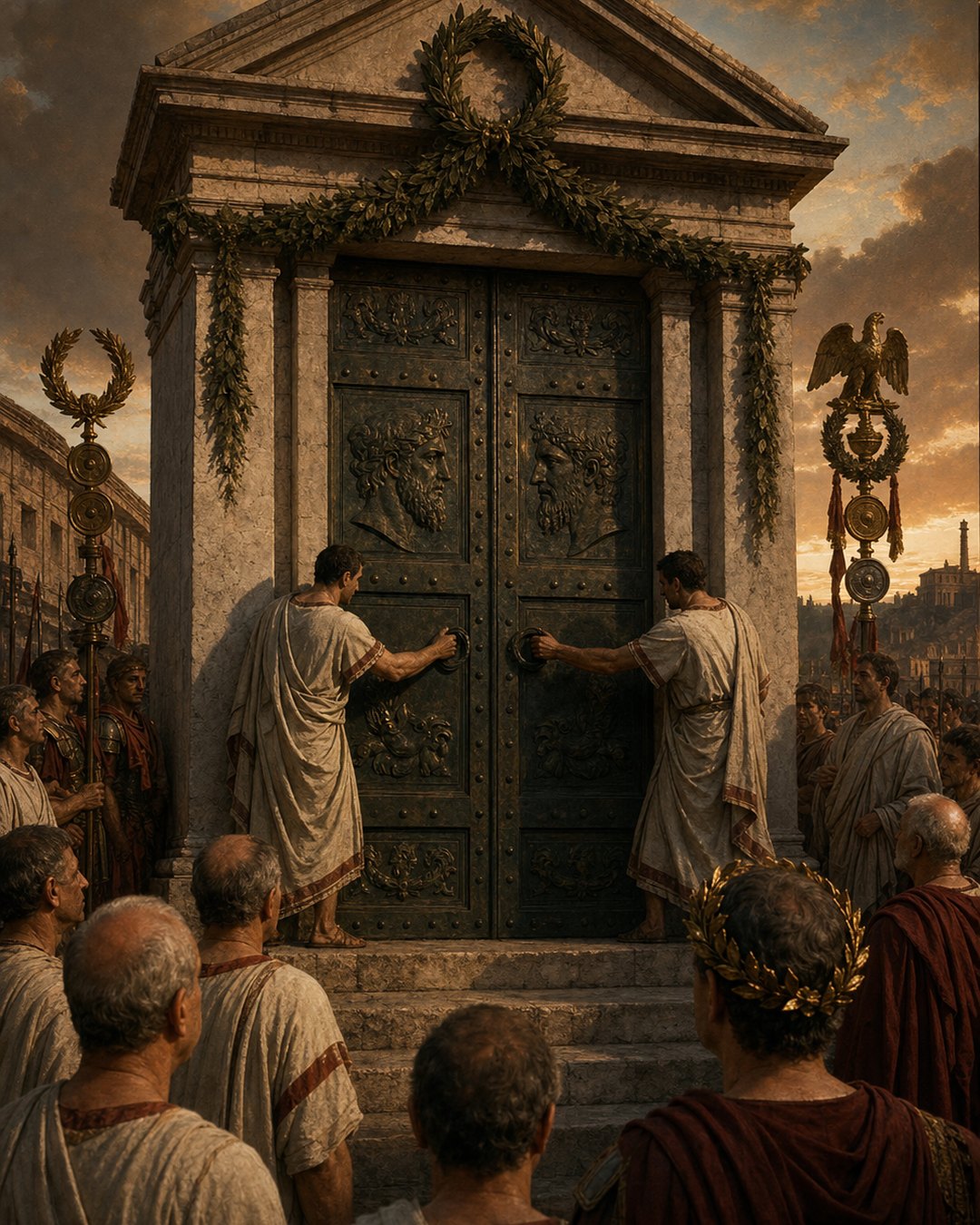
Two doors move together, and Rome is invited to read the world in their position. Open means war. Closed means peace. The idea is almost aggressively simple, which is why it became so useful to a ruler emerging from decades of civil bloodshed.
The structure was associated with Janus, the god of beginnings, passages and double directions. Roman authors connected its ritual to the reign of Numa, the king imagined as Rome’s great organizer of peace and religion. By the late Republic the closure was described as exceptionally rare. Augustus turned that rarity into a number.
In his Res Gestae, the public account of his achievements, Augustus says the Senate ordered Janus Quirinus closed three times while he was the leading man of the state. He adds that tradition remembered only two earlier closures from Rome’s foundation to his own birth. Three was not merely a ritual count. It was a claim that his lifetime had outperformed the whole past.
Numa’s doors made peace visible
Livy explains the institution through Numa. The king established the shrine as a sign of war and peace: open when Rome fought, closed when peace existed with the peoples around it. The story belongs to Rome’s memory of its own origins rather than a surviving contemporary record from the regal period. Its value lies in what later Romans thought the ritual meant.
Doors gave the condition of the state a body. Peace treaties, military deployments and frontier reports were complex. Hinges reduced that complexity to a public binary. A passer-by did not need access to Senate debate. The opening itself declared that Roman arms remained engaged; closure presented an achieved order.
Janus suited this language because a doorway is both barrier and passage. It can shut danger out, release force or mark movement between conditions. The god’s doubled aspect looked backward and forward. Rome’s war ritual therefore used architecture not as a background for belief but as the instrument that expressed it.
Physical signals carried unusual authority in Roman religion. The disastrous feeding test in the sacred chickens before Drepana turned appetite into a sign about a campaign. Janus’s doors worked on a civic scale. Their position announced how the community should understand its relationship to conflict.
Rarity gave the closure political weight
Livy stresses how seldom the doors shut. He names a closure after the First Punic War and treats the long record of Roman conflict as the reason peace was difficult to display. Plutarch likewise connects the sanctuary with the alternating conditions of war and peace. By Augustus’s day, antiquity and rarity had fused.
A common ceremony offers little distinction. A ceremony performed only after an unusual alignment of victory and settlement creates prestige. Whoever can close Janus appears to have achieved what generations could not. The ritual’s scarcity turned the action into political capital before Augustus ever counted it.
Yet the binary was always a constructed verdict. Rome fought on many fronts and could define which conflicts counted toward peace. News did not stop moving because a hinge turned. Local violence, punitive expeditions and preparations could continue around the edges of an official declaration.
The point is not that the ritual was a fraud. It is that public categories require authorities. The Senate ordered closure; rulers supplied the victories; writers explained the condition. The doors made a decision visible after political power had decided what reality the symbol would represent.
Augustus wrote victory into the definition
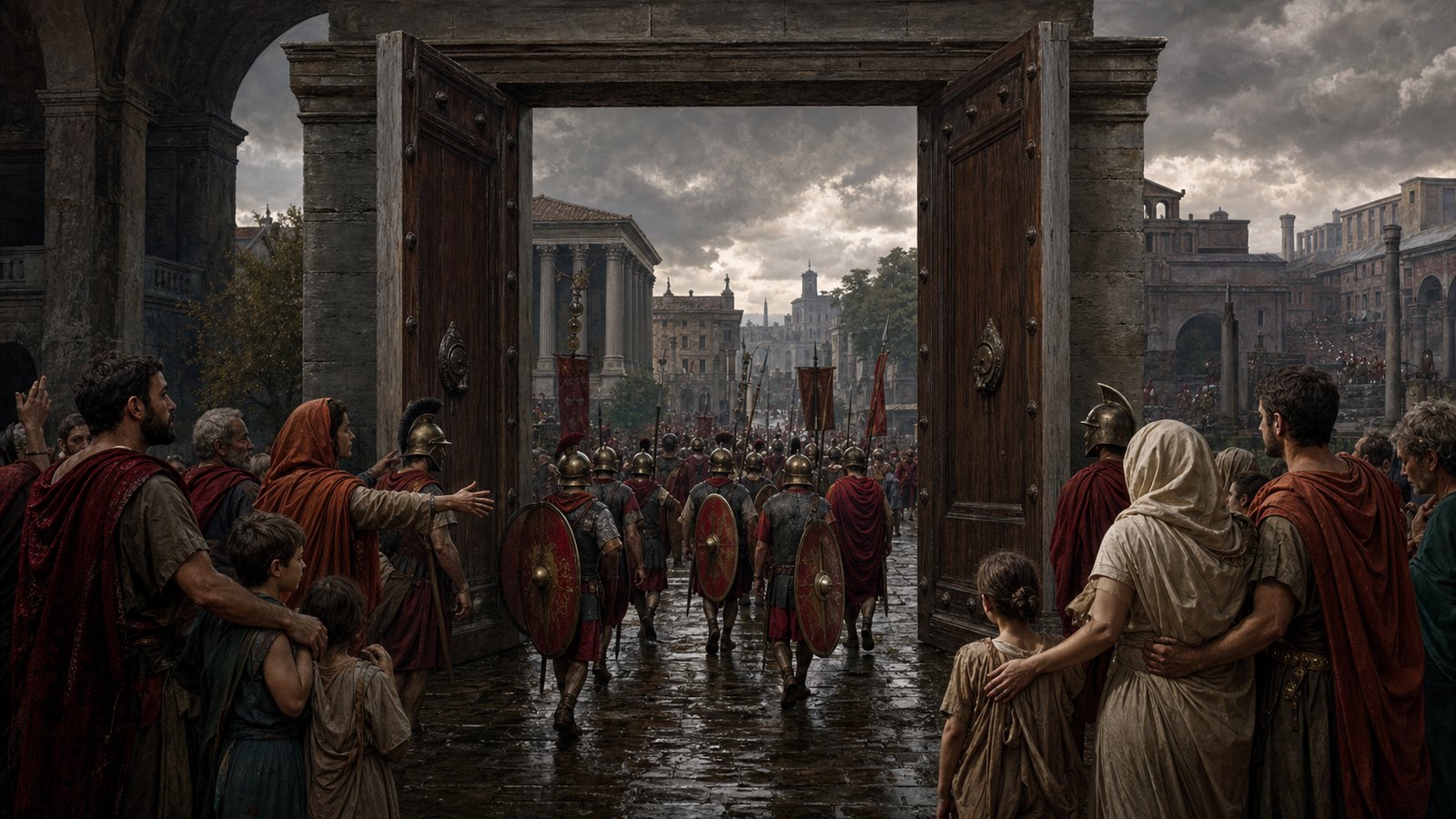
The Res Gestae gives unusually careful wording. Augustus says Janus was to be closed when peace secured by victories existed throughout the dominions of the Roman people. Peace does not appear as withdrawal or mutual exhaustion. It is the condition produced after Roman success.
That phrase resolves a tension central to Augustan rule. Octavian had won a civil war and defeated fellow Romans before presenting himself as restorer. Victory alone could sound like domination. Peace alone could conceal how the new order arrived. “Peace secured by victories” joined the two into one acceptable sequence.
The formulation resembles the ritual logic in Decius Mus’s battlefield devotion. Words, authorized actors and physical acts transformed violence into a culturally ordered event. At Janus, the transformation worked after fighting: conquest was recoded as the condition that permitted closure.
Augustus also credits the Senate with ordering the act. That detail helped preserve the language of republican institutions. The leading man did not claim to swing the doors by personal whim. Senatorial authorization, ancient custom and his victories appeared to cooperate.
Three closures compressed decades into one image
The claim of three closures creates its own rhythm. One might be an accident of circumstance. Repetition suggests a ruler repeatedly restoring order whenever conflict disturbed it. Each closure could absorb a different political moment while the final total became a property of the reign.
The comparison with the past is audacious. Augustus says only two closures had occurred before his birth, then places three under his own leadership. His personal biography becomes a new scale for Roman time. The old kings, Republic and centuries of expansion occupy one side; the princeps’s record occupies the other.
Numbers in the Res Gestae frequently make power look accountable. Offices, gifts, games and expenses can be enumerated. The Janus total applies the same habit to an elusive condition. Peace itself appears countable because a door ceremony can be counted.
That count also hides duration. A closure could be brief or long, broadly convincing or politically strained. Three tells us how many official acts Augustus wanted remembered, not how every inhabitant experienced security. The neat total is precisely what makes historians ask what had to be compressed to produce it.
The shut door remained an argument
Ancient accounts and later reconstructions do not make every architectural detail certain. The Janus structure was relatively small, and its form and exact history are assembled from texts, coins and topography. Monumental importance did not require monumental size. Its power came from the rule attached to its opening.
For people at Rome, closure offered relief after mobilization, levies, taxation and casualty. For Augustus, it offered legitimacy. For the Senate, it offered participation in the declaration of order. For later readers, it preserved the gap between political language and the many kinds of force that could continue beyond the city.
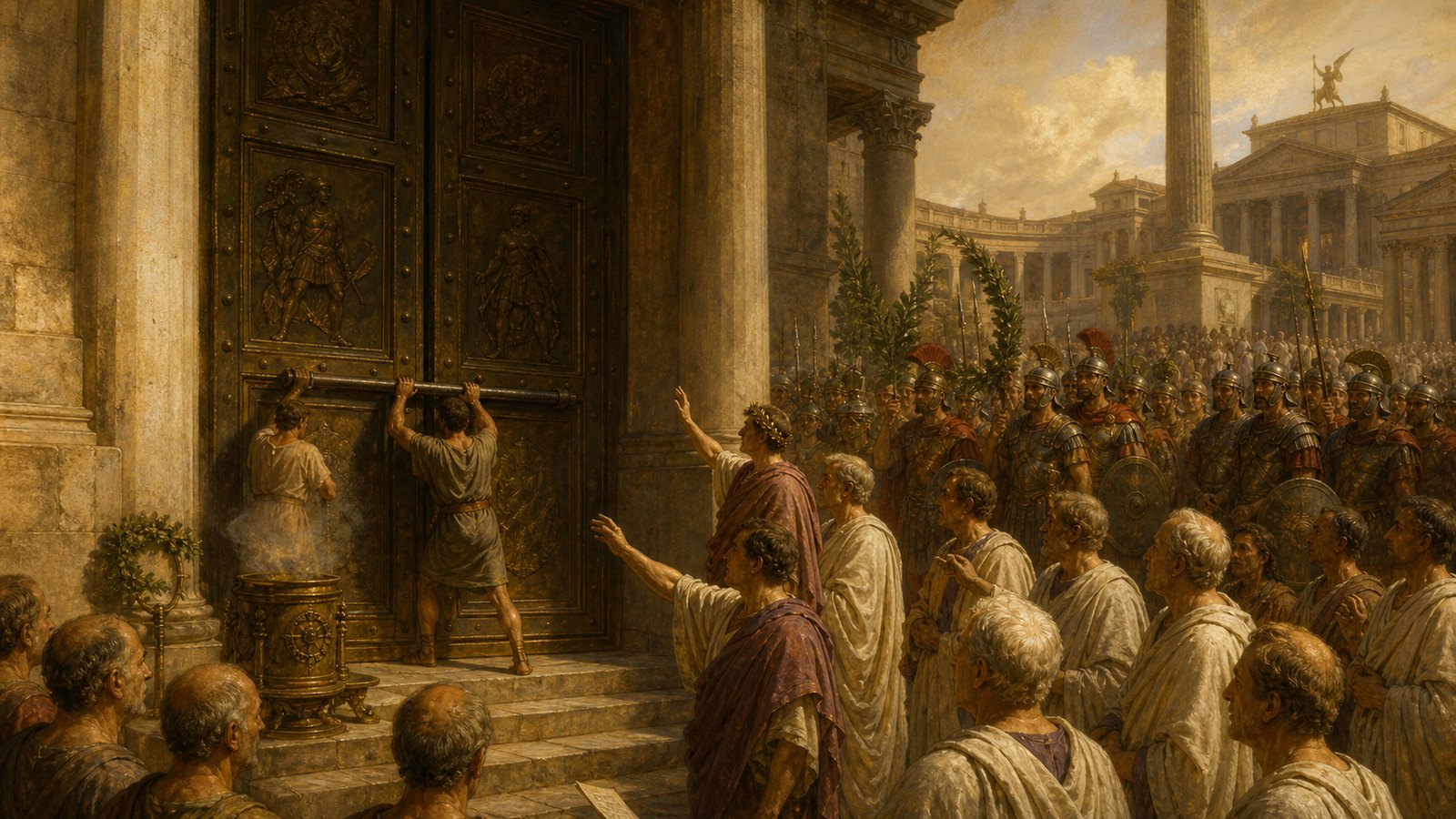
The doors did not measure peace like an instrument measures water. They staged a judgment. Their authority depended on inherited religion, visible action and a community prepared to recognize the sign. Augustus understood that an old sign could carry a new regime more gracefully than a new slogan.
His three closures endure because the count is both concrete and unstable. We can picture the leaves meeting and hear the bar fall into place. We can also see the armies behind the phrase “peace by victories.” Janus closed on war, but the Augustan claim kept conquest inside the doorway.
The ritual also shows why old institutions could serve a new political order so effectively. Augustus did not need to invent a private emblem and demand belief in it. He could activate a sign Romans already associated with the deepest layers of their civic past. Every remembered rarity strengthened the present performance. By placing his three acts beside two closures assigned to all earlier history, he made continuity itself deliver a revolutionary comparison.
Sources
Livy, History of Rome 1.19
Plutarch, Life of Numa 20
Augustus, Res Gestae 13