
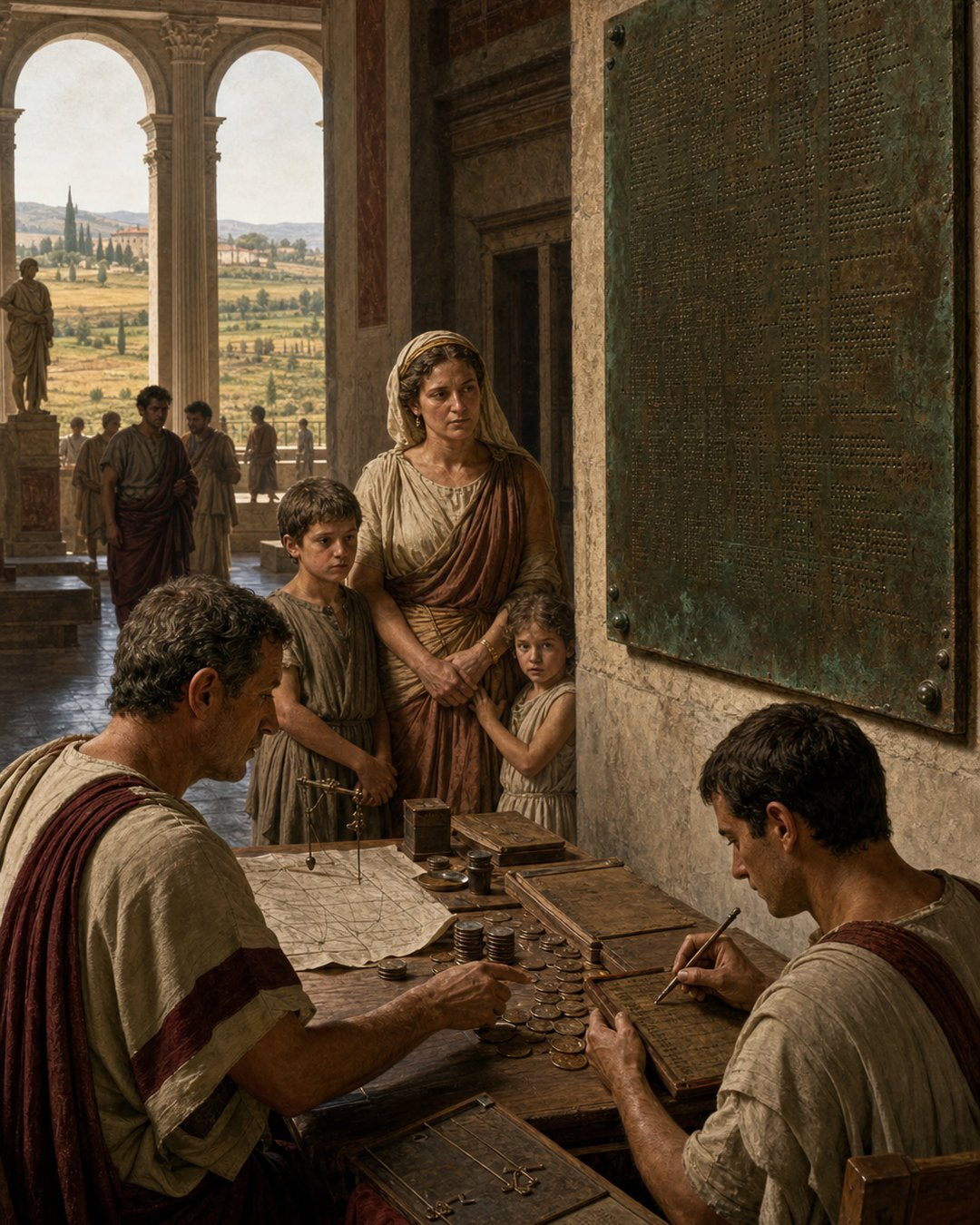
A bronze tablet large enough to dominate a wall records no battle and flatters no victorious general. Its crowded columns list farms. They give owners, neighbours, valuations and sums of money. Read one line at a time, it resembles a rural mortgage register. Read as a whole, it describes how imperial capital was supposed to feed children month after month.
This is the Tabula Alimentaria from Veleia, a town in the hills of northern Italy. It is the most detailed surviving document for the alimenta, programs associated especially with the emperors Nerva and Trajan. Their public purpose was support for freeborn children in Italian communities. Their operating mechanism ran through land.
The table matters because it removes the soft glow from imperial generosity. Trajan did not simply open a chest and distribute coins until it was empty. Money was advanced against agricultural property. Landowners owed interest. Local administration converted that recurring stream into allowances. Welfare, credit and the surveyed landscape became parts of one machine.
The inscription begins with collateral, not compassion
Veleia’s record names estates and the people connected to them. It identifies neighbouring properties, gives valuations and sets out the amounts advanced. These details were not decorative. An administrator needed to know what secured each loan and whether the sum stood in a defensible relationship to the land pledged behind it.
The arrangement used imperial funds as capital. Participating proprietors received loans secured on their farms and paid annual interest, commonly described as five percent. That rate was low enough to make participation attractive. The principal remained tied to property; the interest became useful income for the local alimentary fund.
This structure separated the scheme from a one-time gift. A bag of coins can be spent once. A loan portfolio can produce a scheduled return, at least while borrowers pay and records remain enforceable. The emperor’s initial contribution therefore aimed to create continuity. The children depended not on another spontaneous ceremony but on the performance of many obligations spread across the countryside.
Rome often made abstract authority tangible through measured objects. The calibrated cavities in Pompeii’s public measure table let buyers compare a merchant’s vessel with a civic standard. At Veleia, bronze performed a related task on a far larger scale. It fixed a financial map of fields, people and values where officials could inspect it.
Five percent linked a farm to a monthly allowance
The crucial movement was from annual interest to regular support. Landowners worked property, collected agricultural returns and met the payment attached to the imperial loan. The community then used that income to provide monthly allowances to enrolled children. A harvest, a debt instalment and a child’s ration were distant stages of the same circuit.
The surviving summaries distinguish categories of recipients. Legitimate boys generally received more each month than legitimate girls, while other categories could receive different amounts again. The inequality was built into the arithmetic. Roman policy imagined future social roles differently for male and female children even while placing both on the official list.
Names and numbers made administration possible, but they also created exclusions. Officials had to decide who qualified as freeborn, who belonged to the relevant community and which household remained eligible. A program that looks generous from an imperial speech becomes sharper when viewed from the municipal desk. Every allowance required a category, a record and somebody empowered to say yes or no.
That bureaucracy did not make the food unreal. A recurring payment could change how a household planned bread, clothing and care. The table’s columns are dry because they had to be. Their precision was the route by which a distant claim about imperial concern could arrive as a predictable local sum.
Pliny turned bookkeeping into a vision of Rome’s future
Pliny the Younger presents the alimenta differently in his Panegyric. Praising Trajan, he speaks of children enrolled to be fed at public expense. He then looks forward: these children will grow into citizens and soldiers. Support for households becomes an investment in the population and strength of Rome.
The rhetoric reveals the political return expected from the scheme. Trajan appears as a fatherly ruler; Italian towns experience his resources through their own institutions; beneficiaries are taught that public provision and imperial order belong together. Even genuine relief could carry a message about loyalty and the future labor owed by those who received it.
Pliny’s bright argument should not replace the bronze evidence. His speech tells us how an elite admirer wanted the policy understood. The Veleia table tells us what had to happen for that image to function: land had to be described, borrowers identified, valuations accepted, interest collected and children enrolled. Praise compresses the chain. Epigraphy unfolds it.
That contrast resembles Caracalla’s citizenship grant. A dramatic imperial act could be announced in one sentence, but its consequences depended on categories and documents handled far from the palace. At Veleia, benevolence also needed clerks.
The countryside became a financial map
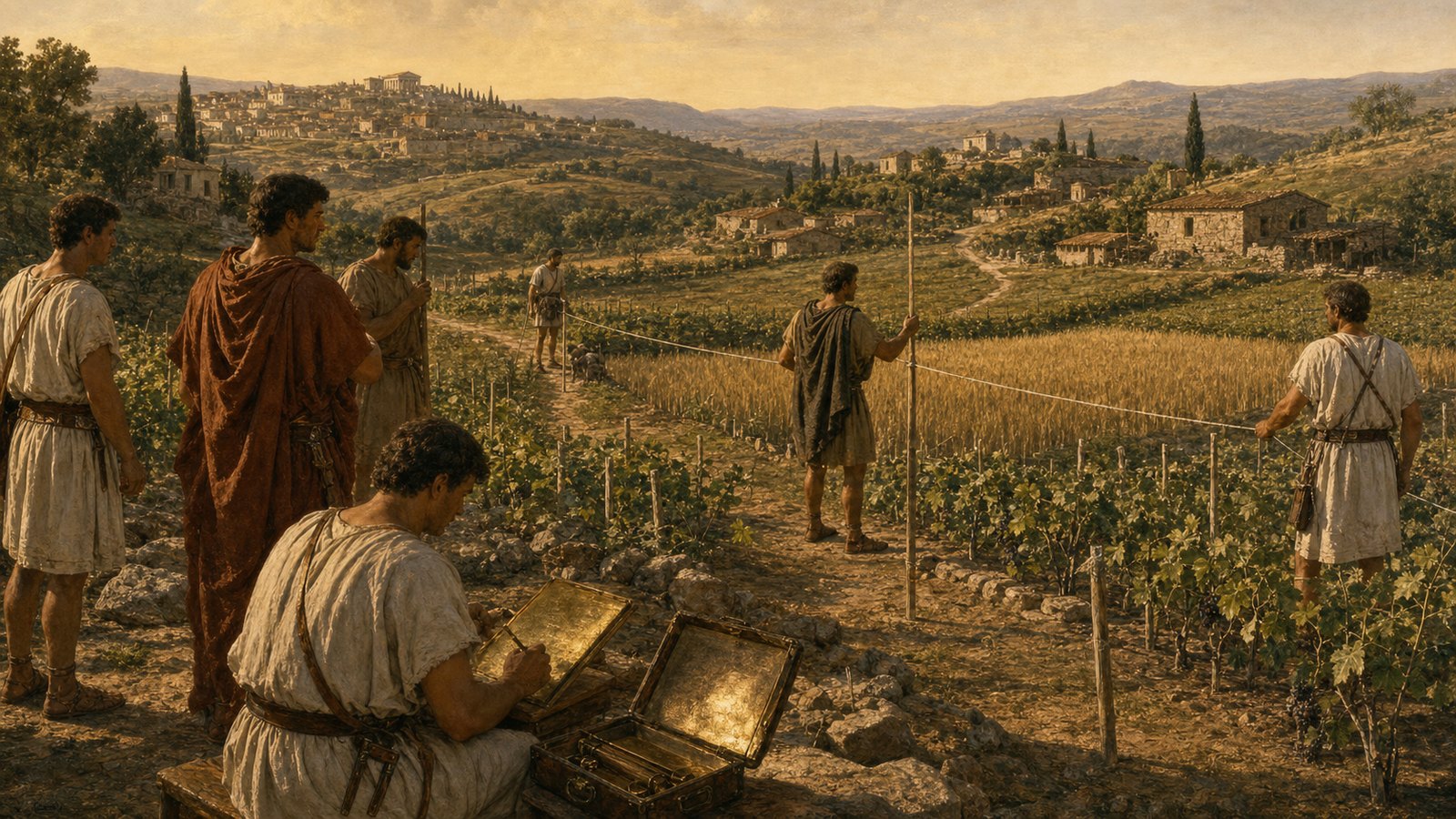
The table’s richest unintended record may be its landscape. Estate descriptions preserve names, boundaries and relationships among properties. Farms appear not as a generic source of Roman abundance but as assessed units with neighbours and owners. The welfare program forced local geography into an administrative form.
That map distributed risk. If one property failed to produce or one borrower defaulted, the promised income did not magically continue. Drought, inheritance disputes, falling values or weak enforcement could interrupt the circuit. The bronze conveys confidence, but its very detail acknowledges that public support rested on many private performances.
Imperial capital also entered existing inequalities. The immediate borrowers were proprietors able to pledge land. They gained access to money at a favourable rate. Children gained allowances from the interest. The scheme could assist vulnerable households while strengthening relationships with local property owners. Those outcomes were not mutually exclusive.
Veleia therefore warns against forcing the alimenta into a modern label. It was welfare, rural credit, municipal administration, population policy and imperial theatre at once. Each description captures one part. The tablet survives because the parts were deliberately fastened together.
Bronze made a promise inspectable
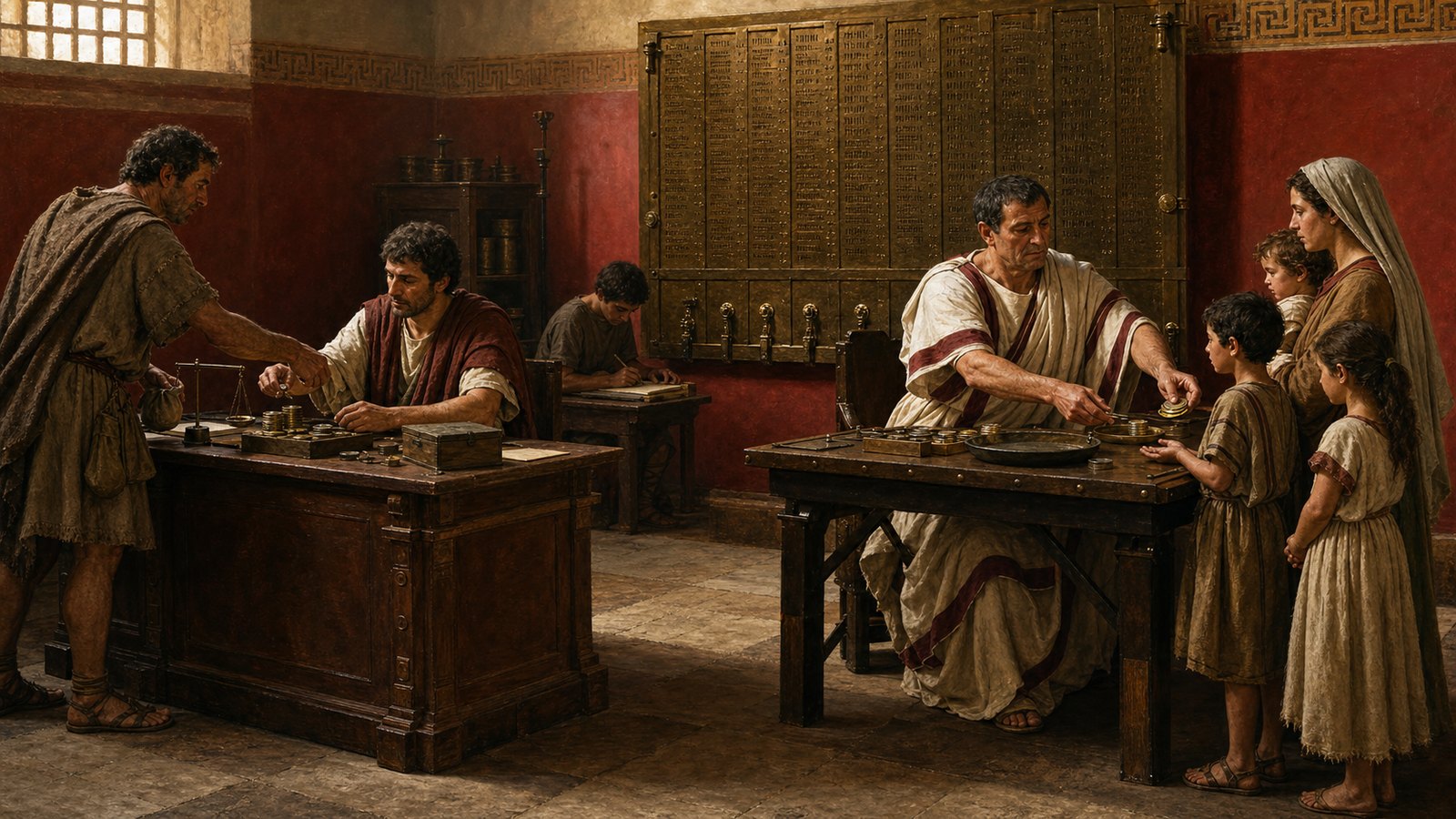
A child receiving support would not need to understand the valuation of a neighbouring estate. Yet the allowance’s reliability depended on people who did. The monument placed those obligations in public view and durable material. It made the financial foundation of imperial care something a community could point toward.
We cannot assume that every payment always arrived or that the scheme worked identically across Italy. The inscription records design and commitments more clearly than daily compliance. It nevertheless proves the scale of thought behind the system. Hundreds of local facts had to be assembled before imperial generosity could pretend to be simple.
The Tabula Alimentaria is compelling because its emotional subject is almost hidden. Children appear at the end of a chain beginning with acreage and debt. That distance was not a flaw in the program. It was the mechanism chosen to make assistance repeat rather than vanish after a single distribution.
At Veleia, a farm became more than soil and harvest. In the official ledger it became security for capital, a source of interest and part of a public claim about Rome’s future. Bronze held the pieces together: emperor, proprietor, magistrate and child, all connected by columns of names and sums.
Sources
Pliny the Younger, Panegyricus 26–27
Tabula Alimentaria and alimenta historical reference