
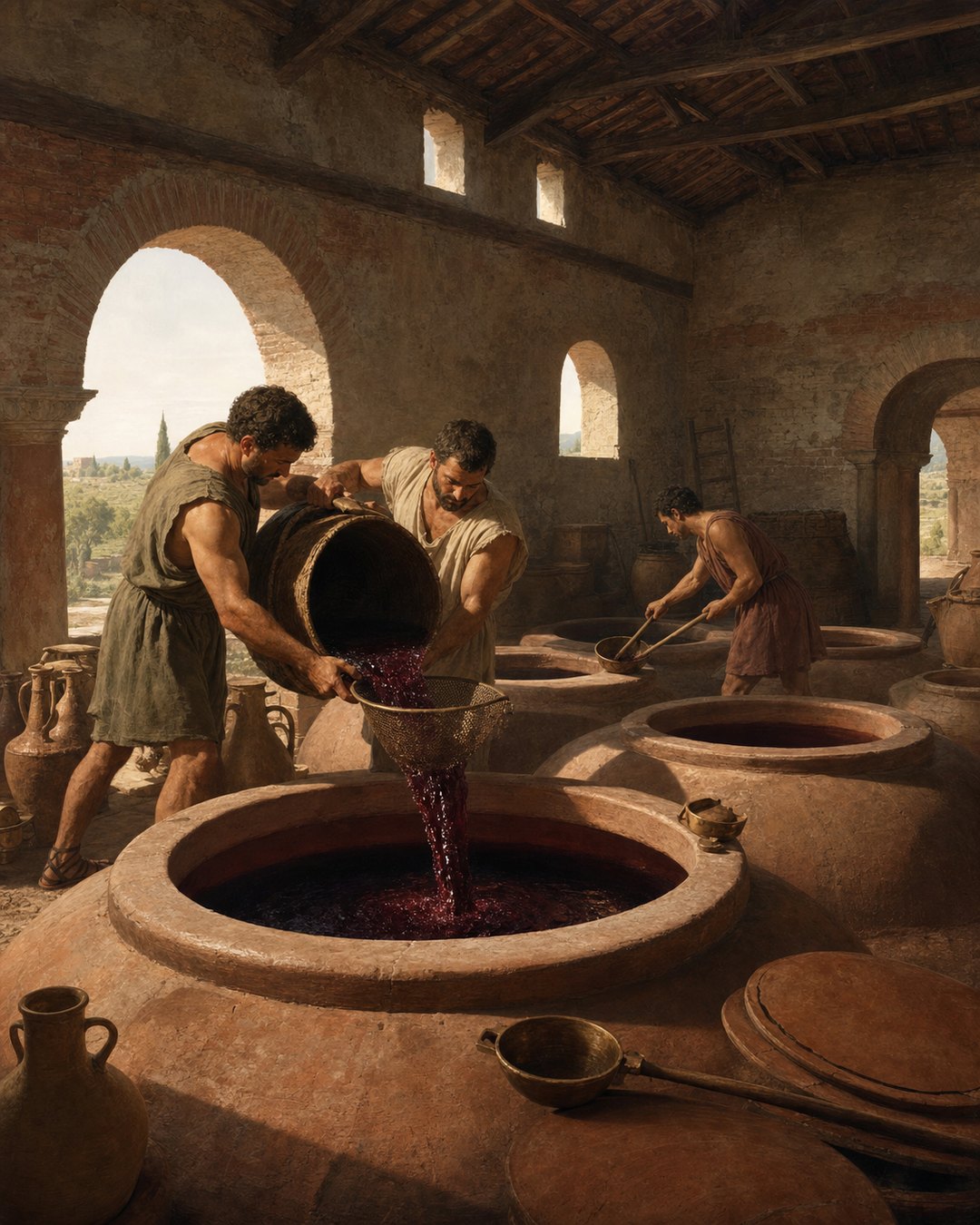
A full Roman dolium could not be lifted onto a cart when the owner changed his mind. The vessel might hold more than a thousand litres, stand taller than a crouching worker, and sit partly buried in the floor. Wine went into it by bucket, funnel, or jar. Once filled, the clay container became less like crockery than part of the building.
That immobility was useful. A harvest arrived in a rush, but wine, oil, and grain had to last through seasons and reach buyers on another timetable. Dolia made delay possible. They concentrated the work of fields and presses into stocks that an estate could seal, inspect, measure, blend, draw down, and protect. Rome’s familiar amphora carried products away; the dolium made them wait.
A giant jar began as a problem in wet clay
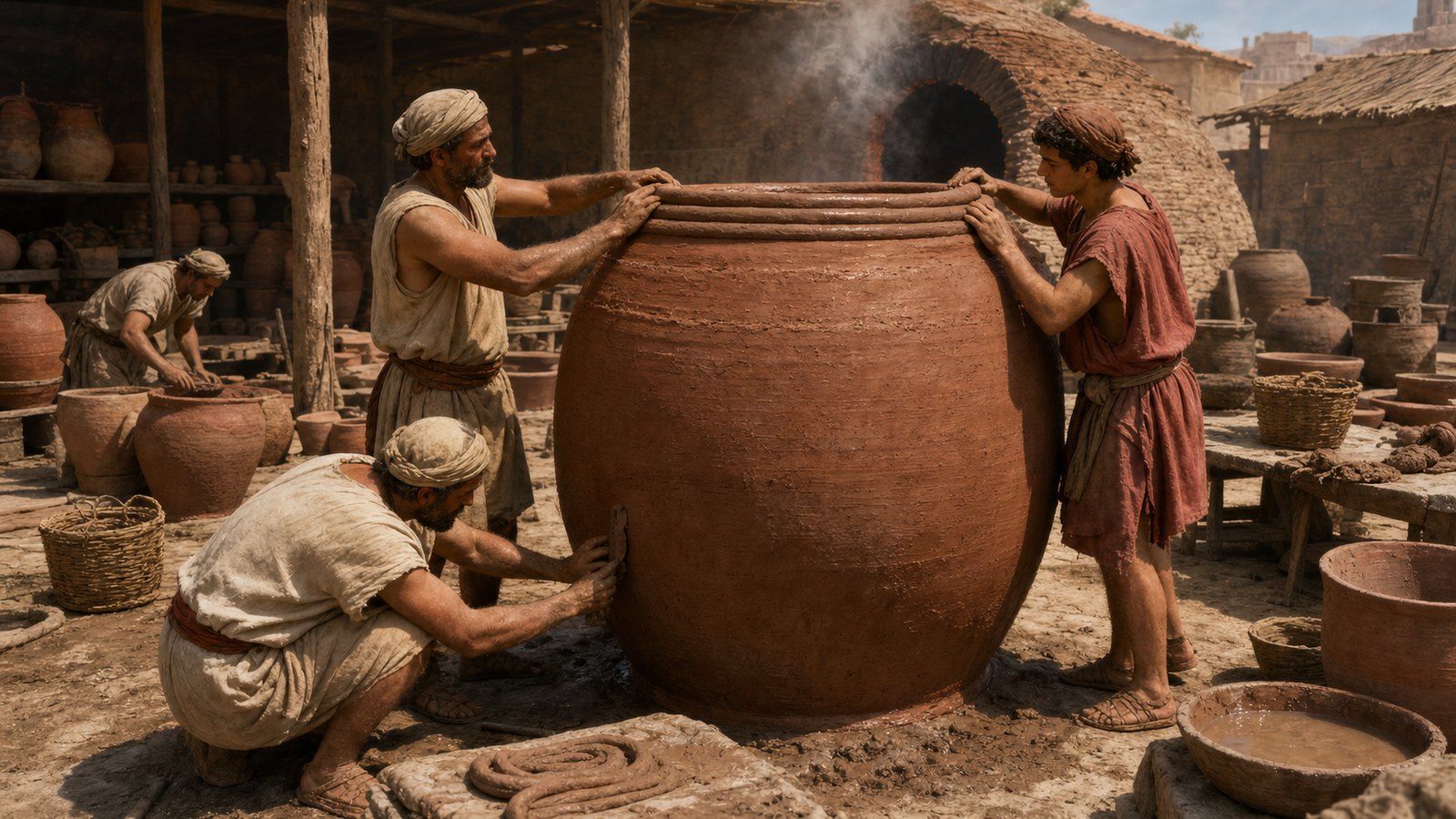
An ordinary potter’s wheel could not spin a vessel of this scale into existence. Large dolia had to rise gradually. Potters built thick walls in stages, adding coils or bands of prepared clay and allowing the lower work to become firm enough to support the next lift. Every new course increased both capacity and risk.
The clay had to remain joined across those stages. A weak seam could become a crack during drying, firing, or use. Thickness needed judgment: too little invited failure, while too much added weight and made drying uneven. The maker worked around the circumference, smoothing, compressing, and correcting a form whose final value depended on remaining watertight.
Firing was another commitment. A huge body of damp clay heated and cooled slowly. Uneven temperature could split it after days of labor and a large quantity of fuel. The finished jar therefore embodied craft before it held a single drop. Its plain surface hid repeated decisions about clay, moisture, wall tension, and heat.
Scale changed the customer’s calculation too. Buying a dolium meant preparing a place for it, not clearing shelf space. The jar, floor, doorway, and work routine had to fit one another. Storage began with architecture because the container could outgrow the route by which smaller vessels normally entered a room.
Sinking the vessel made bulk easier to control
Many dolia were set partly into floors. Burial steadied the rounded body and lowered the mouth to a practical working height. A laborer could pour into the opening, remove a cover, inspect the surface, or draw out a quantity without climbing around an exposed vessel balanced above ground.
The surrounding earth and masonry also moderated sudden changes around the lower body. The effect should not be confused with modern mechanical refrigeration, but a floor-set jar experienced a different environment from a small amphora standing in direct sun. Stability mattered when fermentation, aging, and storage unfolded over weeks or months.
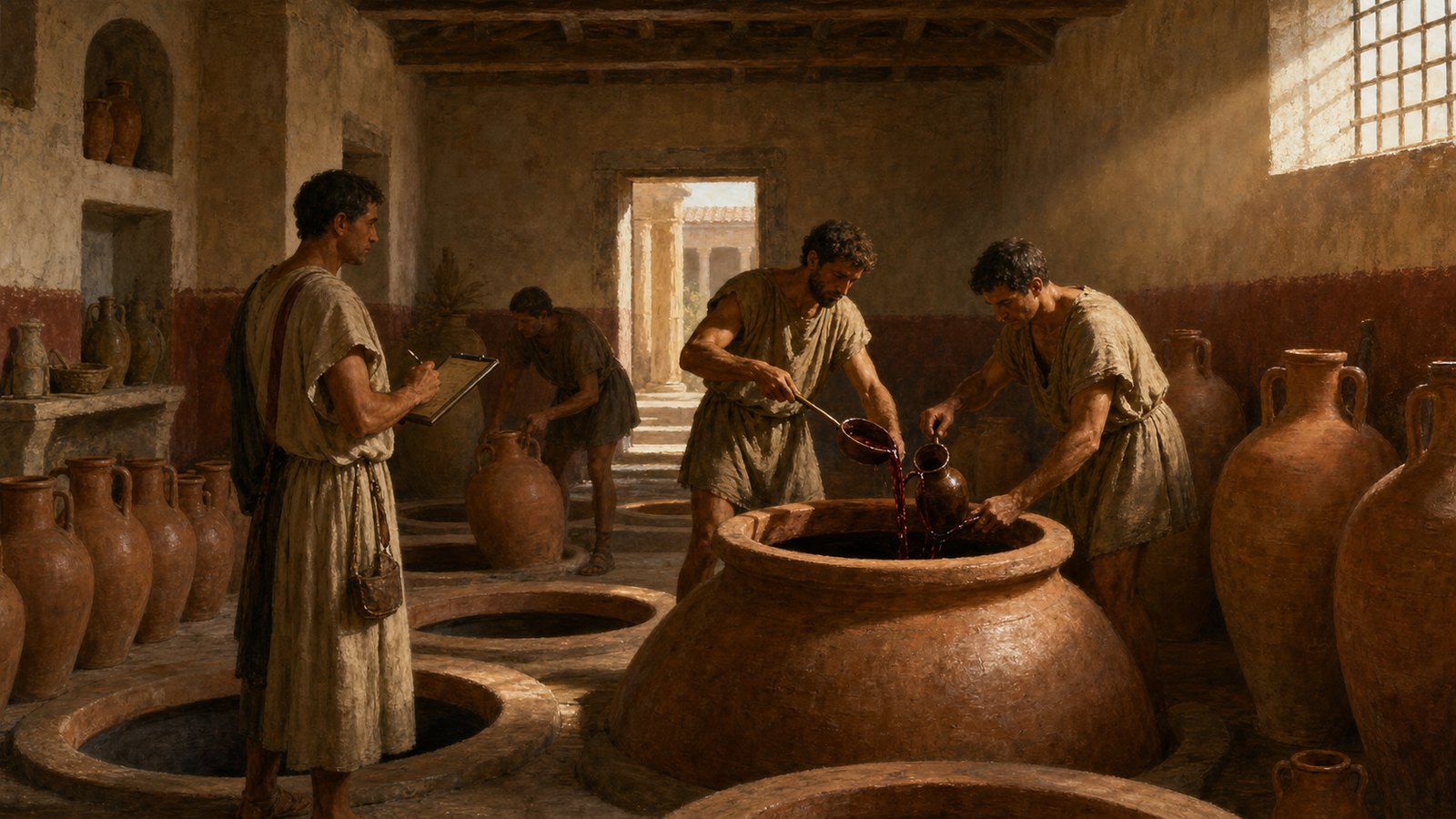
A room containing several mouths in the floor became a map of inventory. One vessel might hold new wine, another oil, another an older or different grade. Covers and seals separated contents, while workers needed a reliable memory of what lay below each opening. The estate’s abundance became physically ordered.
This was the ceramic counterpart to the controls inside Roman horrea. A warehouse used walls, raised floors, doors, and officials to manage stores. Dolia reduced the same problem to a row of immense containers, each one a bounded quantity with its own condition and risk.
Wine turned waiting into a production stage
Grapes did not become a stable commercial product when they left the vine. They had to be crushed or pressed, and the resulting must had to ferment. A dolium gave that transformation volume and time. Producers could receive the season’s rush without pretending that the product was finished on pressing day.
Pliny’s long discussion of wines, districts, qualities, and treatment shows a culture attentive to difference. Romans did not speak of wine as one interchangeable liquid. Origin, age, preparation, additives, and reputation mattered. Storage protected those distinctions while also creating opportunities to blend, correct, or market them.
Picture the first days after pressing. Buckets darken the floor. Foam rises beneath a jar’s rim. Workers clean splashes, check covers, and listen for trouble. The sweet smell of must shifts as fermentation proceeds. A year’s agricultural work is now concentrated inside clay that cannot be replaced quickly if it leaks.
The vessel made patience productive. While wine remained in the dolium, its owner could decide when to transfer it into smaller containers. Release could follow household need, a merchant’s arrival, a price, or the judgment that the liquid had reached a desired condition. Storage inserted choice between harvest and consumption.
The amphora began where the dolium ended
Dolia and amphorae solved different parts of one supply chain. The dolium was efficient because it stayed put and held a large stock. The amphora was useful because one or two people could handle it, fit it into a ship’s cargo pattern, identify its contents, and deliver it to another storehouse or kitchen.
When wine moved from the giant vessel into amphorae, bulk became parcels. Each transfer required clean containers, closures, labor, and some way to preserve identity. A careless pour wasted product; a weak stopper damaged value in transit. The fixed jar was not the opposite of trade but the reservoir from which trade could be portioned.
That contrast gives context to the archaeological routes traced by Roman amphorae. Amphora fragments tell us where portable packages traveled. Dolia tell us about the less mobile moment before departure, when a producer accumulated enough product to decide what would travel and what would remain.
Some ships were even fitted with dolia for bulk carriage. That unusual arrangement pushed fixed storage onto the sea, concentrating cargo in giant jars inside the hull. It promised capacity but also concentrated danger: breakage or shifting weight could be far more serious than losing one portable amphora.
Concentrated wealth created concentrated risk
A dolium full of wine or oil represented land, weather, labor, fuel, animal power, presses, and time. A crack therefore threatened more than clay. Liquid could escape before workers found the fault, soak the floor, contaminate neighboring stores, and erase the expected return from part of a harvest.
Repair was possible in some circumstances, but the vessel’s size made every intervention awkward. Metal clamps, patches, resins, or careful sealing could extend use, yet a damaged wall remained a place to watch. An estate manager needed attention not only to how much entered and left but to the physical health of the container itself.
The same concentration invited control. Access to the storage room, covers, measuring vessels, and records determined who could release value. A cup taken from a household jar was small; repeated unrecorded draws from a bulk store could become substantial. Inventory required trusted hands as much as strong clay.
Storage also exposed inequality. The workers who harvested, pressed, carried, fired, and cleaned did not necessarily own the liquid whose loss they were ordered to prevent. The great jar made an estate’s surplus visible, but it also fixed responsibility around that surplus: someone held the key, someone kept account, and someone was blamed for a leak.
Dolia made abundance last longer than harvest
Roman food systems depended on controlling time. Grain ripened, olives were pressed, and grapes arrived according to seasons rather than a city’s daily appetite. Without storage, abundance would become a brief glut followed by scarcity. Dolia helped stretch the moment of production into a longer period of use and exchange.
Their achievement was quiet because successful storage looks like nothing happening. The cover remains in place. The floor stays dry. The contents wait. Yet that stillness is engineered by fired clay, prepared rooms, routine inspection, and the decision not to move a product before conditions are right.
Archaeologists often recover the lower bodies, impressions, or fragments of these vessels after roofs, shelves, and written labels are gone. The surviving scale changes a room’s interpretation. What might appear to be empty domestic space becomes a production zone organized around thousands of litres and the labor needed to manage them.
Roman dolia turned wine into stored wealth because they gave a perishable harvest duration. They did not create grapes or markets. They created the pause between them—a clay-built interval in which liquid could mature, owners could choose, workers could measure, and one season’s effort could remain available after the vines were bare.
Sources & Further Reading
- World History Encyclopedia, Food in the Roman World
- Dolium overview and references
- Pliny, Natural History, Book 14