
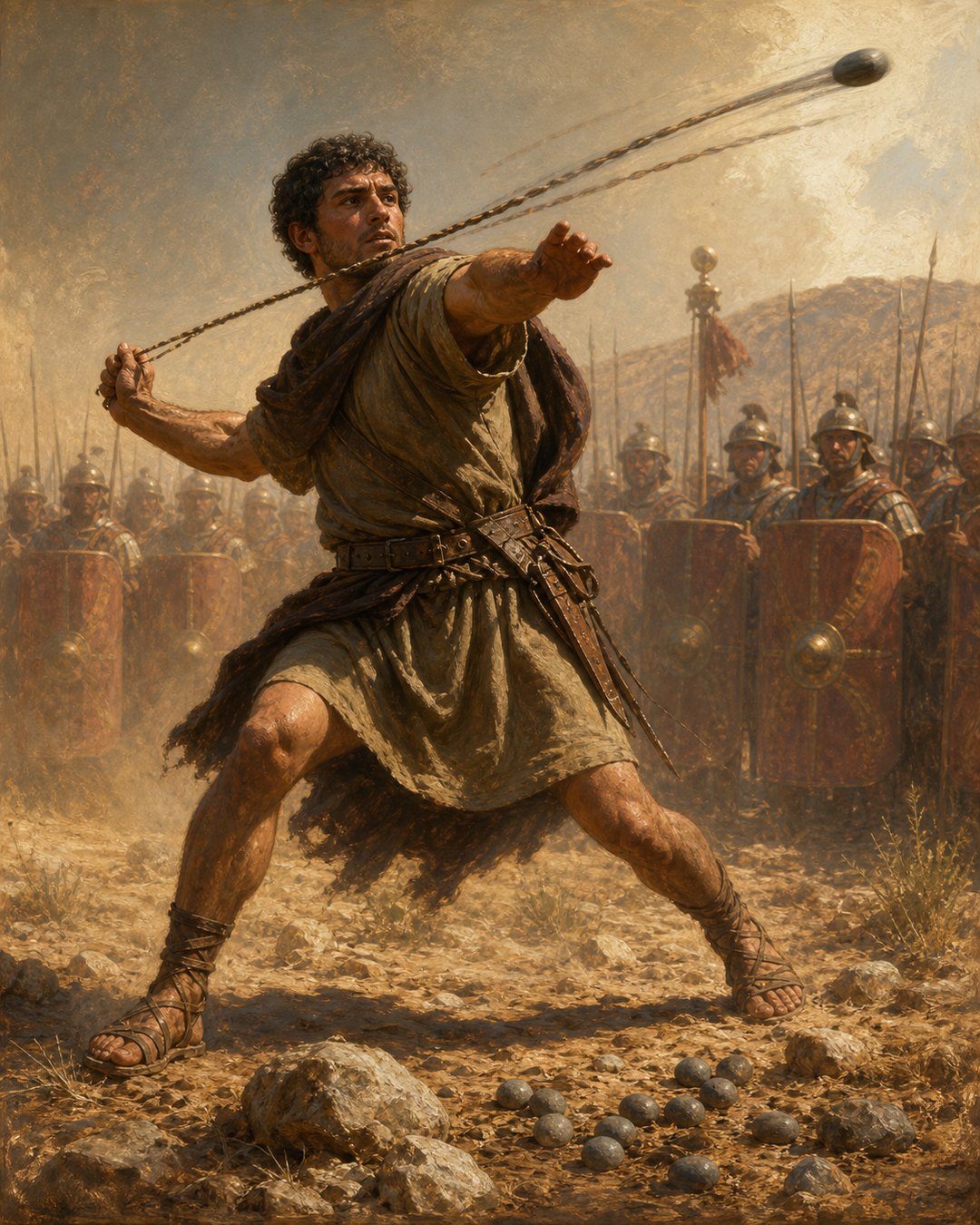
A sling could be rolled into a hand and mistaken for spare cord. In use, it changed the reach of that hand. A pouch held stone or lead, two cords extended the radius of rotation, and the release of one end let the projectile leave at speed. No wooden bow, iron spring or torsion frame carried the load. The machine existed briefly in the practiced relationship between fingers, cords, ammunition and timing.
Rome did not invent this ancient weapon, and Roman armies drew on communities whose slinging traditions were older than their service under Roman command. The tool’s cheap appearance concealed specialization. A poor release scattered a valuable lead glans or endangered nearby troops; a trained one sent compact ammunition far ahead of the heavy line. Slingers turned portable shot into repeated long-range pressure before swords could matter.
Two cords lengthened the throwing arm
The sling’s pouch cradled a projectile between a retained cord and a release cord. During rotation, tension kept the load moving along a curved path. The cords effectively extended the radius beyond the thrower’s hand, so the pouch traveled faster than the hand alone. When one cord was released at the chosen moment, the pouch opened and the projectile continued forward instead of following the circle.
This description is simple enough to memorize and difficult to perform. A fraction of a turn changed the direction dramatically. Cord length, projectile mass, stance and style altered the rhythm. The slinger had to feel tension without staring at the pouch, coordinate the whole body and release while the target, wind and friendly troops refused to remain abstract. The weapon rewarded repetition stored in muscles more than instructions stored on a tablet.
More rotations did not automatically mean more power. Every extra circle consumed time, advertised the release and increased the chance of tangling or losing alignment. Different traditions used different motions, but useful technique sought a repeatable path into one decisive opening. The slinger managed acceleration rather than performing a theatrical whirl, and the shortest reliable sequence was valuable when ammunition had to follow ammunition under pressure.
Ammunition began with selection
Ordinary stones made the sling easy to supply only where suitable stones existed. Size, shape and mass affected how a projectile sat in the pouch and left it. A mixed handful created mixed timing. Selecting rounded pieces imposed a small logistical discipline: ammunition had to be gathered, sorted, carried and kept accessible while the slinger’s hands remained responsible for cords as well as shot.
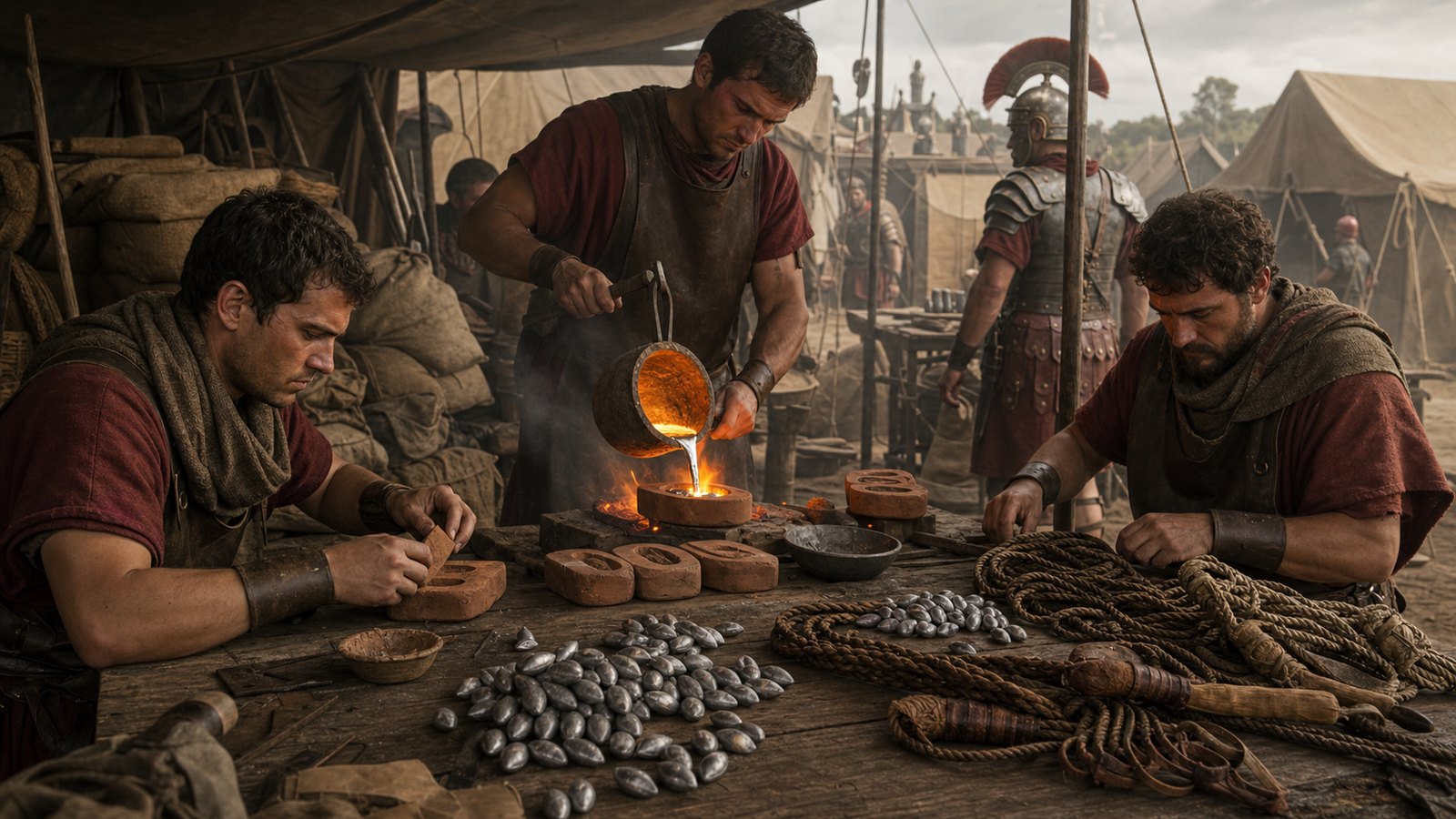
Manufactured lead bullets pushed that discipline further. Often described as glandes because of their acorn-like profile, they packed density into a small form. Lead could be melted and cast in molds, producing batches closer in size than beach stones. Compact shot took less space for a given mass, though its weight still accumulated in a pouch. Standardization made repeated releases more predictable; it did not make aim automatic.
Casting also moved preparation away from the instant of battle. Fuel, scrap or ingots and reusable molds could create ammunition before troops reached the exposed ground where it would be spent. Marks or words on surviving glandes show that some molds carried more than shape, yet plain shot served the same physical need. Once cooled and counted, each piece represented stored workshop time that a trained slinger could convert into seconds of pressure.
Lead made the projectile small but not harmless
Dense lead allowed a short projectile to carry meaningful momentum while presenting a compact shape to the air. Archaeological examples preserve pointed or almond-like forms, and some carry molded or incised words and signs. Those inscriptions are vivid evidence of manufacture and military culture, but their survival should not distract from the ordinary mechanical purpose: the bullet had to leave cleanly and arrive with disruptive force.
The contrast with the Roman pilum is instructive. A pilum was a long iron-and-wood weapon used in a shorter tactical interval and could interfere visibly with a shield. Sling shot was far smaller and easier to carry in number. It did not need to reproduce the pilum’s effect; it forced opponents to react earlier, disturbed exposed troops and made open ground costly.
Small size made incoming lead difficult to interpret. An opponent might hear movement or impact without tracking the entire flight against a bright or dusty sky. That uncertainty encouraged defensive posture before contact. Armor reduced some danger but could not protect every hand, face or leg, and impact still demanded attention. The tactical value lay partly in forcing many people to divide awareness between the line ahead and projectiles arriving from beyond it.
Training was the expensive part
A sling contains little material compared with a helmet, shield or torsion engine. Its true cost lay in the time required to use it reliably. Ancient traditions singled out communities such as the Balearic Islanders for exceptional skill. Reputation of that kind makes sense when competence begins young and is reinforced by constant practice rather than issued with equipment on enlistment day.
Range alone was not enough. A projectile sent far beyond the line but nowhere near an enemy spent ammunition without tactical effect. Useful slinging joined distance to direction, tempo and restraint. The thrower also needed to operate beside others. Cords demanded clearance during rotation, and a crowded formation punished careless release. Specialists occupied space differently from legionaries whose scuta aligned at close quarters.
Volleys made uncertainty accumulate
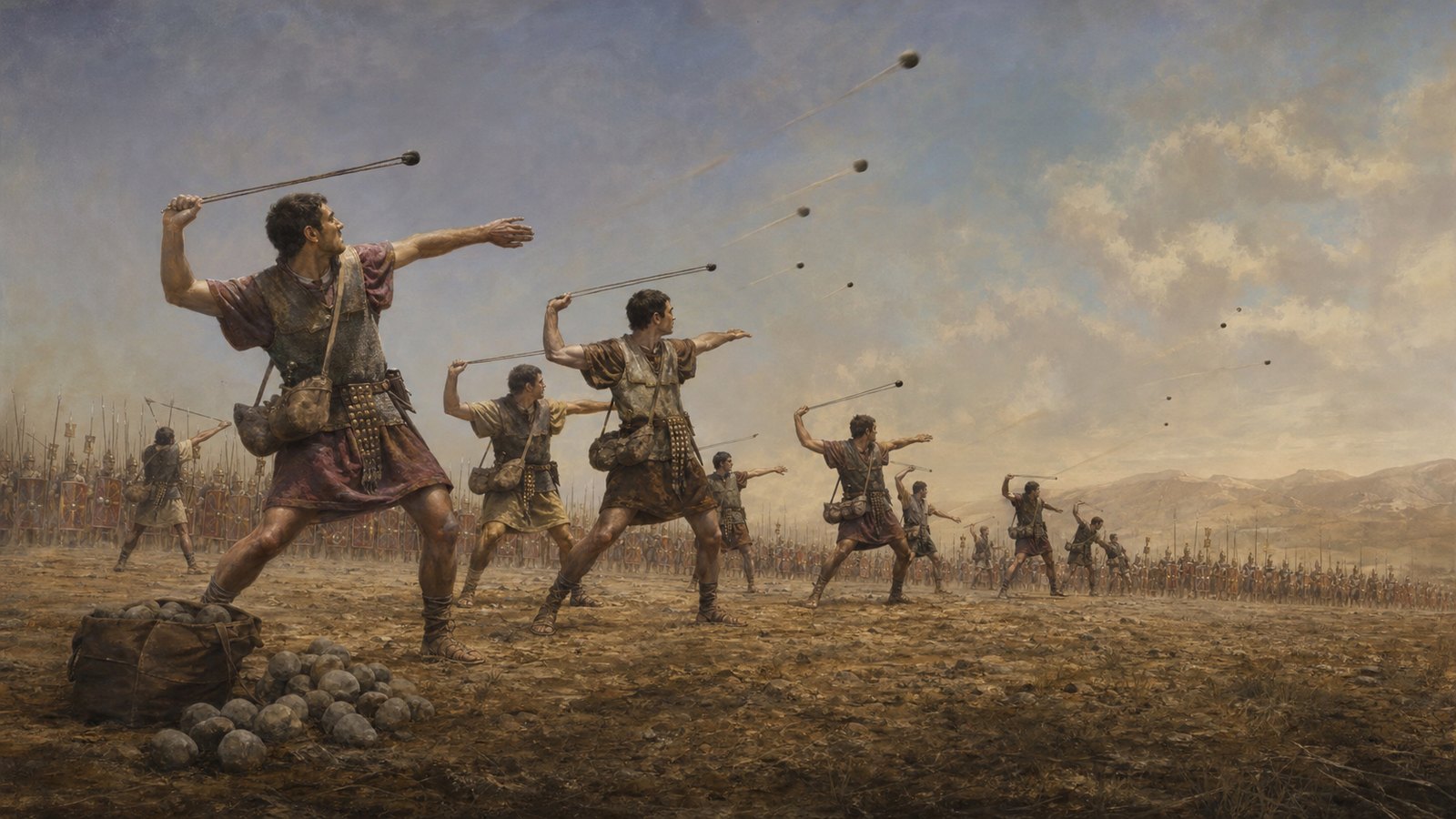
One unseen projectile could make a target flinch. Repeated shot from several slingers changed behavior across a wider front. Troops raised shields, broke a comfortable pace, sought cover or hurried through exposed ground. Not every cast had to strike armor to influence movement. The pressure came from uncertain arrival: the small bullet was hard to track, and the next release followed before the threatened formation reached the slingers.
Coordination protected the specialists as well. Slingers working forward of heavy infantry needed a route back before opposing troops closed. Their timing joined harassment to withdrawal and the advance of the main line. In that sequence they resembled Roman torsion artillery crews only at a distance: both projected force, but one relied on portable trained motion while the other stored energy in a built frame.
The smallest weapon carried its own supply chain
Portability did not eliminate logistics. Cords wore, pouches stretched, lead required fuel and molds, and stones had to be found before the ground became unsuitable. Ammunition expended in battle was rarely recovered in full. A commander using slingers repeatedly had to think in bags and batches, not merely admire a specialist’s single cast. The humble weapon converted local material and metal supply into tactical time at range.
Roman slingers turned small shot into long-range pressure by joining leverage, density and trained release. The cords amplified motion; selected ammunition made that motion more repeatable; coordinated volleys transformed individual skill into a problem for an entire formation. Nothing about the weapon needed to look monumental. Its effectiveness was measured in the space opponents could not cross comfortably and in the minutes gained before heavier Roman equipment entered reach. A coil of cord became military power only when practiced bodies, prepared ammunition and a planned, reliable route of withdrawal made its apparent simplicity operational.
Sources & Further Reading
- Sling, weapon
- Smith Dictionary, Funda
- Roman military personal equipment