
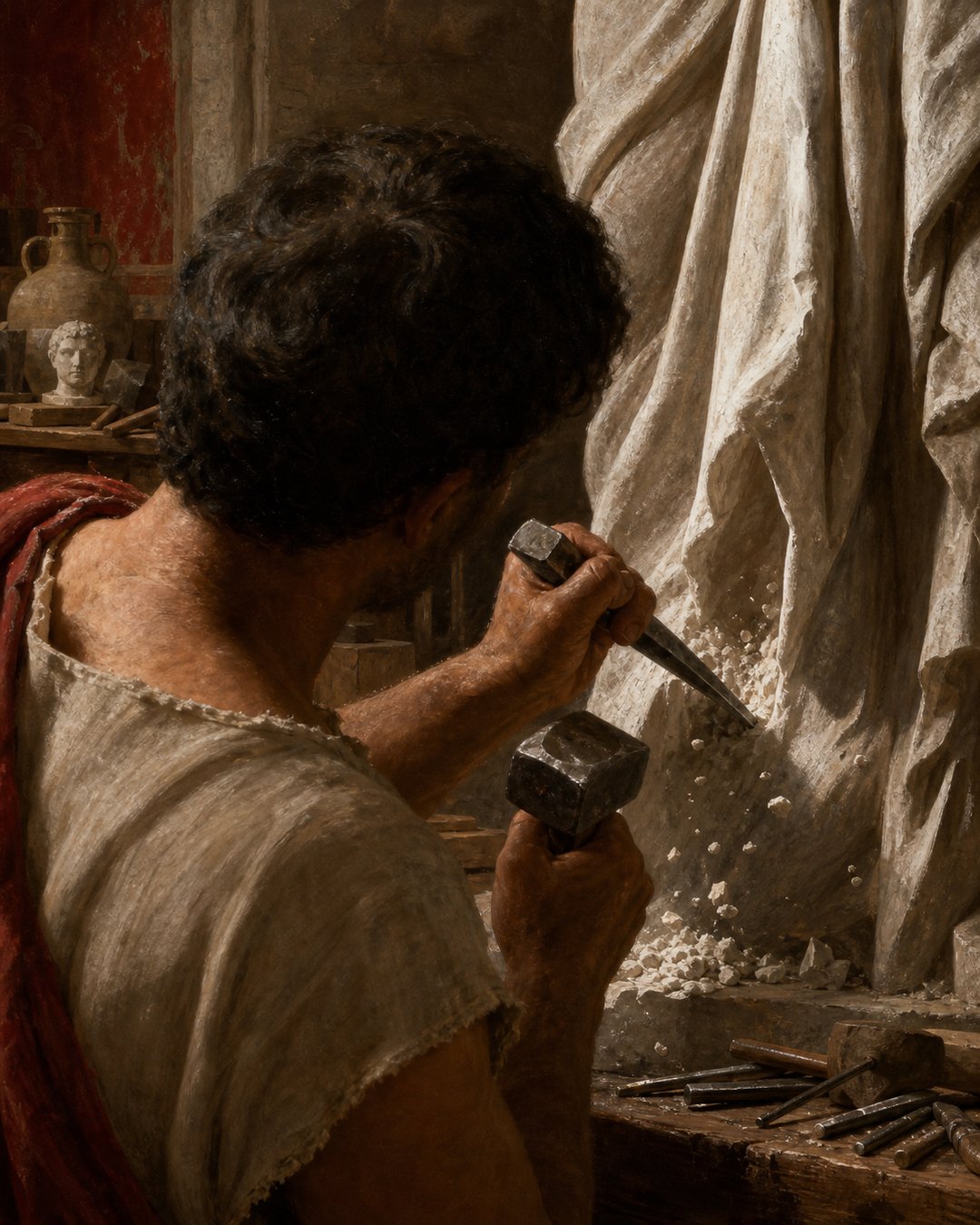
A chisel can have a narrow edge and still be too wide to follow its own cut. As a groove deepens, the shaft above the edge begins rubbing the walls. Roman channelling tools solved that problem with a shape that changes depending on where one stands: narrow from above, thicker from the side.
Art of Making describes cutting edges only half a centimetre to one centimetre wide on shafts fifteen to twenty-five centimetres long. Immediately behind the edge, the shaft narrows in plan so it can enter deep crevices and hollows. In profile, however, the same region thickens so structural strength is not surrendered.
That double shape produced the British name “fish tail” chisel. In the Roman period its primary work was deep drapery, often in places where a drill might also be used. The tool turned a constraint—the walls of a narrow recess—into the reason for a carefully redistributed cross-section.
Half a Centimetre Could Define the Entrance
Art of Making groups a range of chisels under the name channelling tools because their shared purpose is cutting narrow channels. Their edges measure roughly 0.5 to 1 centimetre. That small front controls the width of first contact and the minimum opening the tool needs.
The shaft behind the edge runs about fifteen to twenty-five centimetres, comparable to other hand-held carving chisels. A carver holds and aims it while a separate blow drives the cutting end. Length keeps the striking point outside the recess even as the edge works deeper within it.
A narrow edge concentrates force, but concentration alone does not guarantee a useful channel. The tool has to clear its own sides. If the shaft remains as broad as a conventional chisel immediately behind the cut, the walls begin pinching it before the intended depth is reached.
The problem differs from flat-chisel work on open surfaces. There, a broad straight edge can travel with space around it. In a channel, every successful millimetre of depth makes the route behind the edge more restrictive.
From Above, the Shaft Gave the Crevice Room
The distinctive feature appears when the tool is viewed from above: the shaft narrows immediately above the cutting edge. The cutting front opens the route, and the reduced neck follows without scraping both channel walls at once.
That clearance lets the carver change angle slightly inside a deep hollow. A full-width shaft would turn the surrounding stone into a rigid guide, perhaps jamming the tool or levering against a delicate edge. The narrow plan gives working space where the eye sees almost none.
Clearance also helps debris escape. Powder and tiny chips still have to be brushed or shaken from a recess, but a shaft that does not fill the opening leaves some path around the metal. The carver can withdraw the tool without dragging every fragment against the finished lip.
The narrowing is local rather than universal. Farther up, the shaft can return to a comfortable body for the holding hand and striking load. The design removes metal where access demands it, not from every part merely to make the whole chisel look slender.
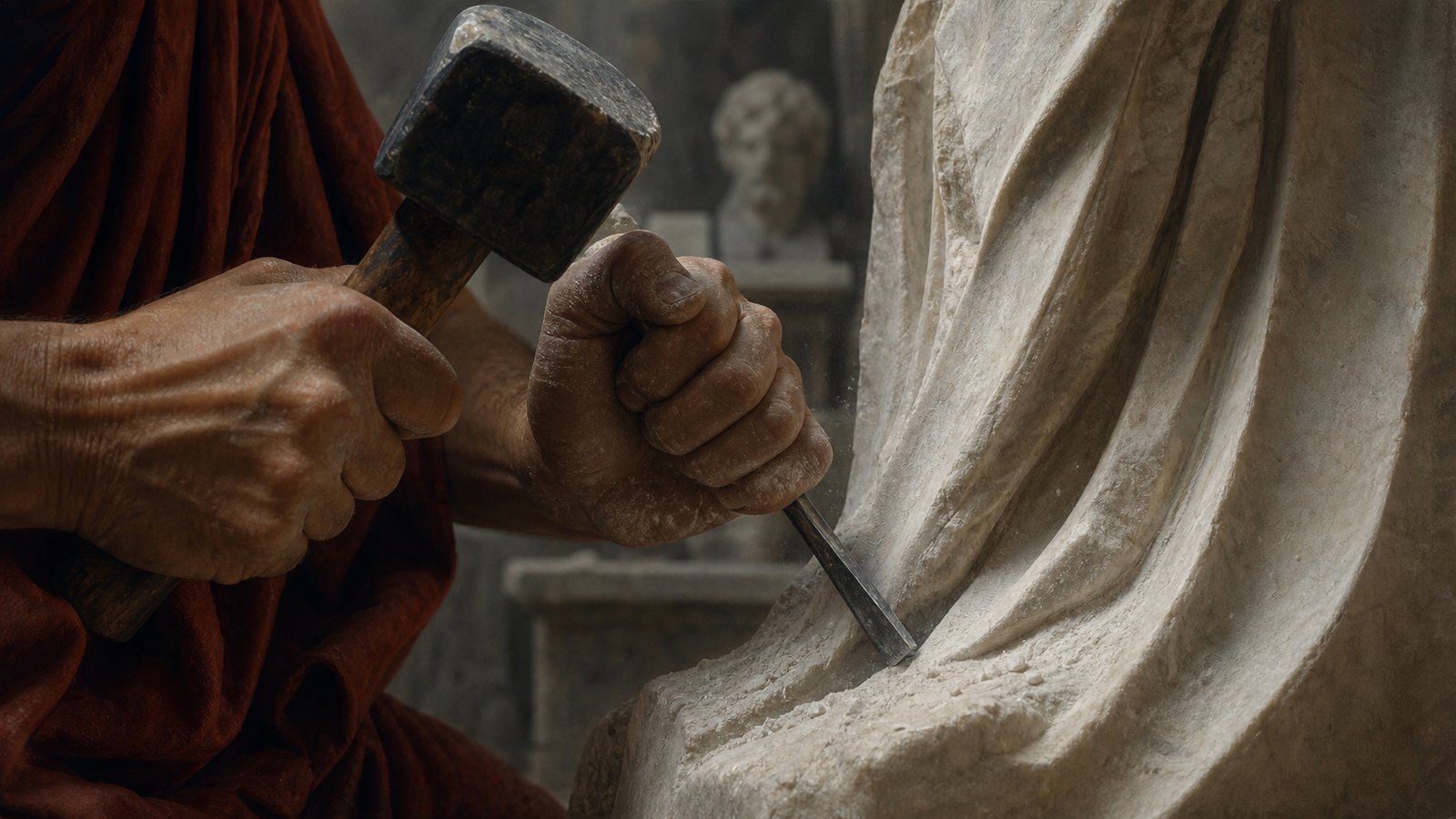
From the Side, Thickness Preserved the Blow
Viewed in profile, the same region thickens. Art of Making explicitly connects this side-profile depth with preserving structural strength. The tool does not solve access by reducing its neck equally in all directions, because that would create a weak hinge directly behind the cutting edge.
A hammer blow sends compression and bending through the shaft. Inside a channel, the edge may meet uneven resistance or be held obliquely, adding lateral stress. Enough metal must remain in the plane that carries those loads, or the narrow neck can deform or snap.
The fishtail cross-section redistributes material. Width is sacrificed to clear the walls; depth is retained or increased to carry force. The resulting form is not ornamental resemblance but an answer to two incompatible demands placed on one short segment.
This is workshop engineering at hand scale. No calculation survives on the chisel, yet its geometry embodies a calculation of consequence: remove too little width and it cannot enter; remove too much total section and it cannot survive the blow.
Deep Drapery Needed a Tool That Could Follow Shadow
The source identifies deep drapery as the channelling tool’s primary Roman use. Carved folds gain visual depth from recesses that separate ridges of cloth. The deeper and narrower the cut, the darker the shadow and the more strongly one stone surface can read as layered fabric.
Drapery is not a single straight trench. Folds bend, merge and disappear beneath one another. The carver must advance the tool along a planned path while protecting the raised stone that represents the cloth’s lit edges. The fishtail neck permits access without requiring the visible fold to be widened merely for the tool.
Each channel also changes the next one. A ridge left too thin may break when its neighbor is deepened. A hollow placed too close can turn two folds into one unsupported strip. The tool provides reach, but composition still governs where that reach may safely be used.
The surviving recess becomes image rather than evidence of labor. Viewers read darkness as depth and stone as textile. The chisel’s achievement is concealed inside that illusion: its own narrow body allowed the carved shadow to stay narrow too.
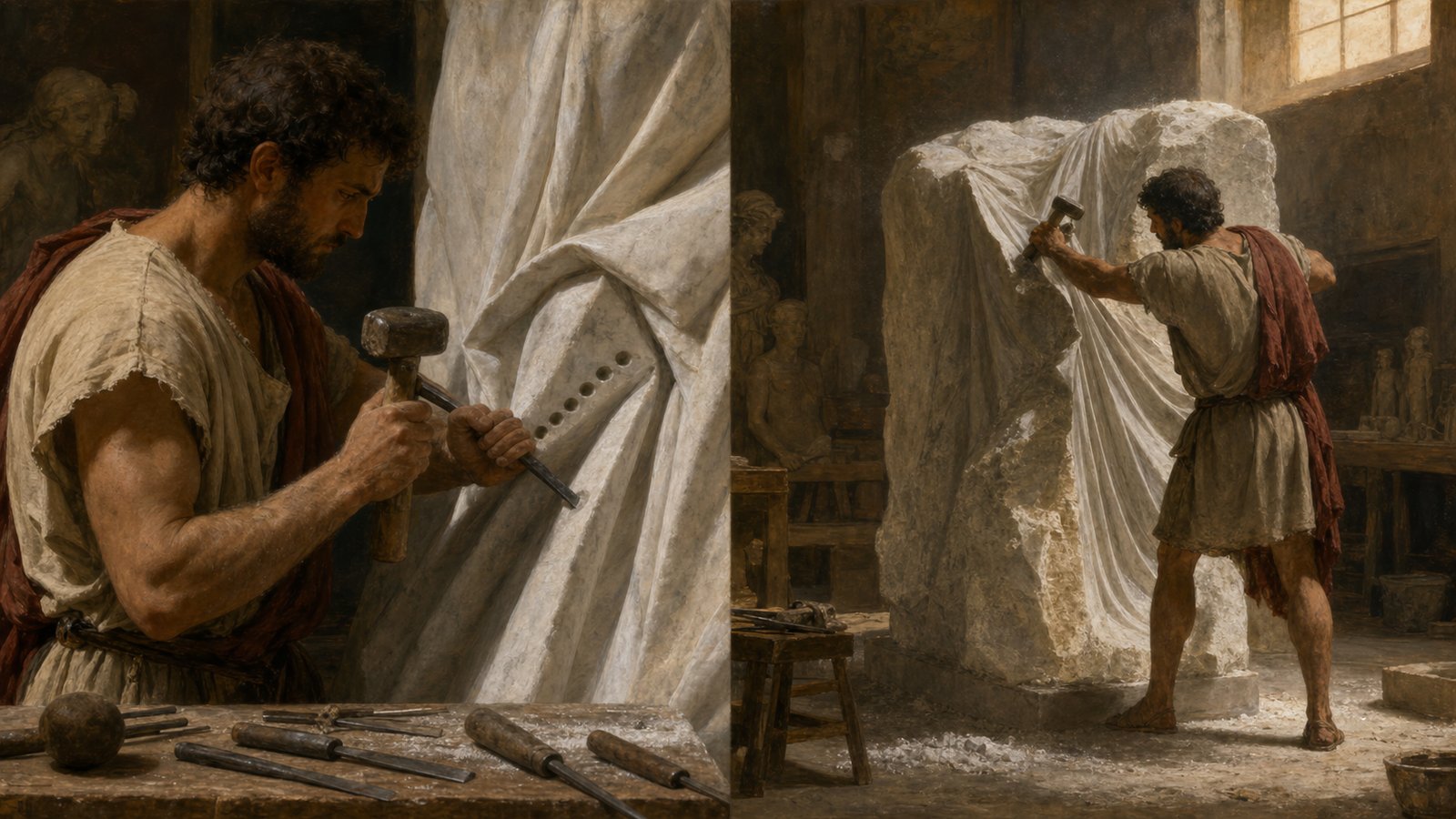
The Drill Could Reach Similar Places by Another Route
Art of Making notes that the channelling tool worked in much the same places as a drill. Both can enter deep drapery, but they arrive through different motions. A drill rotates a point and tends to establish circular depth; the chisel receives directed blows and advances an edge along a channel.
The archive article on Roman bow drills follows the conversion of back-and-forth pulling into repeated rotation. The fishtail tool instead preserves the logic of the chisel: orient the edge, strike, withdraw, clear and continue.
The two tools can be complementary. A drill may establish deep points or perforations that quickly create shadow. The channelling edge can connect, open or regularize the route between them, reducing the beaded appearance of separate holes while respecting a narrow fold.
Tool marks help reveal the choice. Circular pits or running drill channels differ from the directional cuts of a chisel. Where later smoothing has not erased them, the recess can show whether depth was bored, struck, or built through a sequence using both.
The Fishtail Name Preserved a Cross-Sectional Solution
The shape explains why the implement is often called a fishtail chisel in Britain. The name is memorable because the narrowed neck and widening parts resemble a tail seen from above, but the useful lesson lies in switching viewpoints.
An overhead drawing alone suggests delicacy and access. A side drawing restores the missing strength. Only together do the profiles explain how a tool with a half-to-one-centimetre edge could travel into a deep cut and still accept repeated blows through a metal shaft.
Other names recorded by Art of Making—Italian “L’Unghietto” and French “Le Bédane” or “Le Bec d’âne”—remind us that modern workshop vocabularies classify overlapping forms differently. Function and mark can be more reliable than expecting one ancient tool to fit one modern label everywhere.
The Roman channelling tool made deep drapery reachable by refusing to be simply thin. It became narrow only where the crevice demanded clearance and thick where impact demanded survival. The finished fold hides that compromise, but every dark stone channel depends on it.
Sources & Further Reading
- Art of Making, “Tool: Channelling Tool”
- Wikipedia, “Chisel”