
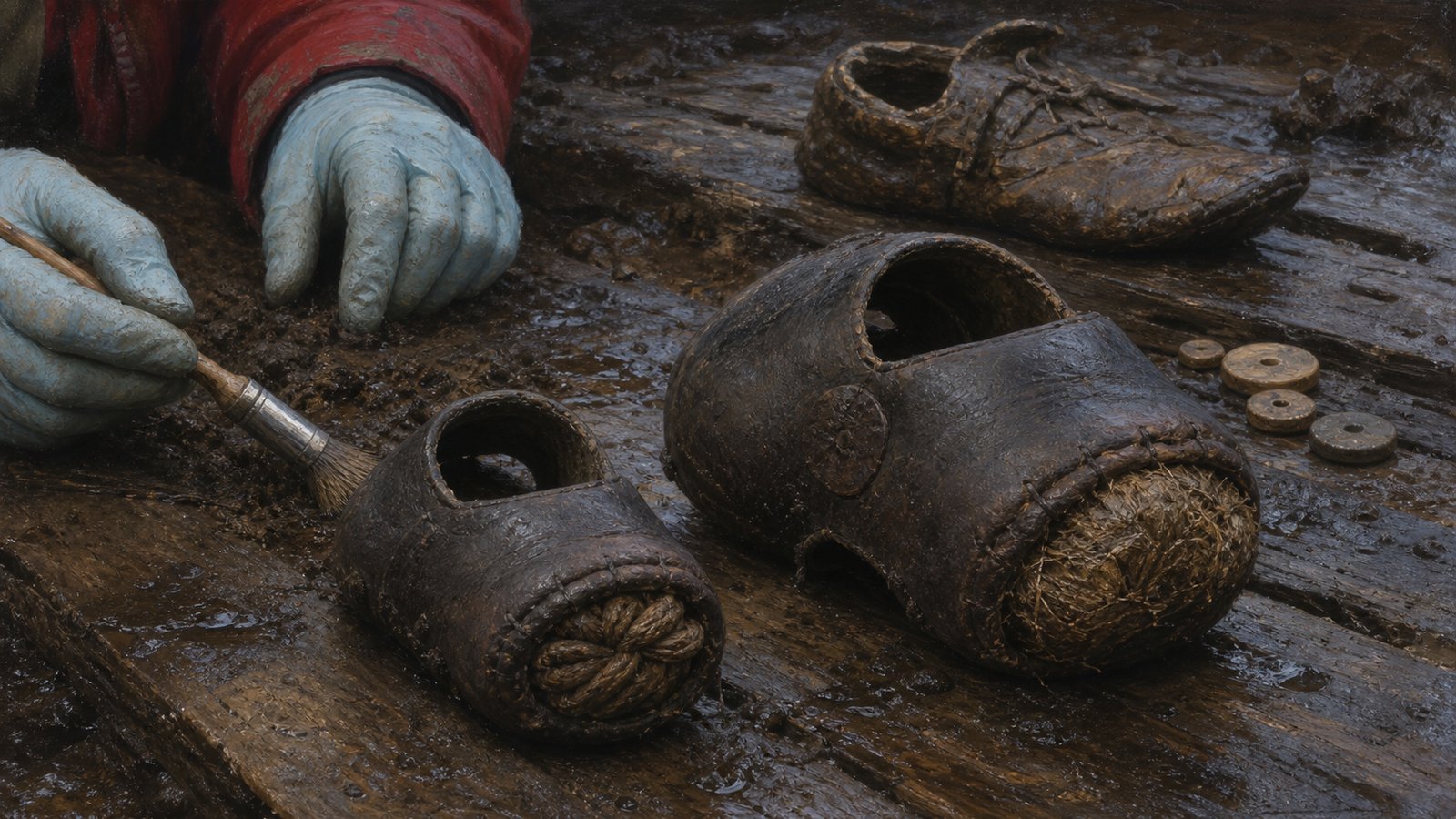
The smaller leather guard still carries the pressure of a vanished fist. Its surface bends where knuckles once pressed from inside, while a coil of twisted hide remains packed beneath the striking face. The larger object is broader, more heavily worn and repaired. They are not a matching pair, and neither resembles the padded glove hanging in a modern gym.
Excavators found both on the floor of a cavalry barrack at Vindolanda, the Roman fort just south of Hadrian’s Wall. The layer belonged to about AD 117–119. Around the guards lay the ordinary equipment of a crowded military community: horse gear, shoes, gaming counters, bath clogs and a nearly complete sword.
Images of ancient boxers survive in sculpture, painting and mosaic. Leather normally does not. These two objects therefore preserve something pictures cannot: the way a hand entered the guard, the material chosen to absorb a blow, the edge that wore down and the repair made after repeated use. They turn boxing from an ancient pose into a physical routine.
A Barrack Floor Held More Than Military Equipment
Vindolanda occupied a wet northern frontier where successive timber forts and settlements left unusually rich deposits. Waterlogged and oxygen-poor ground protected materials that usually disappear, including wood, leather and thin writing tablets. The famous correspondence discussed in the Vindolanda tablets survives through the same archaeological accident: vulnerable everyday matter remained where drier sites would have reduced it to stains or nothing at all.
The guards emerged during excavation of a pre-Hadrianic cavalry barrack. Archaeology Magazine dates them to about AD 117–119 and records their dimensions as roughly 5.3 by 3.3 inches and 6.1 by 5.1 inches. Both are small enough to sit over the knuckles rather than swallow the whole hand. Their scale immediately separates them from modern boxing gloves.
The surrounding objects make the room legible as lived military space. Excavators reported horse equipment, leather footwear, wooden bath clogs, gaming pieces, writing tablets and a sword. None proves that a boxing match happened at the instant the floor was abandoned. Together, however, they collapse the false boundary between duty and downtime. Riding, washing, writing, gaming and training all left material in the same barrack environment.
This mixed assemblage adds texture to the army as a long career. A cavalryman did not spend every hour in formation. He maintained equipment, waited, exercised, socialized and prepared his body for violence that might never arrive on a particular day. The boxing guards belong to that rhythm of readiness.
Each Guard Solved the Blow Differently
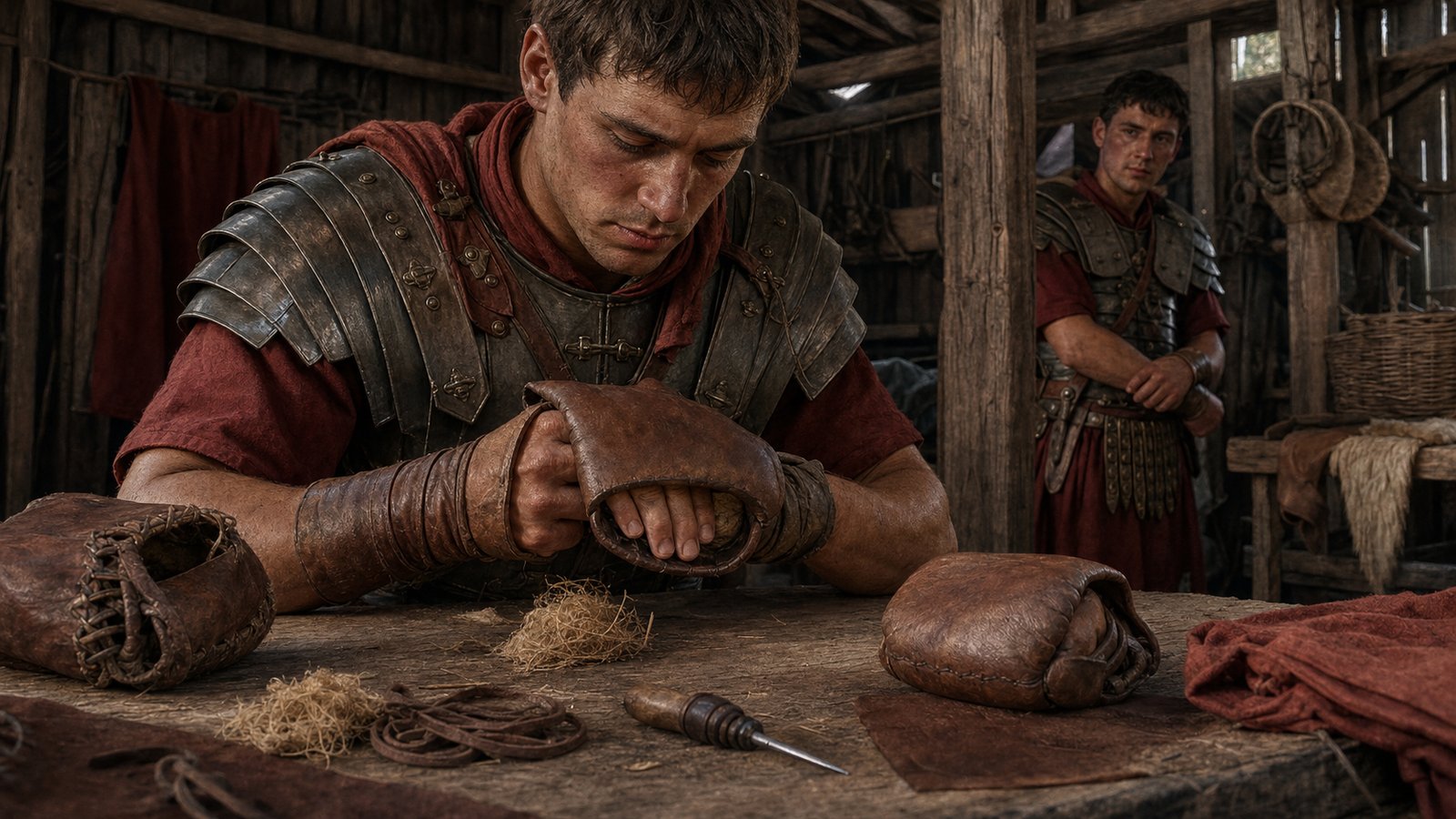
Current Archaeology describes a shared construction principle. A single piece of leather was folded into a pouch, its ends joined to create an opening through which the hand could slide, and the front packed. The design protected the knuckles while leaving much of the hand free. It was economical, repairable and made from materials available to a military leatherworker.
The two objects are similar without being twins. The smaller guard contains a coil of hard, twisted leather. Layers of hide created a dense pad, and the imprint of the user’s knuckles remains visible. That impression is unusually intimate evidence. It is not a maker’s ideal geometry but a deformation produced by one person repeatedly closing a fist inside the object.
The larger guard was stuffed with natural fibrous material that acted as a shock absorber. Its contact edge shows heavy wear. Current Archaeology also notes a tear covered by a circular patch, evidence that someone considered the object worth mending rather than discarding. Archaeology Magazine reports a heat-hardened leather strip at an edge, a feature Andrew Birley thought could make a strike cut rather than merely cushion.
Those differences caution against calling the finds a pair. They may have belonged to different users, served different intensities of practice or simply reflect separate makers. Birley proposed that the softer guard suited sparring while the larger could deliver a harsher blow. Other reporting emphasizes that the finds lacked the metal inserts associated with more dangerous ancient bouts. The leather supports comparison; it does not preserve a written rulebook.
Training Made Violence Repeatable Without Making It Safe
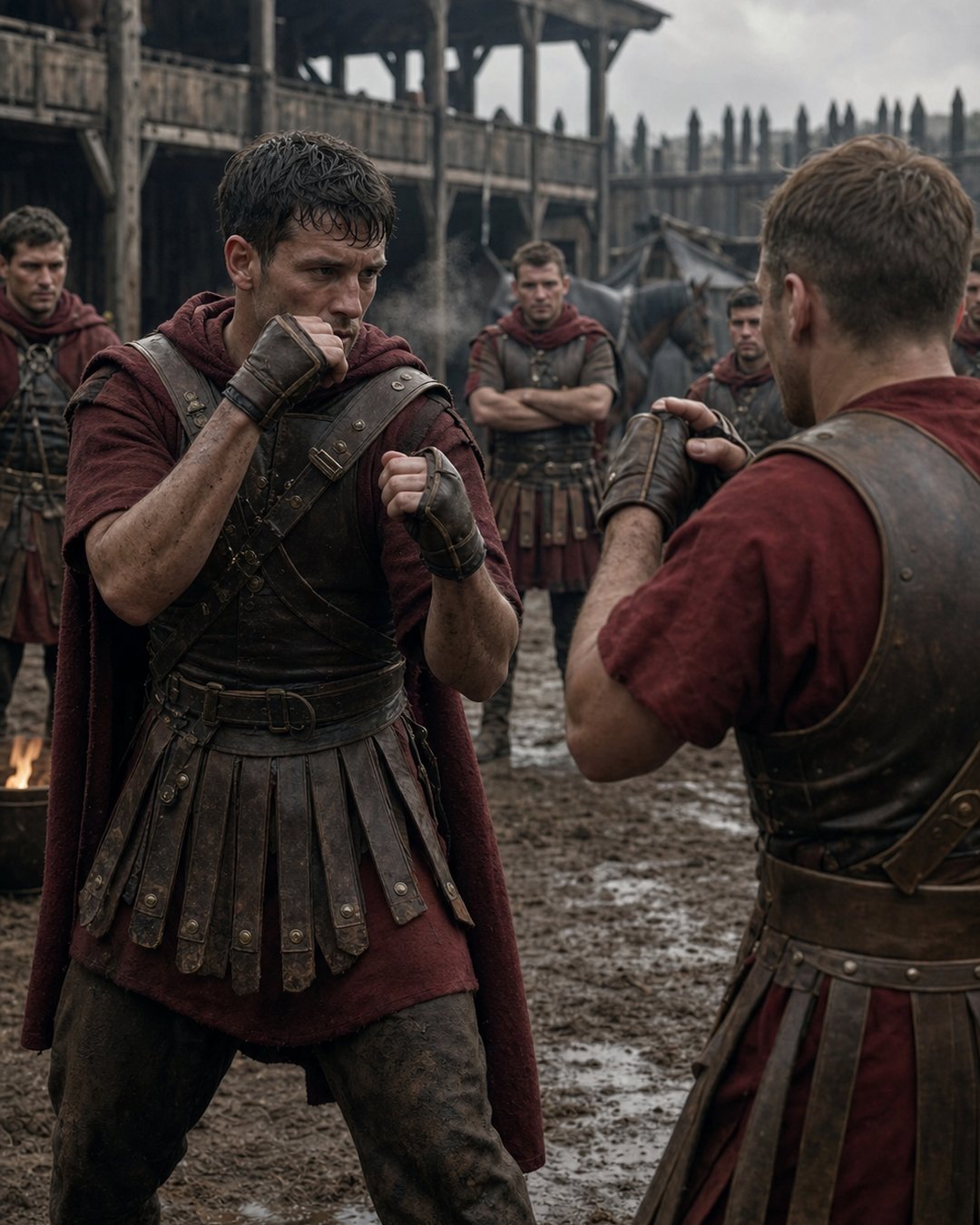
Boxing offered Roman soldiers several things at once. It demanded balance, distance, timing, endurance and the ability to continue while tired. A cavalryman whose battlefield work depended on horses and weapons still needed a conditioned body. Training with a comrade turned those qualities into a repeated contest that required little space or elaborate equipment.
The guards altered the exchange of force rather than removing danger. Padding protected the wearer’s knuckles, allowing more strikes before the hand failed. It also changed what reached the opponent. A soft stuffed face could moderate impact in practice; a hardened edge could concentrate it. The same broad object type could therefore occupy territory between exercise, entertainment and serious fighting.
The Roman evidence does not justify reconstructing one official army boxing programme from two finds. Andrew Birley notes references to boxing in military life and interprets it as training, exercise and entertainment. The barrack context makes that interpretation plausible, but it does not identify the men, their rank, the frequency of matches or whether money changed hands.
What the objects demonstrate securely is preparation for repeated impact. Someone selected leather, shaped an opening around a hand, packed the striking surface and later repaired at least one damaged guard. That sequence required expectation. The object was not improvised for a single ceremonial pose; its wear belongs to use over time.
Preserved Leather Carries Evidence a Statue Cannot
Ancient art makes boxing visible. Sculptures show battered faces and wrapped hands; mosaics freeze fighters opposite one another. Such images can communicate stance, status and drama, but artists select what an audience should see. A leather guard recovered from a floor was not composed to explain boxing to posterity. Its evidence lies in accidental marks.
The knuckle impression records pressure from within. Abrasion marks the side that met repeated contact. A patch records failure followed by intervention. Different stuffing records choices about weight and resilience. These details connect manufacture to use without requiring the object to speak in a complete sentence.
Organic survival also changes which Roman lives can be studied. Stone inscriptions favor names, offices and deliberate memory. Bronze may survive because it was valuable enough to deposit or lose, although much was recycled. A small leather guard was neither monumental nor intended for centuries. Its preservation gives disproportionate visibility to an ordinary bodily habit at the edge of the empire.
This is why Vindolanda’s wet layers are more than a treasure cabinet. They preserve systems of maintenance. Shoes carry repairs, tablets carry hurried handwriting, and these guards carry the fatigue of impact. The fort appears not only as a strategic point near the developing frontier, but as a place where objects passed repeatedly through hands.
Two Gloves Reveal a Routine but Not a Match
The finds were announced after specialists compared their form with representations and evidence for ancient boxing. The Vindolanda Trust called them probably the only known surviving Roman-period examples. That claim reflects the exceptional rarity of worked leather, not the rarity of boxing itself. Many more guards may have existed and vanished.
The safest reconstruction begins with what survives. There are two guards, not a matched set. Both came from a cavalry-barrack floor dating about AD 117–119. One is smaller and densely packed with twisted leather; the other is larger, fibrously stuffed, heavily worn and repaired. They fit over knuckles rather than covering the hand like modern gloves.
From there, interpretation can widen carefully. The context supports soldierly exercise and entertainment. Differences in padding may reflect different uses or users. Wear shows repetition. None of this tells us who won, whether the contest had spectators, what rules governed a bout or whether these two guards ever faced one another.
That uncertainty does not weaken the discovery. It keeps a vivid object from becoming invented biography. BBC News, Archaeology Magazine and Current Archaeology preserve overlapping descriptions while differing in emphasis about sparring and harsher fighting. Reading those accounts together makes the boundary between material fact and expert reconstruction visible.
The guards restore a small sound to the Roman frontier: leather meeting leather, feet shifting on a barrack floor, companions watching between duties. The precise scene cannot be recovered, but the objects prove that hands were wrapped for impact and that at least one damaged guard returned to use after repair.
Two thousand years later, the most eloquent feature is not a heroic image. It is the depression left by knuckles inside the smaller guard. A soldier’s name disappeared, and the match—if there was one—left no score. The shape of effort survived.