
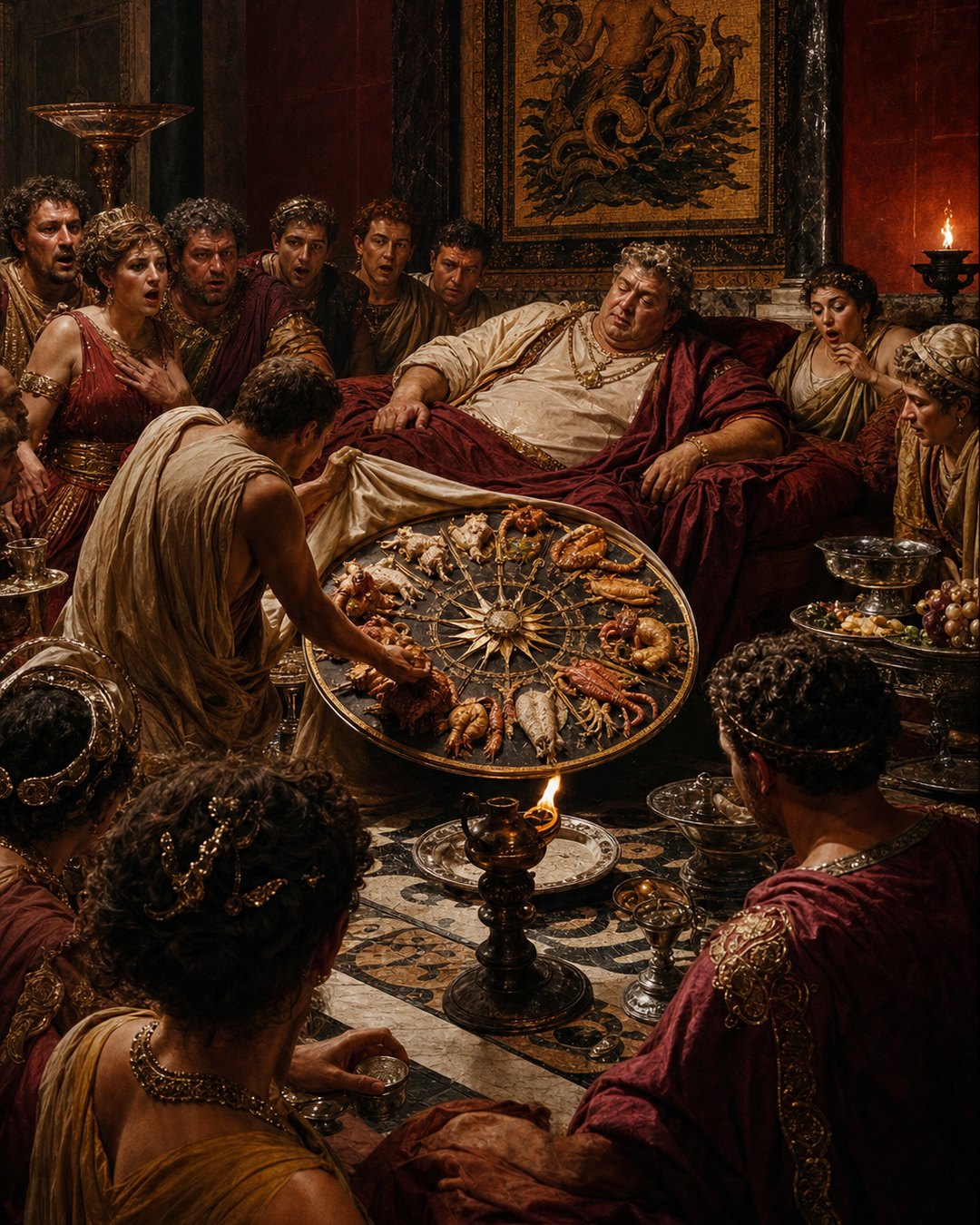
The first warning arrives before the main spectacle. A silver skeleton is dropped onto the table, its loose joints clattering while Trimalchio recites about the brevity of life. Then the servants bring a circular tray marked by the zodiac. Each sign carries an appropriate morsel. The guests see a disappointing assortment and begin to judge it. They have judged too soon.
Under the decorated upper tray waits a second course of richer food. At Trimalchio’s dinner, seeing is only the opening move in a joke controlled by the host. A boar is also a freed slave, pastry piglets are souvenirs, thrushes hide inside the carcass, a hare becomes Pegasus, and a cook appears to forget how to gut a pig before sausages spill from its belly.
The Cena Trimalchionis occupies chapters 26 to 78 of Petronius’s fragmentary Satyricon. Its host is a fantastically rich freedman, and its narrator Encolpius is educated enough to recognize bad taste but compromised enough to keep eating. The banquet’s real subject is not a menu. It is the exhausting work of making status look unquestionable.
The House Announces Its Owner Before He Enters
Encolpius encounters Trimalchio at the baths, playing ball while attendants count misses instead of retrieving them normally. At the house, the entrance carries warnings and displays. A large dog painted near the doorway startles the narrator beneath the words cave canem. Wall imagery recounts the master’s rise from the slave market toward commercial and financial success under the guidance of Fortune.
The decoration turns biography into a triumphal route. Trimalchio does not hide that he was enslaved; he restages the ascent as proof that destiny selected him. Yet the painted dog also teaches the reader how the house works. An image pretends to be a threat, and the guest’s mistaken reaction becomes part of the entertainment.
The archaeological silver service from the House of the Menander shows how much real labour and material could support elite dining. Petronius uses equally concrete objects but makes them behave like stage props. Lamps, vessels, clocks, mosaics and couches continually tell the guests what kind of man owns them.
A Zodiac Tray Rewards the Guest Who Waits
The circular first course maps food onto twelve signs. Aries receives ram’s vetches, Taurus beef, Gemini kidneys, Leo an African fig, Libra a balance holding a tart and a cake, Scorpio a small sea fish, Aquarius a goose and Pisces two mullets. In the centre, turf supports a honeycomb. It looks intricate but meagre.
Trimalchio gives a signal, musicians strike up and servants lift the top. Beneath it, the guests find poultry, sow’s udders and a hare fitted with wings to represent Pegasus. The trick does more than deliver abundance. It lets the host watch educated visitors misunderstand his table, then corrects them with a revelation only his household can cue.
The zodiac flatters Trimalchio’s claim to universal knowledge, but his learning is visibly assembled from fragments. He later assigns personality and occupation to people born under each sign and announces his own birth under Cancer. The performance makes astronomy, mythology, carving and dinner service answer to one owner, whether or not the connections withstand scrutiny.
The delay is as important as the ingredients. Guests must first expose an interpretation, then wait while music and servants disclose the hidden arrangement. Trimalchio owns the interval between error and correction. Each course trains the room to distrust its first impression and to look toward the host for permission to understand what has arrived.
The Boar Performs Manumission Before It Becomes Meat
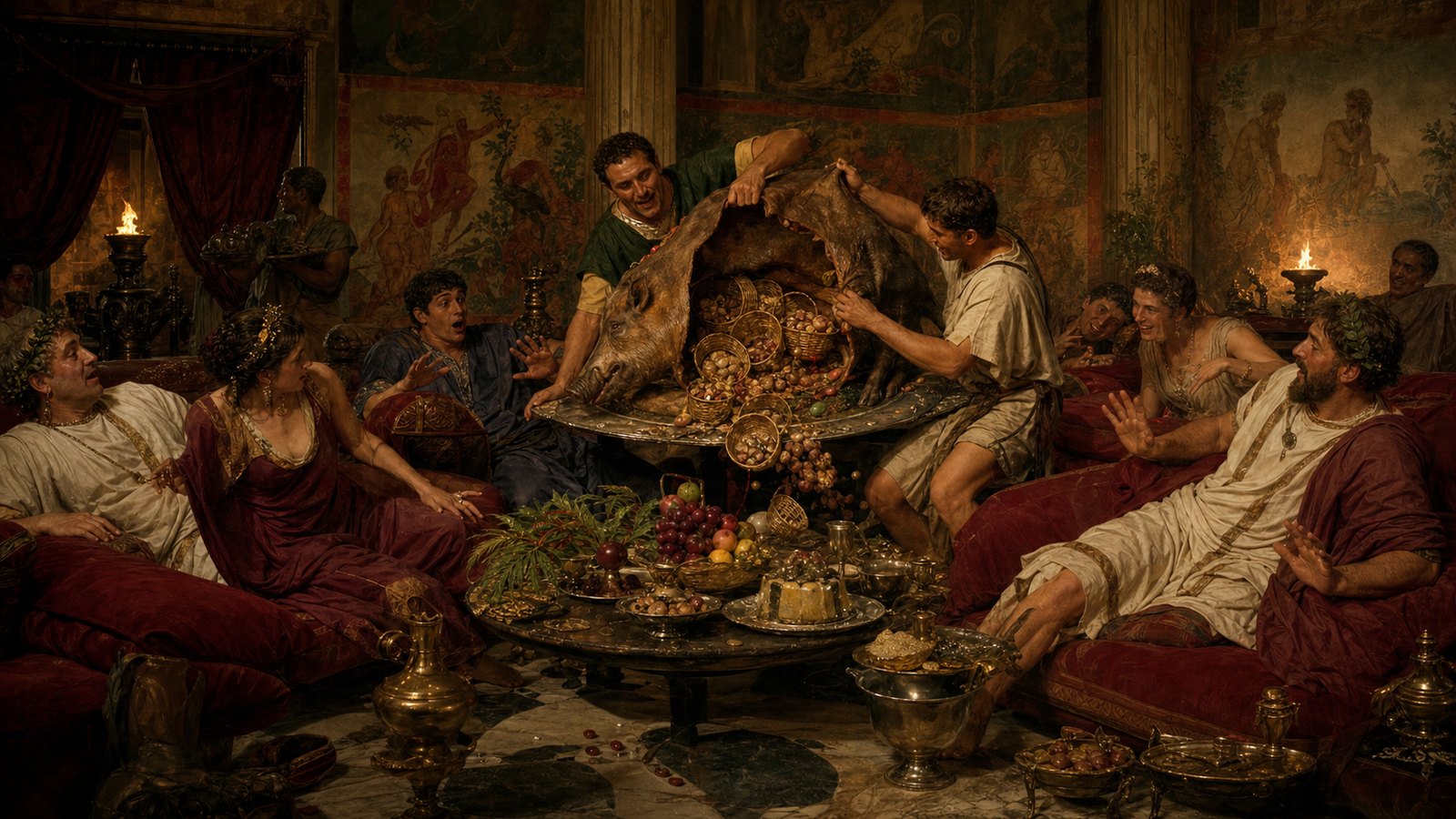
Noise erupts outside the dining room and hunting dogs run around the table. A giant boar arrives wearing a liberty cap, the felt cap associated with manumission. Two palm-fibre baskets hang from its tusks, one filled with Syrian dates and the other with Theban dates. Pastry suckling pigs surround it, presented as take-home gifts.
A costumed carver plunges a hunting knife into the animal. Live thrushes fly from the opened side and attendants catch them for distribution. Trimalchio explains that the boar had eaten especially fine acorns. The course has become a miniature hunt, an origin story and a liberation ceremony, all staged after the animal is already dead.
The cap makes the joke uncomfortably close to the host. Trimalchio is a freedman displaying another “freed” body that his guests will consume. Petronius does not need a narrator to explain the symbolism. The object is funny, lavish and cruel at once. Wealth allows Trimalchio to repeat the transformation from possession to freedom as table theatre under his command.
The episode also compresses the household hierarchy into one reveal. Animals, cooks, costumed carvers and bird-catchers all appear spontaneous, yet every movement has been prepared. The apparent marvel depends on invisible rehearsal and on servants whose precision is converted into evidence of their owner’s imagination.
Ordinary Voices Keep Leaking Through the Programme
When Trimalchio leaves for the lavatory, the centre of gravity shifts. Freedmen talk about the weather, prices, bread, games, schools, funerals and neighbours. Their idiom is rough and their judgments can be comic, but the conversation briefly stops behaving like a rehearsed pageant. Material worries enter the room without a servant lifting a lid.
Those voices prevent the dinner from becoming a simple catalogue of one man’s vulgarity. The guests have histories of slavery, business, bereavement and precarious success. Trimalchio himself later describes trading ventures, losses, recovery and the size of his estates. Exaggeration surrounds the account, yet economic risk remains beneath the gold.
Encolpius’s position sharpens the satire. He recognizes the host’s mistakes and repeatedly registers disgust, yet he is dependent on the invitation and fascinated by every reveal. He cannot stand safely outside the performance as a neutral judge. Petronius makes taste into another contested status claim: education gives Encolpius a vocabulary of superiority, but not independence from the table.
Red rental notices such as the one in the Pompeian baths advertisement preserve actual urban commerce in a compressed public form. Petronius preserves something different: fictional speech tuned to social observation. His freedmen count grain, patrons and burial costs while the host tries to count everything as evidence of himself.
A Funeral Rehearsal Finally Escapes the Host’s Control
Death has shadowed the evening from the silver skeleton onward. Trimalchio reads provisions from his will, frees slaves in advance, discusses the monument his stonemason guest should build and specifies scenes to be carved upon it. He imagines his epitaph and wants his clock included so that anyone checking the time must also read his name.
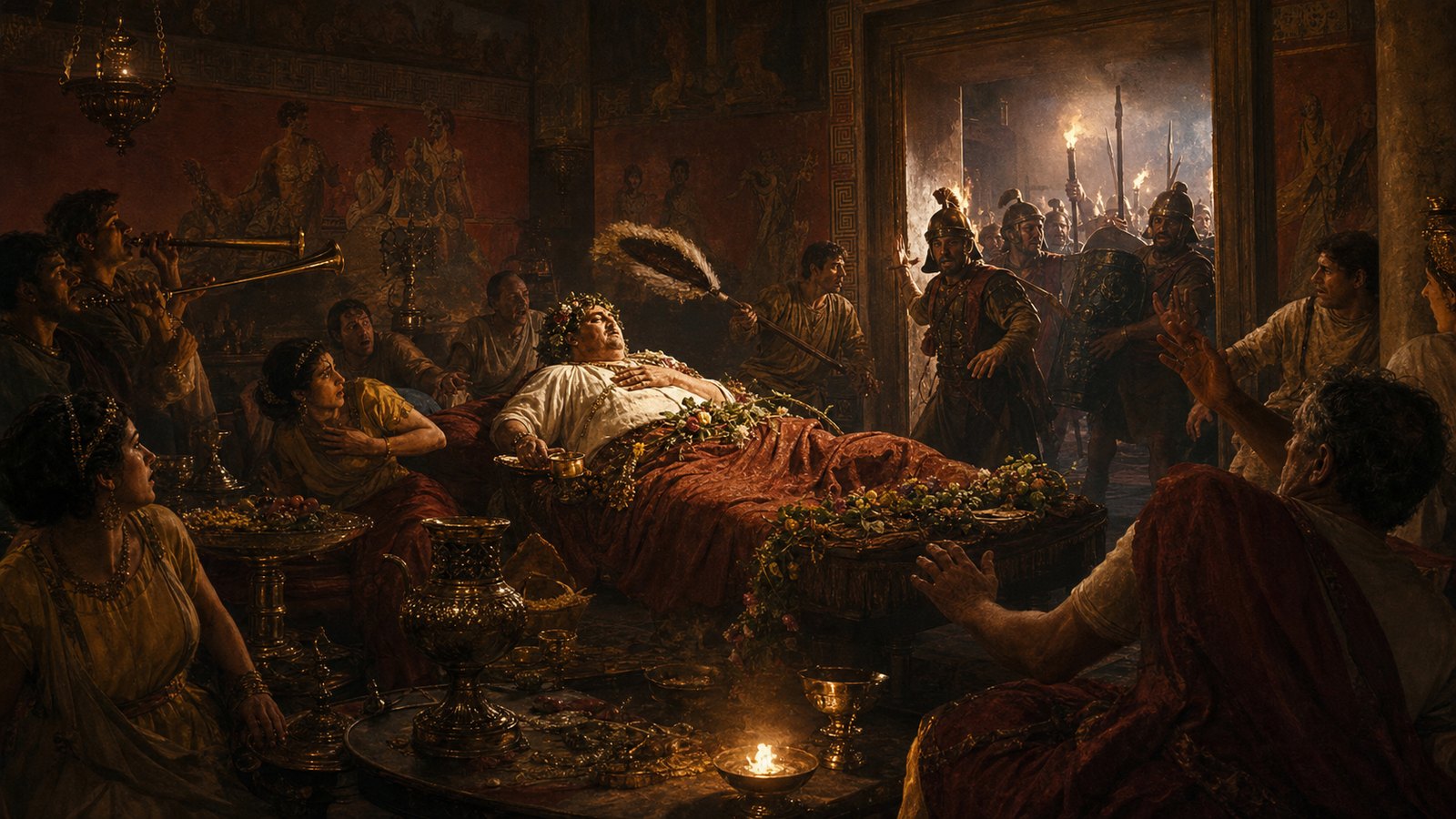
Near the end, he orders the household to treat him as dead. Horn players perform loudly while he lies arranged for mourning. The sound reaches the vigiles, Rome’s fire watch, who mistake it for an emergency. They break into the house with water and axes. A controlled rehearsal of posthumous fame produces an uncontrolled public response.
Encolpius and his companions use the confusion to flee. Trimalchio can disguise food, script servants and convert his biography into decoration, but he cannot guarantee what listeners outside the room will think a horn means. The final mistake is structurally perfect: one more false appearance, except this time the host is trapped inside it.
The feast endures because Petronius refuses to let luxury settle into a single meaning. Each marvel is ingenious and embarrassing, each guest both observer and participant, each revelation a new surface. Even abundance feels precarious when its value depends on applause arriving at exactly the right cue. Trimalchio can purchase surprise after surprise. What he cannot buy is the authority to make every witness admire the same thing.