
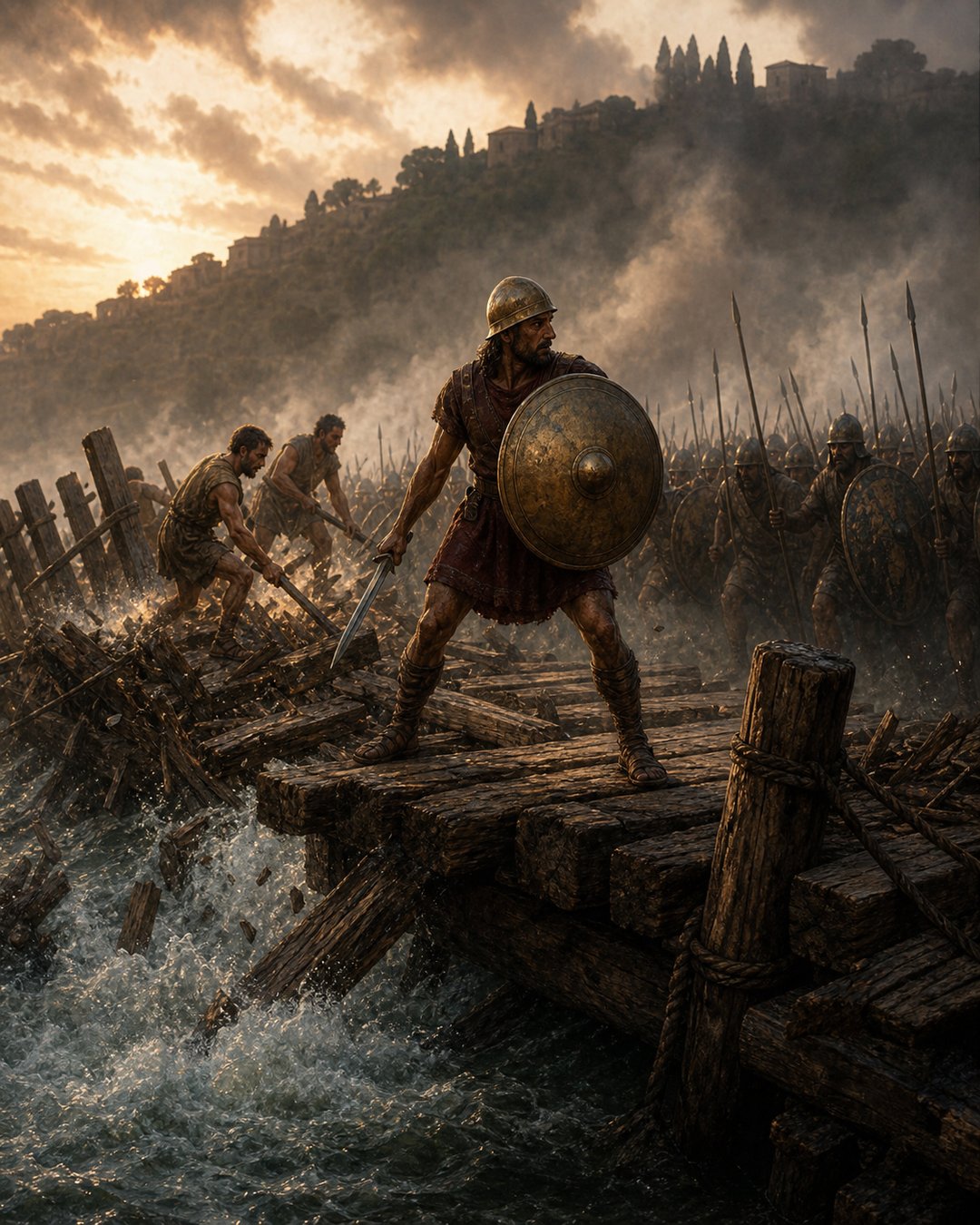
Horatius Cocles stood at the Sublician Bridge while Romans hacked and burned the crossing behind him. The enemy could reach the city if the timber remained intact. Rome’s defence therefore depended on destroying its own route across the Tiber.
When the bridge crashed down, Horatius prayed to Father Tiber and jumped fully armed into the river. Livy says missiles fell around him, yet he swam safely to his companions.
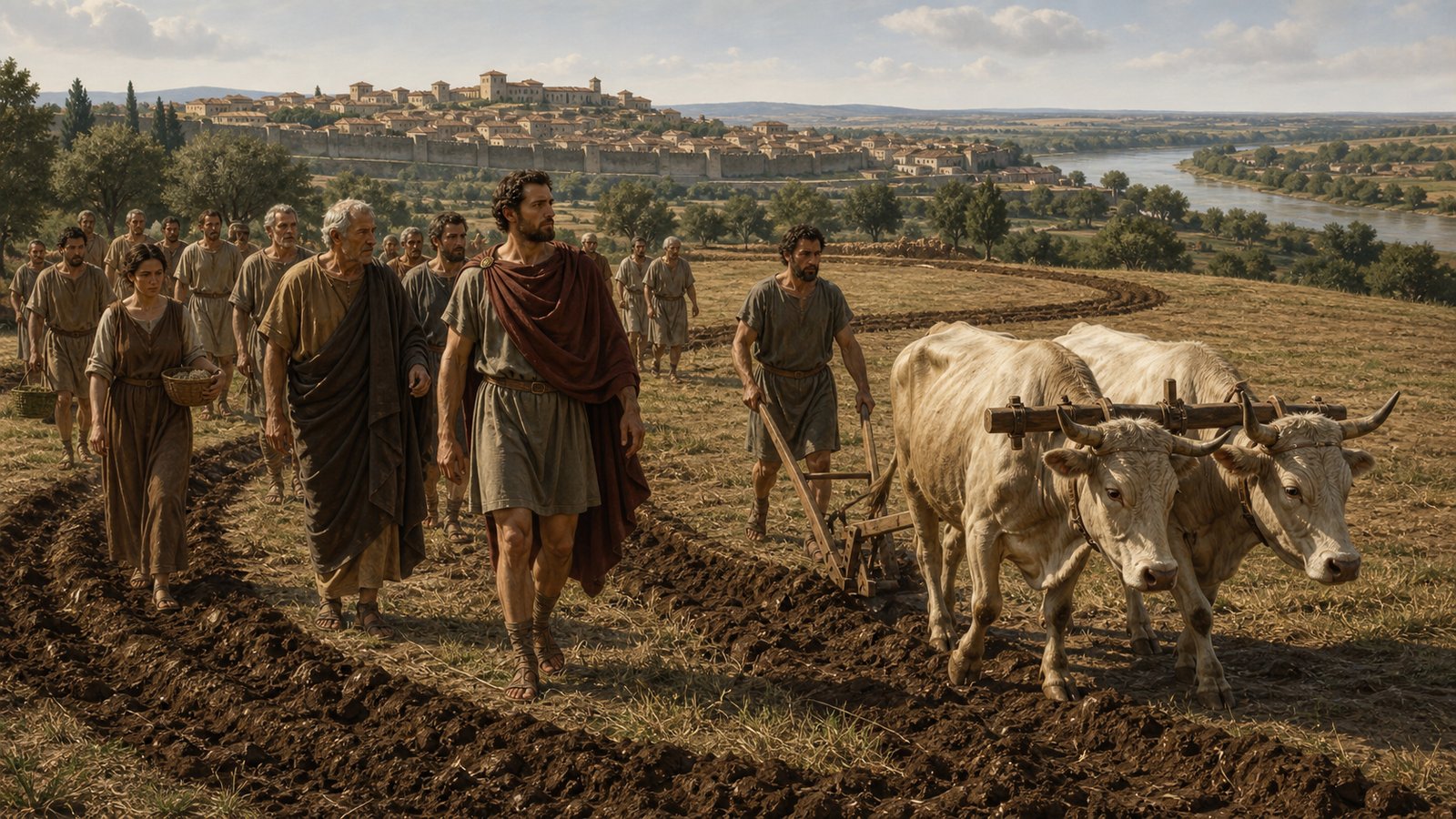
The city answered with more than praise. It placed his statue in the Comitium, granted as much land as he could encircle with a plow in one day, and watched citizens give him food from their own scarce stores. The defence ended in a measurement of what Rome believed it owed.
The Janiculum Fell Before the Bridge Did
Livy places the episode during Lars Porsena’s attack on Rome. Country people fled into the city, weak points were occupied, and the walls and Tiber were expected to protect the rest.
The crisis sharpened when the enemy seized the Janiculum in a sudden assault. From there attackers rushed downhill toward the river and the Sublician Bridge.
Horatius happened to be on guard at the crossing. He saw Roman soldiers abandoning their posts and throwing away weapons as panic turned a military line into a fleeing crowd.
He argued that flight could not save them if they left the bridge open. An intact crossing would carry the enemy from the Janiculum toward the Palatine and Capitol.
His order was brutally practical: cut or burn the bridge by any available means. Horatius would delay the attack for as long as one man could hold it.
The article on Roman bridges making rivers governable follows crossings as instruments of movement and control. At the Sublician Bridge, control required the opposite operation. The useful structure had to become a gap before the enemy could use it.
Three Defenders Bought Time for Demolition
Livy does not begin with Horatius entirely alone. Spurius Lartius and Titus Herminius, both described as men of high birth and courage, remained with him when shame stopped them from joining the flight.
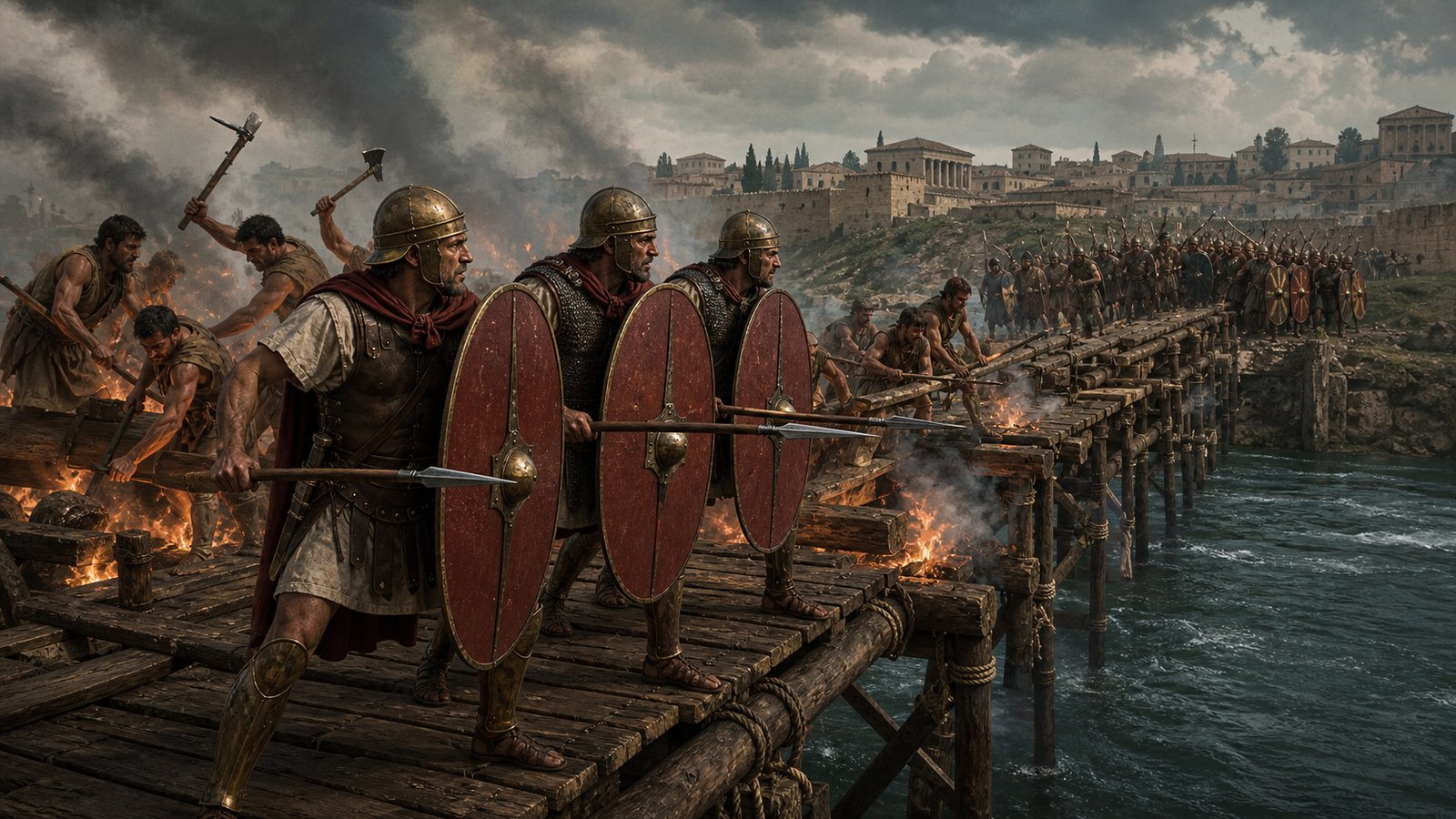
The three received the first confused assault while Romans worked on the bridge behind them. Their task was not to win a field battle. It was to convert seconds of close fighting into time for demolition.
When only a small part of the bridge remained, the workers called for the defenders to withdraw. Horatius insisted that Lartius and Herminius retreat, leaving him at the head of the narrowing crossing.
Livy gives him speech as a weapon. Horatius challenged Etruscan leaders and mocked them as servants of kings attacking another people’s liberty.
The enemy finally threw javelins from all sides. Horatius caught them on his outstretched shield and kept his footing while the last supports behind him failed.
The crash of the bridge changed the battle instantly. A shout rose from the Romans, and the attackers who had been preparing to charge stopped in sudden panic. Timber completed the work that Horatius’s shield had delayed.
Father Tiber Became the Escape Route
The broken bridge protected Rome but stranded its defender on the enemy side of the new gap. Horatius could no longer retreat by the surface he had saved the city by destroying.
Livy gives him a brief prayer to Tiberinus, holy father, asking the river to receive his weapons and warrior. The appeal turns the physical obstacle into a divine recipient before Horatius enters it.
He jumped fully armed. Armour, shield and weapons made the crossing more difficult, while missiles continued to fall over the water.
Livy says Horatius swam safely to his friends. He immediately adds that the deed was more famous than credible to later generations, preserving admiration and doubt in the same sentence.
That qualification matters. The account is a foundation story shaped by civic memory, not an after-action report with measured currents and equipment weights. Its reliable object of analysis is the way Livy organizes courage, infrastructure, divine appeal and reward.
A different crossing in Caesar’s Alexandrian swim with papers and cloak preserves command by carrying objects through water. Horatius enters the Tiber only after the bridge and the route it represented have been surrendered.
A Statue and a Plow Measured Public Gratitude
The state placed a statue of Horatius in the Comitium. The location made remembrance visible in a civic space rather than leaving the episode only in military storytelling.
Rome also granted land. Livy defines the amount through an action: as much as Horatius could drive a plow around in one day.
The reward was therefore bounded by movement, daylight and the practical reach of a team and implement. It converted a single day of danger into a single day of measured possession.
The plow also made the grant public in a different register from the statue. Sculpture fixed an image; the furrow established an edge. One commemorated the defender, while the other gave him a material base.
Livy then moves from state action to individual gifts. Despite severe scarcity, citizens contributed food according to their means from their own stores.
Those offerings mattered because Porsena’s pressure soon became blockade and famine. Food was not a symbolic excess. Each household surrendered something already made valuable by shortage.
The combination prevents gratitude from belonging only to officials. Statue and land came from the state; provisions came from citizens. Public honour and private sacrifice answered the same event.
The archive’s article on Roman boundary markers and political land explains how edges could turn claims into durable facts. Horatius’s grant begins one stage earlier, when a plow traces the quantity that courage has earned.
The most revealing part of the story may be the movement from broken timber to cut earth. Romans first severed a line across the river to deny passage. They later drew a line around land to create possession.
Both acts depended on coordinated labour and accepted boundaries. The bridge workers decided where connection must end; the plow decided where reward would end.
Livy’s Horatius is remembered as a solitary defender, but the full scene is crowded. Lartius and Herminius share the first assault, workers destroy the crossing, the river receives the escape, magistrates authorize honours, and hungry households supply gifts.
His courage is central because it holds those actions together. Without delay the bridge cannot fall in time. Without the fall his leap has no purpose. Without survival, the rewards become memorial rather than recompense.
The one-day land circuit closes the sequence with a limit rather than an unlimited promise. Rome does not hand Horatius an abstract fortune. It asks a familiar agricultural action to define a proportionate and visible grant.
That measured ending gives the legend its civic depth. A man held a narrow bridge, a city removed the bridge, and a plow later drew another narrow line to show what the rescued community owed him.
Livy says each citizen contributed in proportion to personal means. That proportional wording preserves inequality without making gratitude optional: households did not give identical quantities, but the shortage forced every gift to be weighed against what the giver could spare.
The later blockade clarifies the value of those provisions. Porsena used boats to hinder grain entering Rome and spread plundering around the countryside. Food given to Horatius belonged to the same threatened supply system that the enemy was trying to close.
The public and private rewards also operated on different clocks. The statue could preserve the deed for later viewers, and the land could support a longer future. Food answered the immediate body that had fought, jumped and swum on the day the crossing fell.
Livy’s phrase that the deed was more famous than credible keeps the account from sealing itself against doubt. He transmits the civic legend while marking its extraordinary physical demand, allowing memory to honour Horatius without claiming that posterity found every detail easy to believe.
Sources
Livy, From the Founding of the City 2.10.