
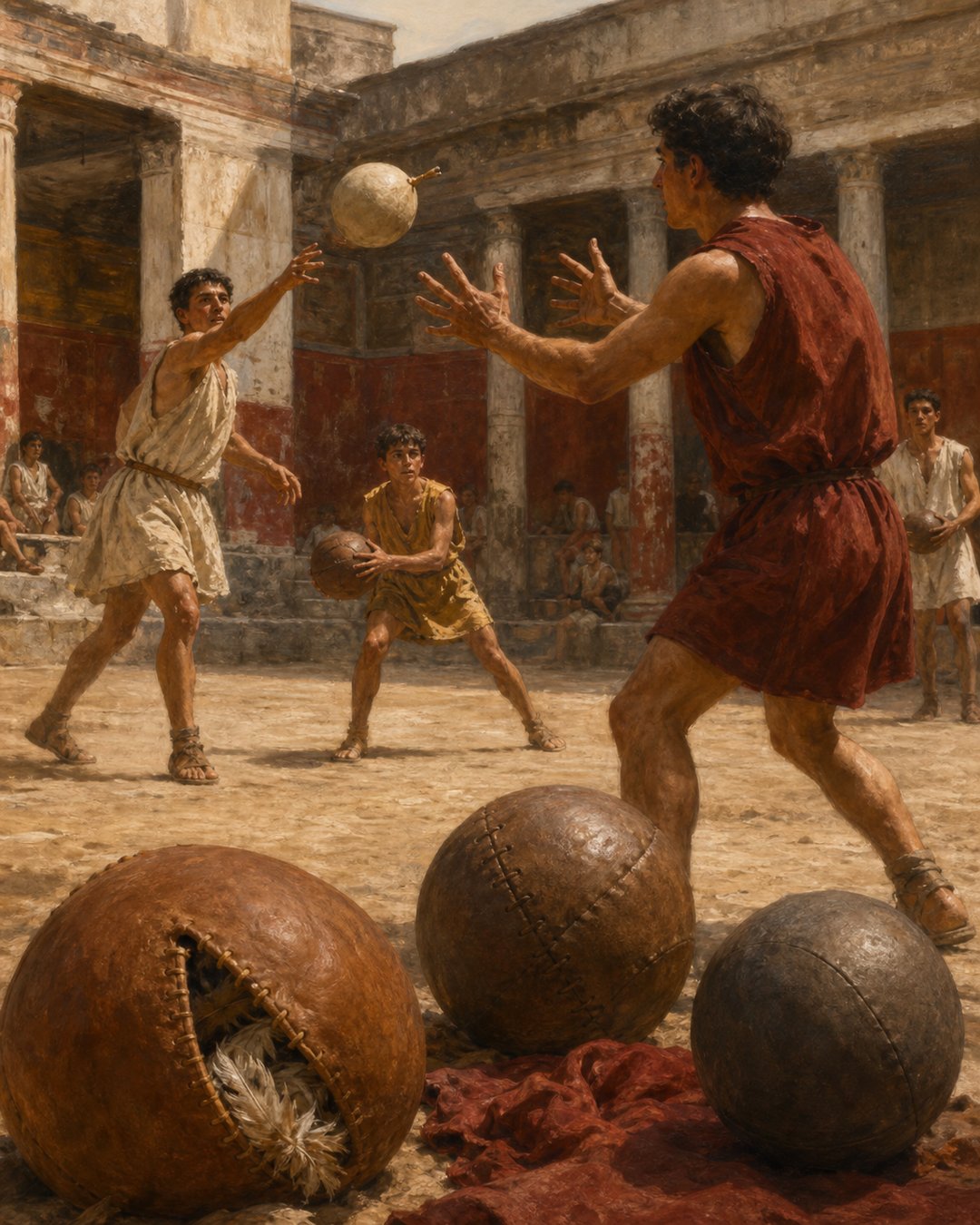
A leather ball struck a left hand and flew across a triangle before the receiver had settled his feet. Nearby, another ball moved at a gentler pace between a boy and an older man. A third kicked up dust as agile players reached and missed. To call all three simply “Roman ball games” would erase the first thing the players felt: the objects were not the same.
Martial places four ball gifts beside one another in Book 14 of his Epigrams. One is stuffed with feathers. One belongs to the rapid exchanges of the trigon. One is a bladder suited, he jokes, to boys and old men. One is a small hand-ball pursued in the dust. The sequence is short, but it shows equipment sorting bodies into different speeds, skills and settings.
A feather ball occupied the difficult middle
Book 14 is framed as a collection of presents for guests during the festive season. Martial insists that every subject can be finished in two lines. The brevity gives each object a voice like a label tied to a gift. A ball does not receive a complete rulebook. It receives one sharp characteristic that lets the reader recognize its use.
The first in the sequence is the paganica. Martial identifies it as stuffed with feathers and calls it difficult to manage. He then locates its feel between two other objects: it is not as soft as a bladder and not as hard as an ordinary ball. Material becomes the definition.
Feather filling would not have behaved like empty inflated skin or a dense solid mass, but the poem does not specify weight, diameter, seam pattern or method of manufacture. Those details remain unknown here. What survives is a relative scale that a player could understand through the hands. Softness and hardness formed endpoints; the paganica sat awkwardly between them.
That middle position explains why a single modern picture of “the Roman ball” misleads. The important variable was not decoration. It was response. A ball that yielded, a ball that resisted and a ball packed with feathers asked for different control. The object could frustrate a player before any opponent did.
The trigon tested speed from three sides
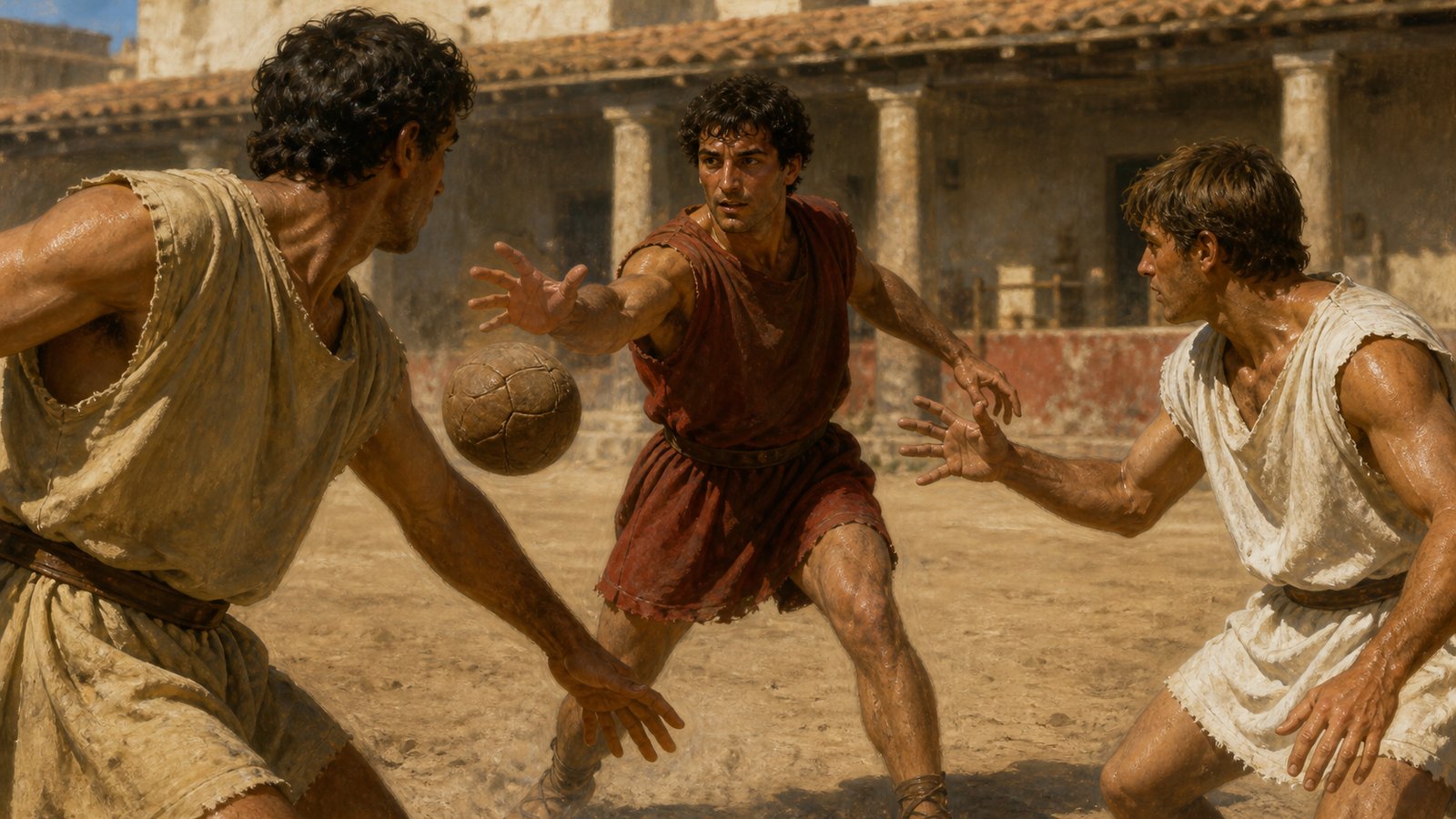
Martial’s next gift belongs to the trigon, which the translation calls the three-cornered game. The ball challenges its recipient to strike it with rapid left-hand blows. If the recipient lacks that skill, the object tells the “clown” to give it back.
The taunt supplies more than comic abuse. It identifies practiced technique as the gift’s condition of use. The left hand is named. The blows are rapid. The social geometry is compressed into the title of the game. A suitable owner does not merely possess the ball; he can keep the exchange alive.
We should not turn the couplet into a full reconstruction of scoring or court dimensions. Martial gives neither. He gives the moment at which competence becomes visible: the ball arrives quickly enough that an untrained hand exposes itself. The gift can therefore flatter a skilled recipient or embarrass an unskilled one.
The scene belongs beside other Roman games without collapsing into them. The board game of encirclement made position visible through counters trapped between enemies. The trigon made control visible through a moving object and rapid hands. Both could reveal judgment, but their material tempo was entirely different.
A bladder sorted players by age
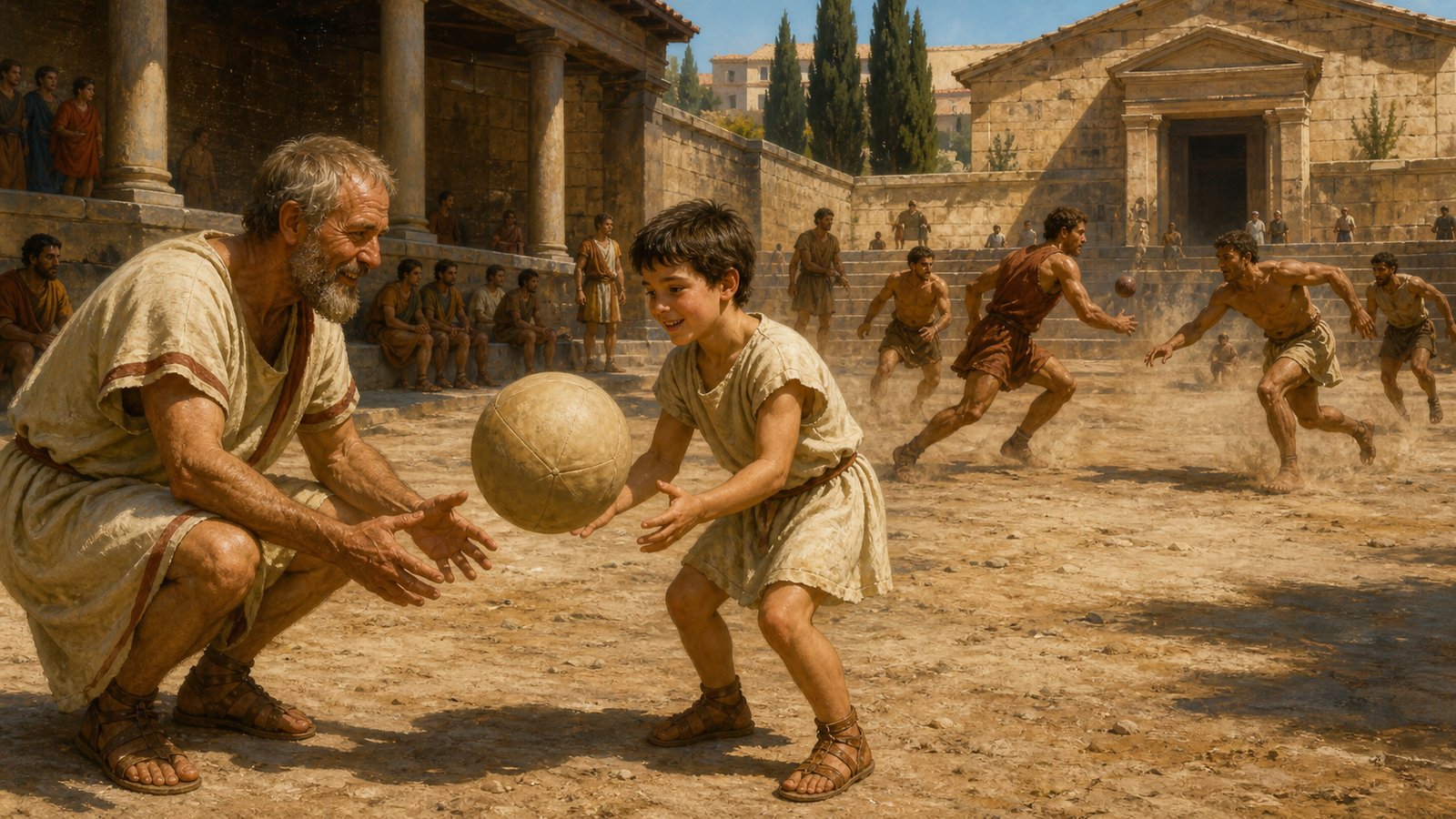
Epigram 14.47 changes pace. Its object is a bladder ball. The ball orders young men to stand back and declares itself appropriate for boys and old men. Martial’s categories are part of a joke, not a medical schedule, yet the contrast is unmistakable. The light or soft object belongs to players outside the vigorous young-adult centre.
This is the clearest point in the sequence where equipment assigns a body. The bladder is not dismissed as a failed version of the harder ball. It has its own users. Children and older men can play with it precisely because it does not demand the same encounter represented by the other gifts.
The wording also warns against translating the object too confidently into modern sport. “Football” appears in the old English heading, but Martial’s couplet does not describe eleven players, a goal, a pitch or a prohibition on hands. The secure claim is narrower: the object is a bladder used for play, and the poet contrasts its suitable ages with young men.
That narrowness produces a better image. An inflated animal bladder has an irregular organic surface, not modern stitched panels. Its movement need not be perfectly true. A boy and an older man can share the space without pretending they are taking part in a recognizable modern match. The ancient joke rests on age and softness, not on a modern code of rules.
The dusty hand-ball raced the bath bell
The fourth gift is the harpasta, a small hand-ball. Martial places an agile young player in the dust of Antaeus, the language of an exercise or wrestling ground. The player stretches his neck and still fails to make the catch. Dust, speed and a missed reach give this couplet more motion than the bladder ball receives.
Another gift much later in Book 14 places ball play inside a daily timetable. The warm baths’ bell is ringing, but the player continues. If he refuses to stop, the poem warns, he will be left with a cold bath before going home. Exercise has run into bathing time.
The bell makes the game part of an urban routine rather than an isolated spectacle. Play raises dust and heat; bathing follows. The player who cannot leave the ball risks missing the desired temperature. The connection helps explain why accounts of Roman bathing as a social practice cannot begin only at the water’s edge. The exercise ground and its equipment shaped who arrived, when they arrived and in what state.
Martial never says that every ball was used at every bath complex, and he does not merge the four named objects into one game. His arrangement does the opposite. The feather-stuffed paganica is measured by hardness. The trigon ball is measured by rapid skill. The bladder is assigned by age. The harpastum is measured by pursuit, dust and failed catches.
Those distinctions are the payoff of reading the gifts as a sequence. Roman play was not an empty category waiting for modern rules to fill it. It began with crafted or inflated material. Feathers, skin, density and size changed the possible movement. A player selected—or was selected by—the object.
The gift-book setting adds another layer. These balls could circulate as presents, and the couplets imagine recipients who would immediately grasp the teasing labels. The paganica’s owner knows what “between bladder and ordinary ball” feels like. The trigon recipient can be challenged on his left-hand skill. The bladder ball can joke about age because the audience recognizes a difference in exertion. Martial’s comedy assumes shared practical knowledge rather than pausing to teach every rule.
It also lets the objects judge their owners. The trigon ball can reject a clumsy man. The bladder can dismiss vigorous youths. The bath-bell poem catches a player who cannot stop. Possession does not guarantee competence or moderation. A small piece of equipment becomes a test of dexterity, age, timing and self-control.
The shortest poem can preserve the instant before play starts. The recipient lifts the gift and tests its resistance. Is it soft enough for a child, awkward enough to challenge the hand, firm enough for rapid exchange, or small enough to vanish into dust and reaching bodies? Before anyone kept score, the ball had already divided the field.
Sources
Martial, Epigrams, 14.1, 14.45–48, 14.163