
Two enormous wooden theatres stood close together in Rome, but their audiences initially faced away from one another. Morning plays ran at the same time, the opposite orientation keeping one cast from drowning out the words of the other. Then the buildings moved.
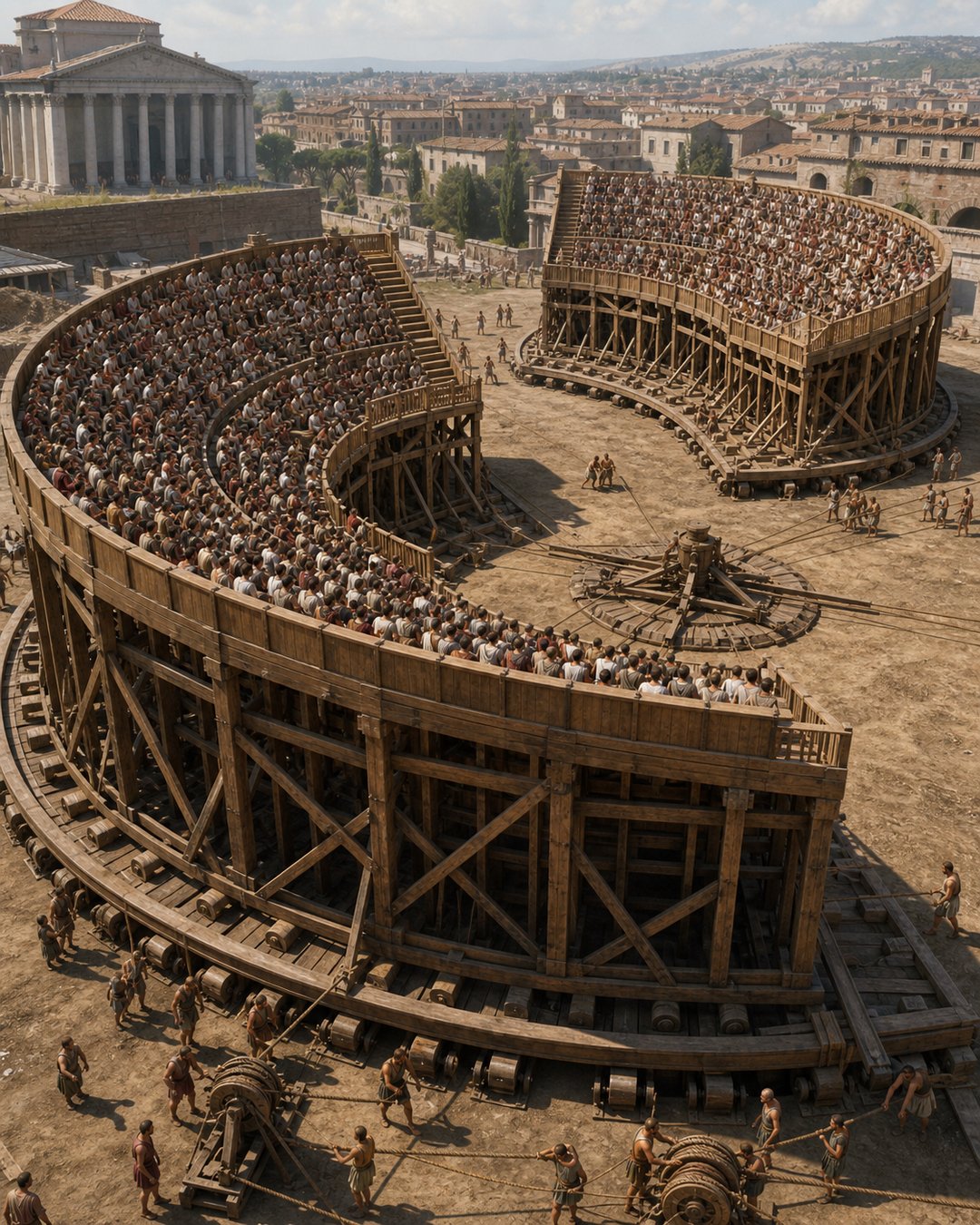
Each semicircular theatre balanced on a pivot. The structures revolved until their corners met and produced an amphitheatre for gladiatorial contests. Pliny the Elder adds the detail that made the device unforgettable: after the first few days, some spectators reportedly remained in their seats while the auditoriums turned beneath them.
Pliny did not preserve a technical drawing, so the exact bearings, labor and power system must remain unknown. He preserved something different: a political reading of moving architecture. Curio could not defeat an earlier sponsor through imported luxury, so he made transformation itself the attraction and asked a Roman crowd to stake its safety on the performance.
Opposite-Facing Stages Solved the Morning Problem
Curio’s entertainment honored his dead father. Funeral games gave the occasion a family frame, but Pliny reads the project through public rivalry. Marcus Scaurus had previously assembled a temporary theatre of such extravagant decoration that another sponsor could scarcely hope to surpass it by spending on the same terms.
The contrast with Scaurus’s month of marble, glass and gilded wood establishes Curio’s problem. Ornament had reached a level that made imitation look secondary. Curio needed a different currency of magnificence. Pliny says he therefore used ingenuity and devised a fantasy in wood.
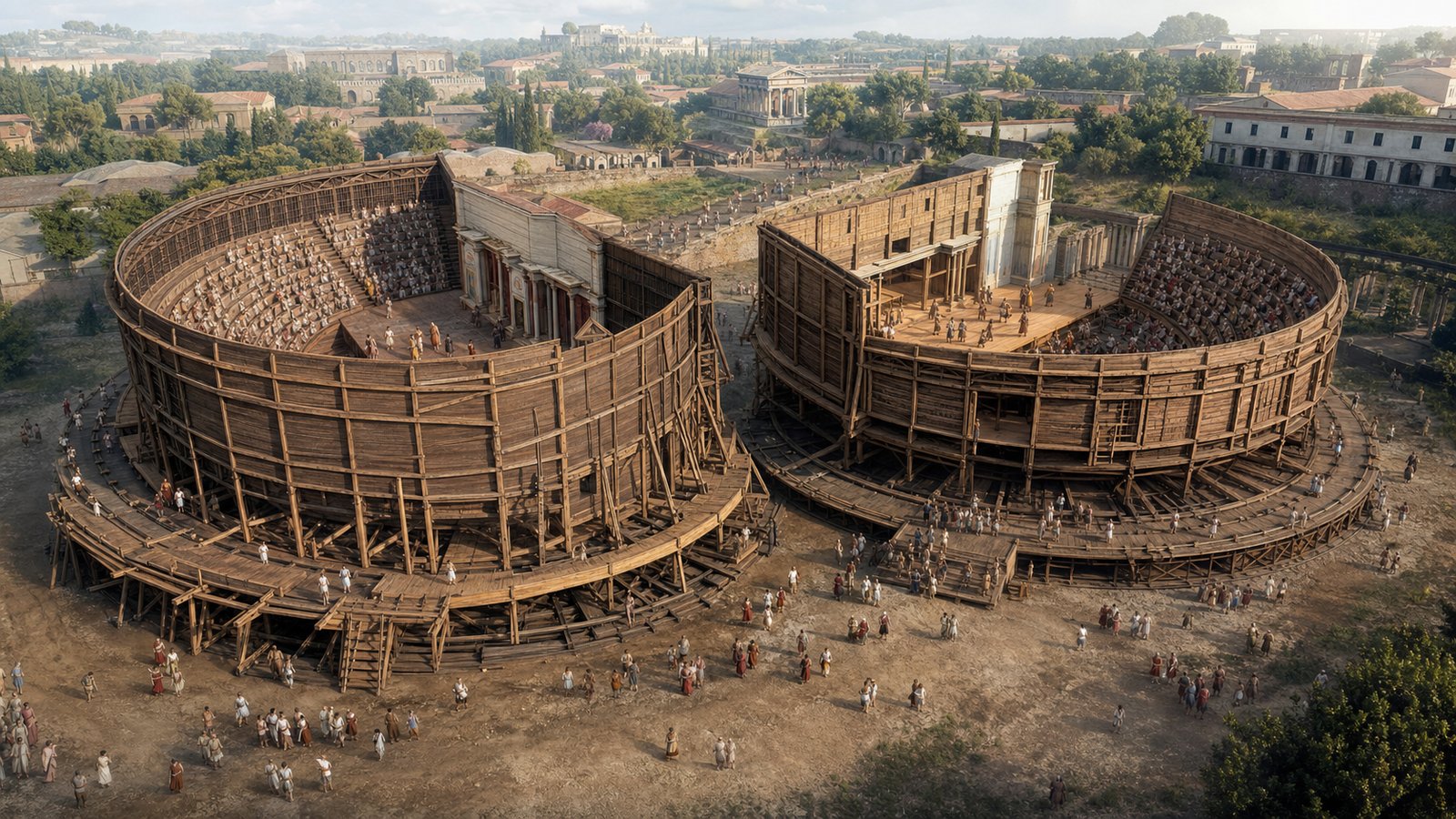
The paired theatres first behaved as theatres. They were very large, close together and mounted on pivots, but their morning position was practical. Both faced outward in opposite directions. Two casts could speak at once without each performance overwhelming the other acoustically.
This detail prevents the device from becoming a simple rotating novelty. Orientation organized sound. Each half created a focused relationship among stage, performers and audience. The wooden mass had to support ordinary theatrical attention before movement gave it a second identity.
Pliny does not identify the plays, count the spectators or explain how workers coordinated two performances. He is more interested in the reversal that followed. Yet the morning arrangement reveals the logic of the whole design: separation was not a flaw waiting to be corrected. It was the first useful state of a building meant to change programs during the day.
Two Pivots Turned Separate Theatres into One Arena
At the chosen moment, both structures revolved. Their corners met, closing the relationship between two semicircular seating forms and producing an amphitheatre. The audience’s attention, previously divided between separate dramas, now converged on contests inside a shared arena.
The mechanism is tantalizing because Pliny offers only its governing principle. Each theatre was poised and balanced on a revolving pivot. He does not say whether people, capstans, animals or another system supplied the force. He does not describe rails, rollers or foundations. Any confident reconstruction of those components would go beyond the source.
Balance, however, is explicit. A large wooden auditorium could rotate only because its weight had been organized around the point of movement. The device did not erase mass. It arranged mass so that a structure capable of holding a crowd could change direction without being dismantled and rebuilt.
Pliny says that after the first few days some spectators remained seated during the turn. The sequence implies an escalation. Rotation may initially have happened with seats emptied; then the moving audience became part of what the occasion offered. Engineering demonstration shifted toward bodily experience.
Once the corners met, gladiators entered the combined venue. This was not merely a scenic change behind stationary seats. The social geometry altered. Separate audiences became one surrounding crowd, while theatrical speech gave way to combat. Curio’s building compressed two venue types and two kinds of spectatorship into a single day.
Pliny Made the Swaying Crowd the Real Spectacle
Pliny responds with outrage shaped as admiration. What deserves greater astonishment, he asks: inventor or invention, designer or sponsor, daring to plan the work or daring to commission it? His questions pile roles together because the object seems to exceed normal responsibility. Everyone involved has crossed a boundary.
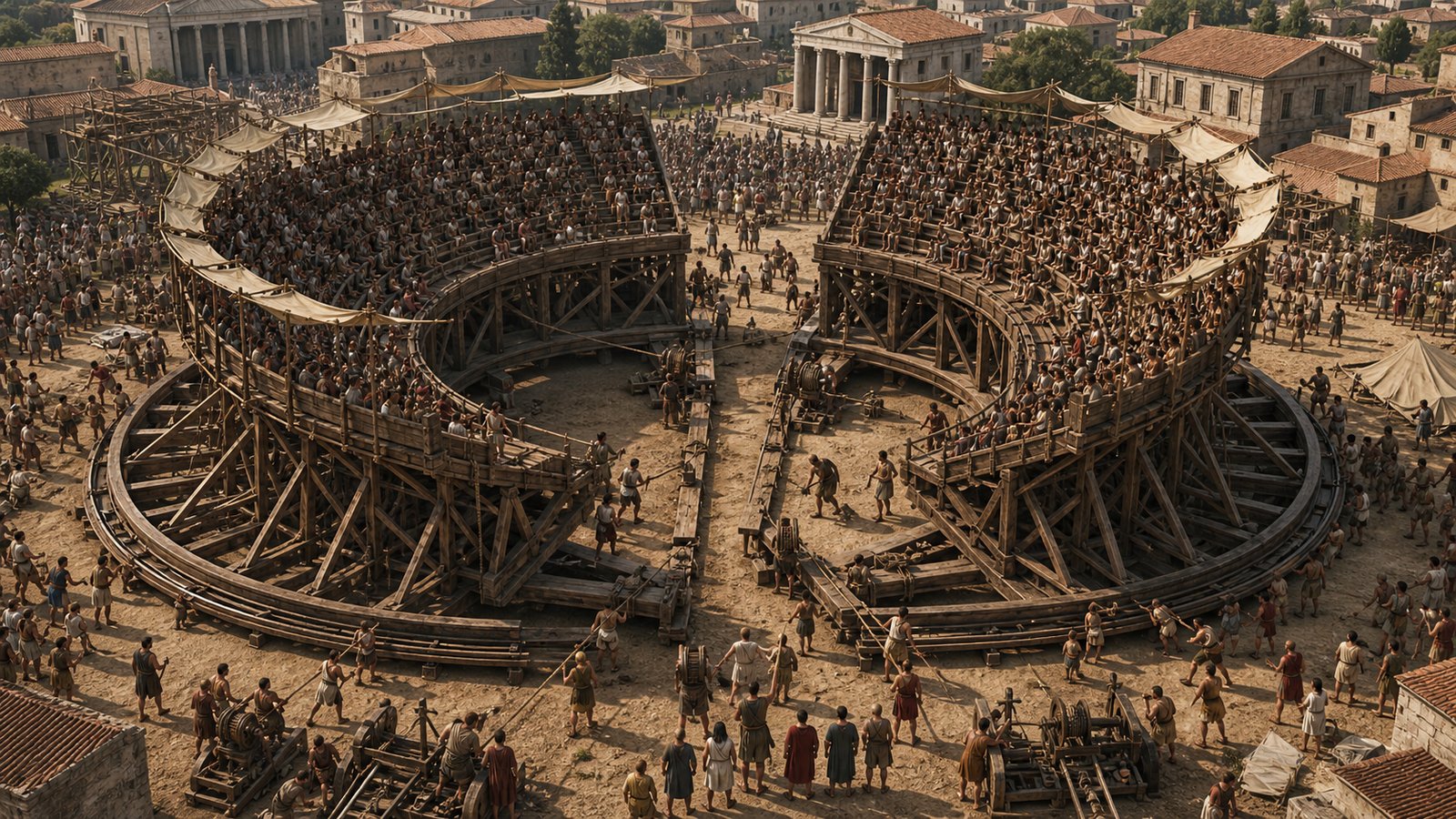
The crowd crosses it too. Pliny calls the seating treacherous and rickety, then contrasts that vulnerability with Roman power. The same people who ruled territories and issued commands abroad sat swaying on a contraption at home, applauding their own exposure to danger.
His most vivid comparison turns the theatres into two frail boats. The Roman people rode on a pair of pivots, at risk if the framework slipped out of place. The gladiators occupied the official arena, but Pliny insists that the larger gamble surrounded them in the seats.
This inversion changes what counted as entertainment. Spectators usually consumed a staged danger assigned to performers. Curio’s rotation made their own security contingent on timber, balance and trust. They could feel the building move, watch the opposite auditorium approach and know that the spectacle worked only while the mechanism held.
The account should not be converted into evidence that the theatres actually collapsed; Pliny records no catastrophe. His argument depends on what could have happened. Possibility enlarged Curio’s achievement and supplied Pliny’s moral indictment. The crowd applauded not after surviving a failure but while participating in risk deliberately built into the event.
Roman venues already arranged status through seats, entrances and lines of sight. amphitheatre seating made hierarchy visible; Curio’s machine added motion to that ordering. Everyone aboard shared structural dependence even if their places in the crowd remained unequal.
Moving Timber Became Political Persuasion
Pliny finally connects the venue to Curio’s career. The spectacle, he says, sought favor for speeches Curio would make as tribune in 50 BC. The physical swaying of spectators becomes a metaphor for voters a speaker hoped to move from the platform.
The connection is Pliny’s moral interpretation, not a transcript of Curio explaining his plan. Yet funeral entertainment, public generosity and future political visibility belonged in the same arena of reputation. Curio gave the people an experience no rival could easily reproduce. The memory of being carried around on the machine traveled with his name.
Wear eventually imposed a limit. Pliny says the pivots became worn and displaced. Curio then retained the amphitheatre configuration rather than continue the same rotation. The adjustment matters because it shows a mechanism with a service life, not magic wood moving forever without consequence.
On the final day, the two stages stood back to back across the middle of the arena for athletic displays. The platforms were then removed, and gladiators who had won earlier contests appeared. Even after rotation stopped, transformation continued through removable interior elements and a sequence of changing performances.
Curio’s achievement therefore lay less in inventing one permanent building type than in controlling transitions. Opposite theatres separated sound. Rotation joined crowds. A combined arena staged combat. Back-to-back platforms divided space again, then disappeared. Architecture became an event schedule executed in timber.
Pliny’s hostility preserves the project with unusual force. He wanted readers to see waste, danger and political manipulation, but those criticisms also reveal why the design worked as spectacle. Curio could not outshine Scaurus by adding more decoration. He made the audience feel the building change beneath it.
The two pivots carried more than wood. They carried a crowd from drama to combat, from observer to participant and from funeral honor to political memory. In Pliny’s telling, the Roman people applauded Curio’s machine because for one alarming moment they were not simply watching the performance. They were inside its moving part.
Sources
Pliny the Elder, Natural History, 36.116–120.