
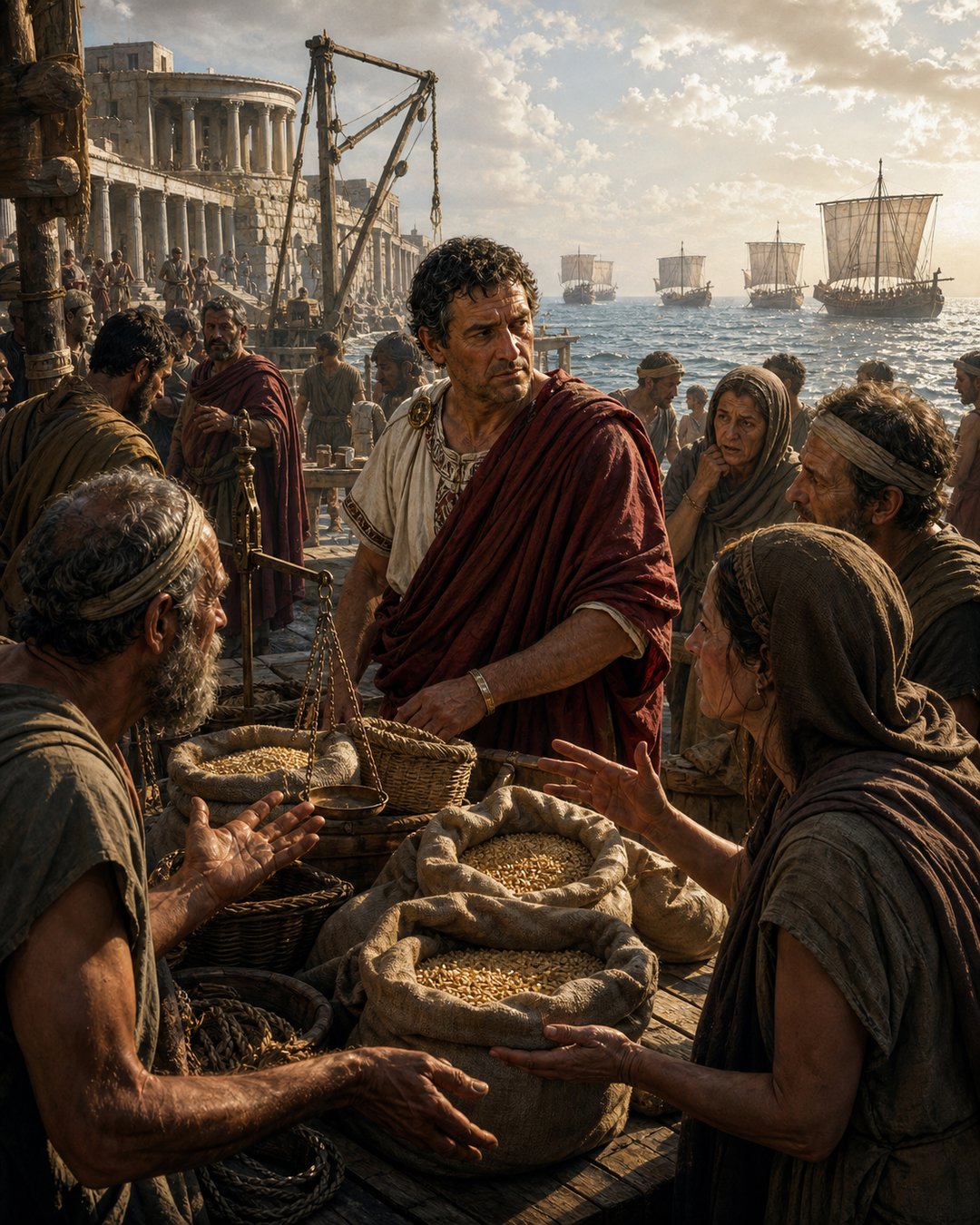
A cargo of grain reaches Rhodes while food is scarce and prices are extreme. Its merchant has come from Alexandria, but his advantage is not merely that he arrived first. During the crossing he saw several other grain ships following the same route. The buyers on the quay do not yet know that relief is already at sea.
Cicero asked what an honest seller should do with that knowledge. He could announce the approaching vessels, changing what the Rhodians were willing to pay for his cargo. Or he could remain silent, make no false claim, and sell at the highest price the shortage allowed.
The problem turns a horizon full of sails into market information. Grain feeds the city, yet news of grain determines the price before the later sacks touch land. Cicero used the scene to ask whether honesty stops at truthful words or reaches the profitable fact a seller chooses not to say.
The First Cargo Carried Two Different Advantages
Cicero located the exercise at Rhodes in a time of dearth and famine. Provisions had reached what his account calls fabulous prices. Into that market came an upright merchant with a large Alexandrian cargo, precisely the stock that anxious buyers needed.
Arrival gave him a normal commercial advantage. He had bought, shipped and brought grain to port while scarcity made it valuable. Nothing in the problem says that his cargo was defective, his measures false or his ownership doubtful. He had real goods ready for sale.
Knowledge gave him a second advantage of another kind. He knew that several other importers had left Alexandria. More importantly, he had seen their laden vessels while at sea. This was not a rumor about a distant harvest. Competing supply was physically following him toward the same buyers.
That distinction separates the case from the stone tariff examined in Palmyra’s bilingual customs schedule. A published tariff made charges legible to people moving goods through a city. Cicero’s merchant possessed private news that could alter an entire market before anyone else on the quay could verify it.
The price therefore depended on two clocks. One measured the present shortage; the other measured the interval before the next sails arrived. The merchant could profit from the first only because buyers could not yet see the second.
Antipater Made the Buyer’s Ignorance the Seller’s Duty
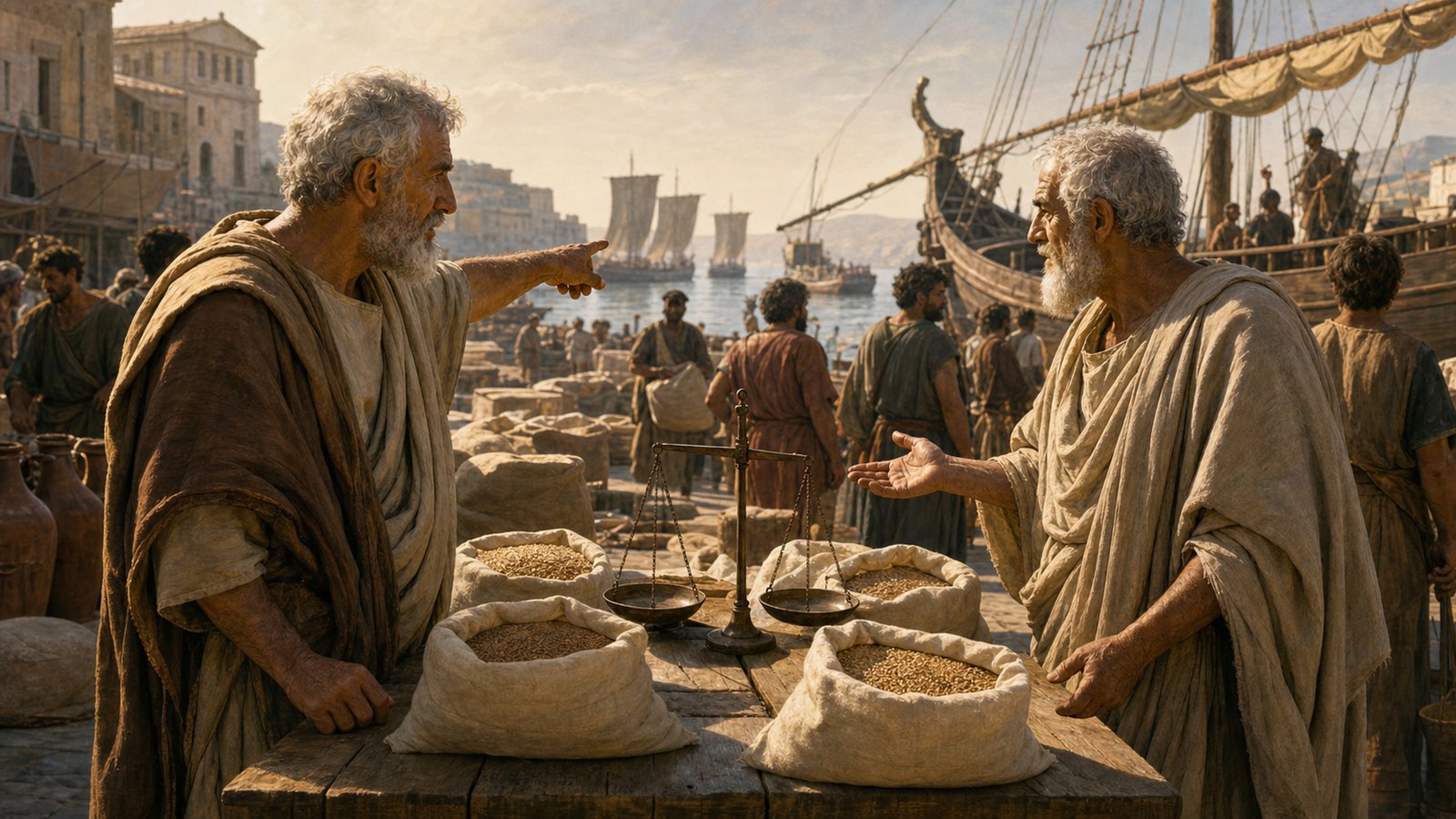
Cicero assigned the demand for disclosure to Antipater, the pupil in his debate. Antipater argued that the buyer should not remain uninformed about anything the seller knew. In the Rhodian case, that meant telling the crowd that several more grain cargoes were close behind.
His argument was wider than a rule for honest weights or sound merchandise. He appealed to fellowship among human beings and to the seller’s place inside a shared society. A transaction could not be judged as though the merchant and the hungry buyers had no obligations beyond the exchange of coins and sacks.
The approaching ships were “relief” in Antipater’s reasoning. That word changes the moral scale of the undisclosed fact. The seller was not guarding a private preference or a harmless trading trick. He knew that more food was coming to people who were pricing his stock under the pressure of famine.
Disclosure did not require him to surrender the cargo. Nor did Antipater say that every private possession must become common. The immediate requirement was that buyers should judge the offer with the same decisive fact the seller already held: today’s apparent scarcity would soon be less severe.
Roman readers could recognize how concrete prices shaped behavior from cases such as the thirty-sesterce peach preserved for two days. Cicero’s thought experiment presses in the opposite direction. Instead of a luxury buyer displaying what he would pay, a necessary food market tests what a seller may withhold.
Diogenes Drew the Boundary at Misrepresentation
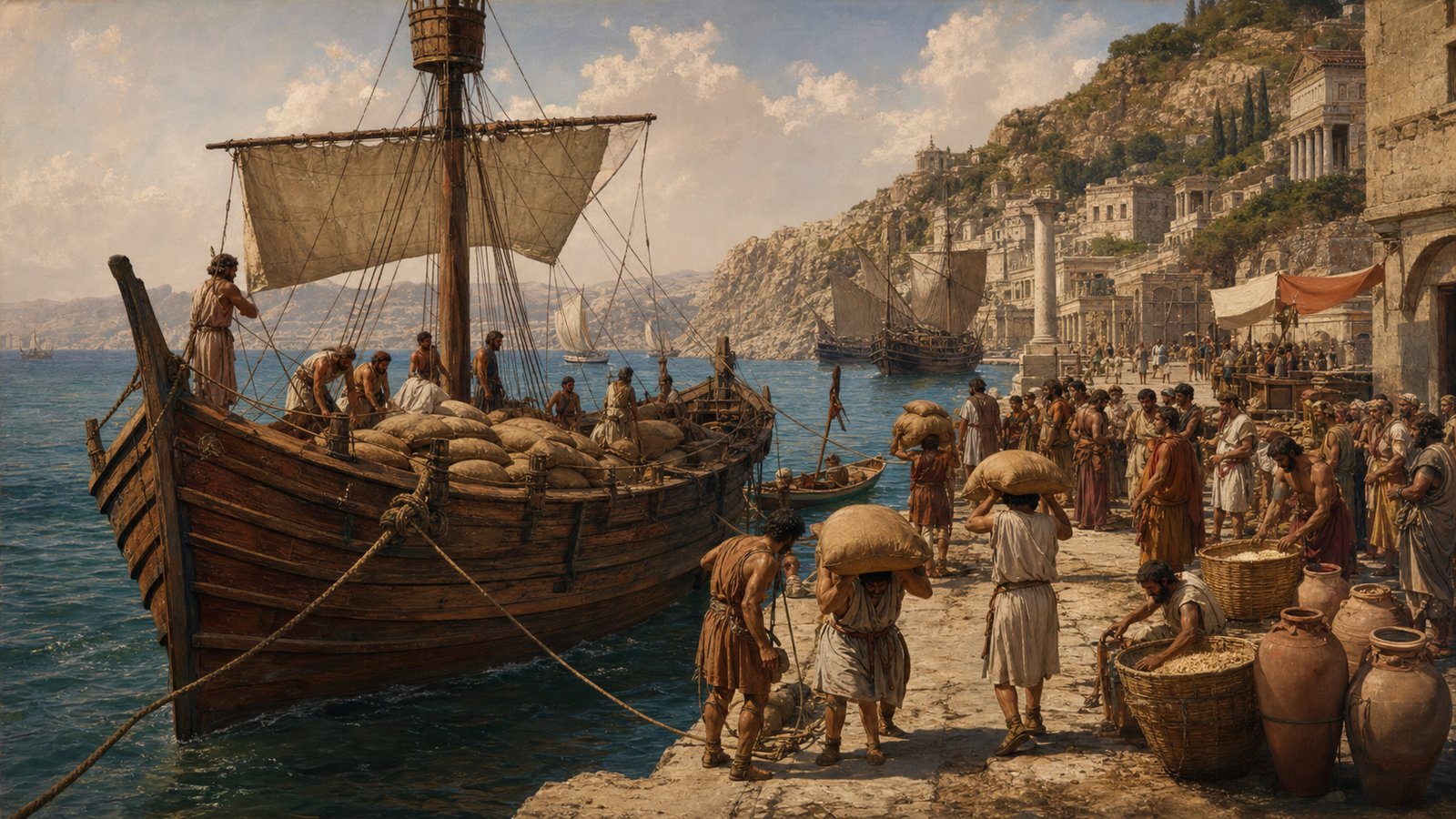
Diogenes of Babylonia defended a narrower obligation. The seller had to declare defects when the law required it and could not misrepresent his wares. Beyond that boundary, he could seek the best available price for goods he legitimately offered.
His imagined merchant had a straightforward answer. The grain was his, it was openly for sale, and he was not charging more than competitors in the same market. If a later oversupply drove prices down, that did not make the present offer fraudulent. No false statement had forced anyone to buy.
Diogenes also separated concealment from non-disclosure. A person does not reveal every useful truth to everyone else at every moment. Failing to volunteer a fact was not automatically the same act as hiding it through deception.
The defense protected the possibility of private property and exchange. If fellowship meant that every advantage had to be surrendered, Diogenes argued, sale itself would collapse into universal gift-giving. A merchant would no longer be allowed to benefit from timing, judgment or information gathered during his own voyage.
This side of the debate makes the case difficult. Cicero did not build it around a villain mixing bad grain into good or tampering with a scale. He made the seller honest and the silence plausible. The dispute begins only after obvious fraud has been removed.
Cicero Treated Silence as an Action When It Controlled the Price
Cicero did not leave the two positions balanced. After pairing the grain sale with another case about undisclosed faults in a house, he ruled that the dealer should not keep the news from the Rhodians.
His explanation focused on purpose. Mere quiet was not always concealment. Concealment arose when someone sought personal profit by preventing others from learning something he knew and that they had an interest in knowing. Intention, advantage and the buyer’s need for the fact had to be read together.
In Rhodes, the merchant’s silence preserved a false picture without requiring him to speak a false sentence. Buyers could see one cargo and infer that supply remained desperately small. He knew the inference would soon be overturned by ships already on the route. Keeping that correction private allowed him to convert their ignorance into a higher price.
The mechanism resembles neither a customs fee nor the cultivation behind Sergius Orata’s oyster reputation. Those stories concern institutions or products that helped assign value. Here value moved because one participant held a time-sensitive fact about supply.
Cicero’s verdict also explains why the distant sails matter more than scenic detail. They make the seller’s knowledge unusually firm. He has not guessed that other merchants may arrive eventually; he has seen laden vessels bound for Rhodes. His silence is attached to evidence gathered with his own eyes.
The thought experiment leaves the cargo on the quay and asks the reader to price the unseen fleet. If the merchant speaks, buyers learn that abundance is approaching before they commit. If he does not, he sells grain at a scarcity price supported by information he knows is incomplete. For Cicero, an honest market could not be built from accurate statements alone when deliberate silence did the profitable work of a lie.
Sources
Cicero, On Duties 3.50–57.