
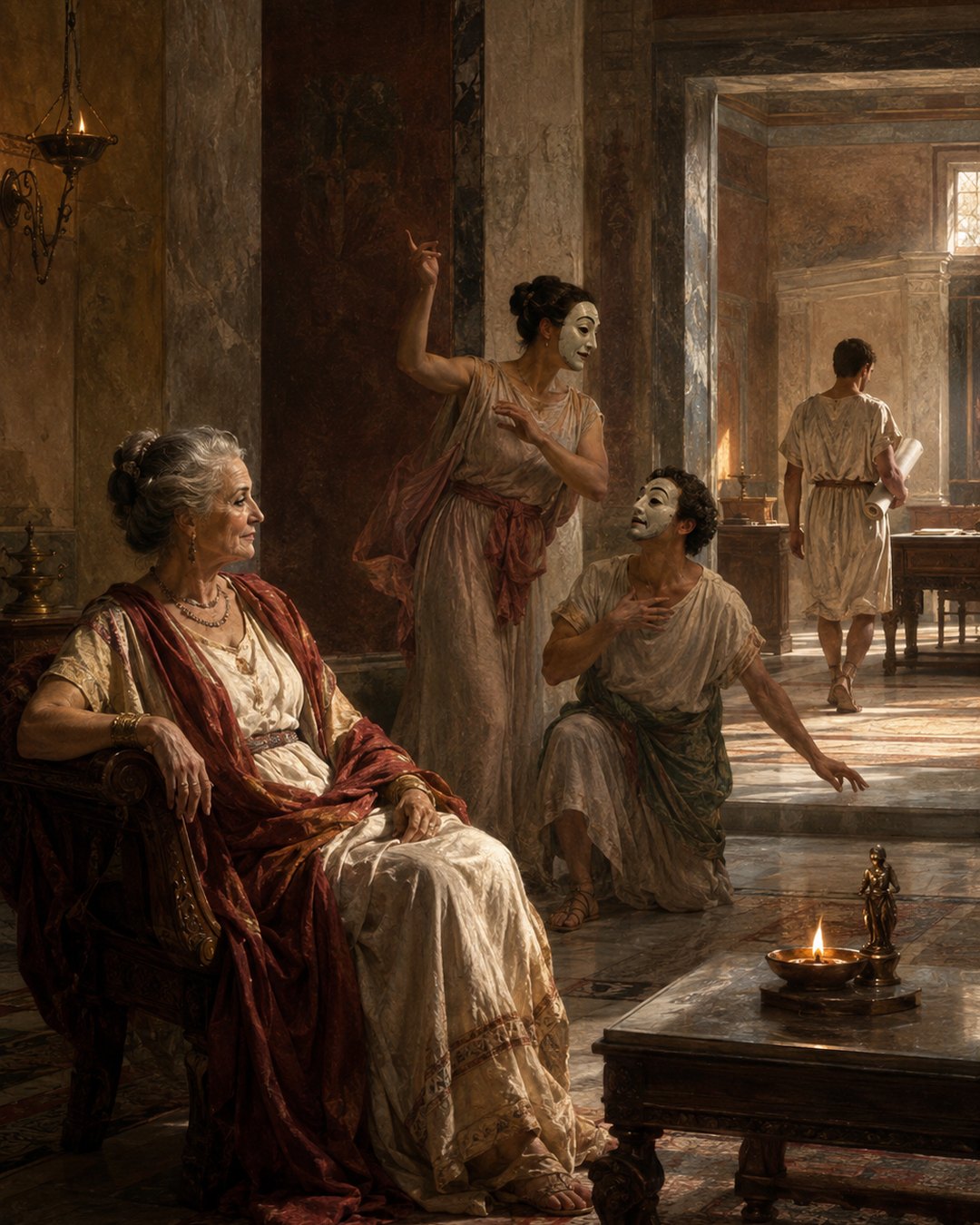
Ummidia Quadratilla’s house could hold a troupe of pantomime performers and a young man who never watched them. She favored the dancers extravagantly. Her grandson Quadratus lived under the same roof through boyhood and youth, yet Pliny the Younger says he avoided their performances both at home and in the theatre.
The separation was not a rebellion staged by the grandson against his grandmother. Quadratilla maintained it herself. Whenever she planned to play draughts or watch her troupe, she urged him to go away and study. Entertainment and education occupied one household without being allowed to become the same inheritance.
Only at the Sacerdotal Games did the adult Quadratus tell Pliny that he had seen his grandmother’s freedmen dance for the first time. By then he had married, built a reputation free from scandal and stood ready to receive most of her estate. The troupe had remained close enough to display her wealth but outside the education of the person who would carry the house forward.
An Heir Grew Up Beside a Taste He Did Not Share
Pliny wrote after Quadratilla died shortly before her eightieth year. Until her final illness, he says, she had been unusually robust. The obituary begins with a formidable body and quickly moves to a will that arranged the future of her property: two-thirds to her grandson and one-third to her granddaughter.
His attention is uneven. Pliny admits that he hardly knew the granddaughter. He knew the grandson closely and wanted his correspondent to admire him. The letter is therefore not a neutral inventory of every person in the household. It is a portrait composed around the heir Pliny considered worthy.
That bias matters because Quadratilla’s pleasures enter the story as a moral test. She liked draughts and kept pantomime performers, showing them a degree of favor that Pliny thought improper for a woman of her standing. Quadratus, by contrast, passed through youth without scandal in his friend’s account. He married in his twenty-fourth year and lived amid luxury without adopting what Pliny treated as excess.
The arrangement resembles neither isolation nor simple imitation. Like Calpurnia listening behind a curtain, members of an elite household could be physically close to a performance while social rules controlled how they participated. In Quadratilla’s house, the significant line was not a wall that kept sound out. It was permission to leave.
Draughts and Dance Triggered the Same Instruction
Quadratilla’s own explanation gives the boundary a repeated action. When she wanted to amuse herself with a board game or with the troupe, she told her grandson to withdraw and study. Two different pleasures produced one educational command.
This detail prevents the dancers from carrying the whole moral burden. Draughts needed no stage, costumes or applause, yet Quadratilla grouped the game with the performance as leisure from which the student should be excused. The contrast Pliny emphasizes is broader: her chosen recreation against the concentrated work expected from an ambitious young man.
She apparently did not demand that Quadratus validate her taste by joining it. Pliny says she never required his attendance, even though obedience to an elder and benefactor might easily have made refusal awkward. Her authority over the house created the entertainment and also protected the route away from it.
Pliny speculates about motive. He thinks love for her grandson moved her, but also shame at being seen in these amusements. We cannot know the proportions. What the letter actually preserves is a habit of separation. Quadratilla could indulge herself, recognize that her heir should be formed differently and make both choices effective under her roof.
The First Performance Arrived in Public, Not at Home
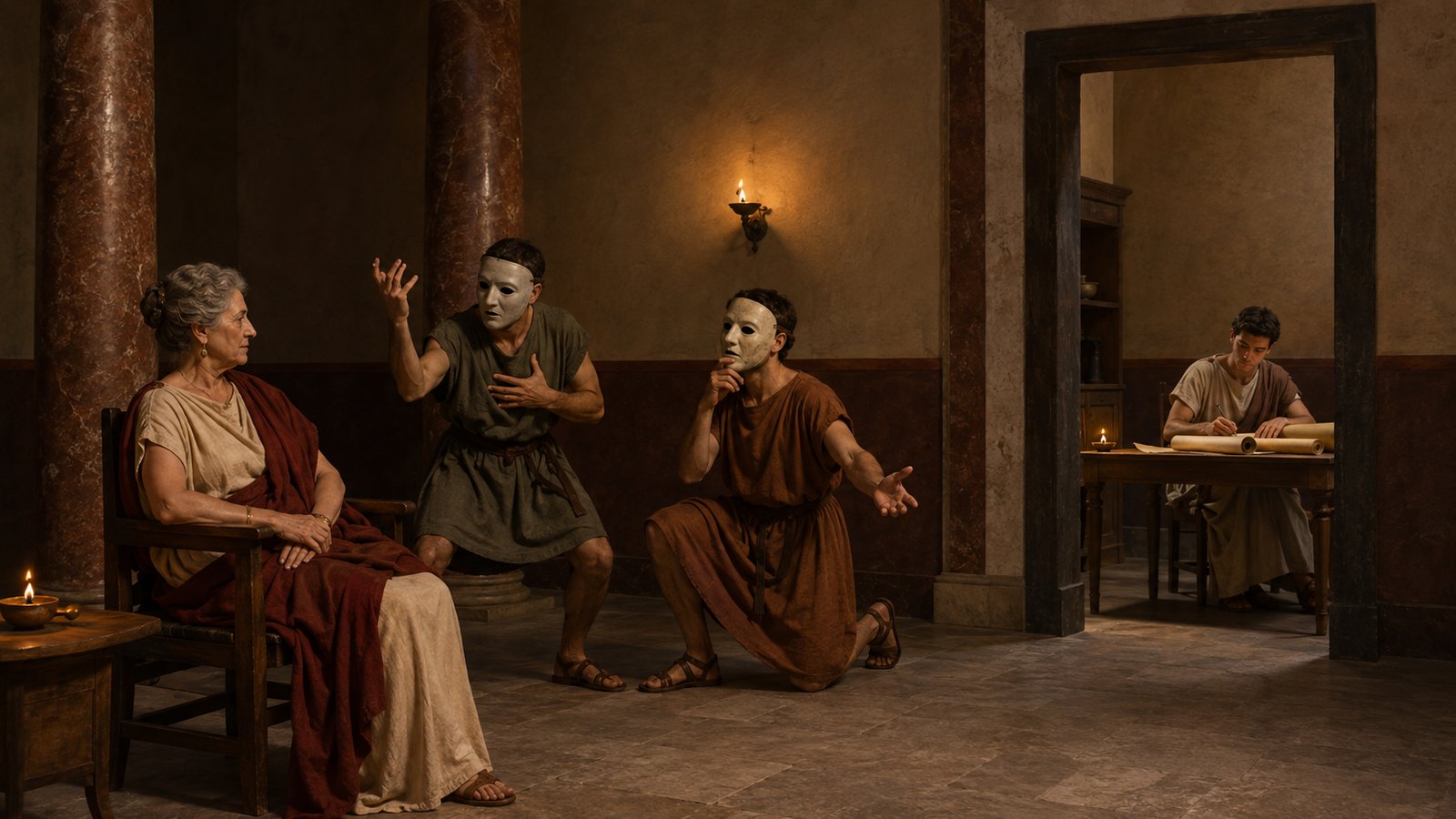
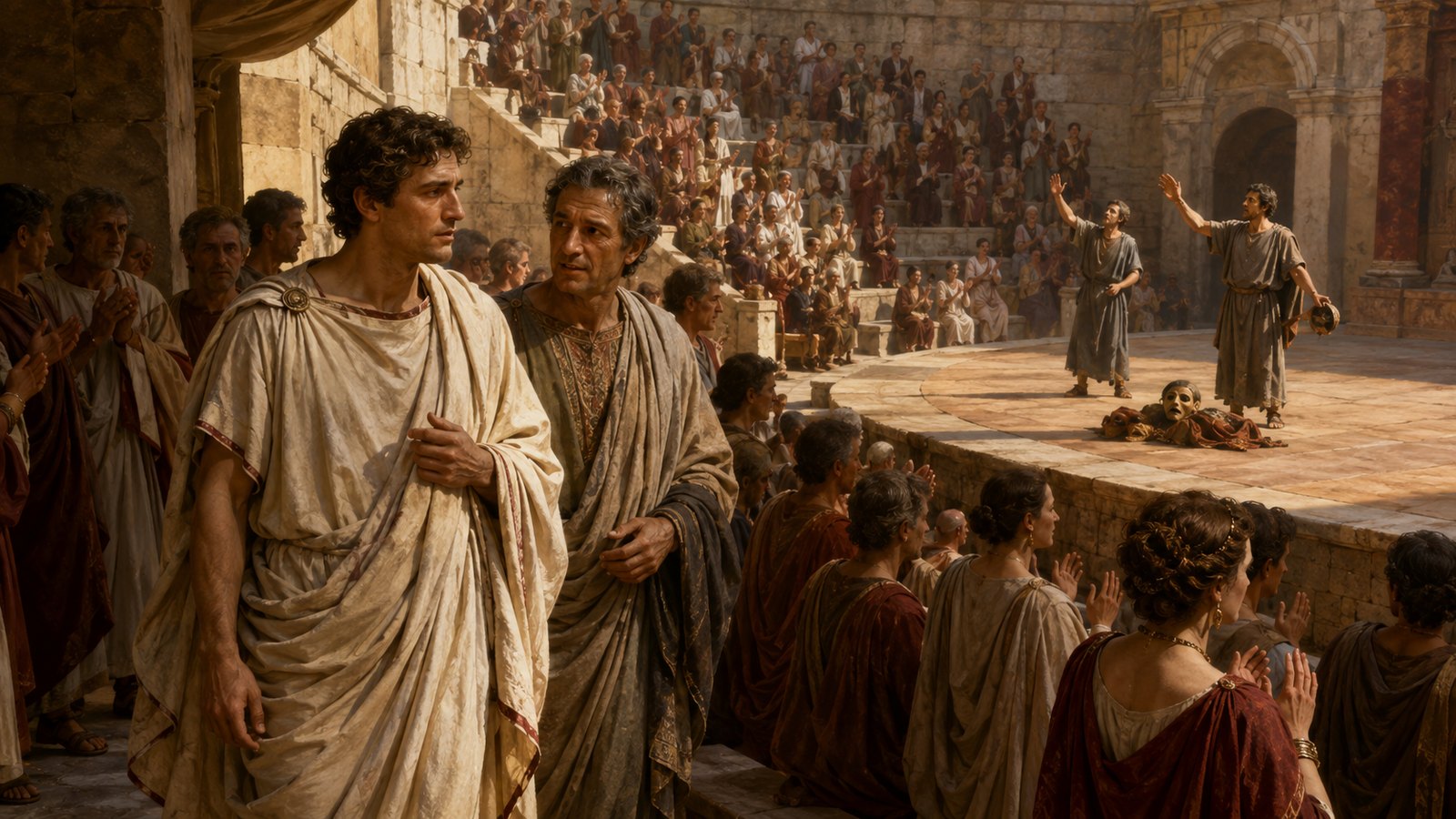
The boundary became visible at the Sacerdotal Games. Quadratilla’s troupe appeared on a public stage. As Quadratus and Pliny left the theatre, the grandson remarked that this was the first time he had seen his grandmother’s freedmen dance.
The comment is precise. It does not mean Quadratus had never encountered any performance, nor that performers had been absent from his household. The novelty lay in seeing this particular group—the people attached to his grandmother—carry out the work for which she maintained them.
Pantomime concentrated story in bodily movement, a division of expressive labor that gives the episode a different angle from Livius Andronicus separating song from gesture. Pliny barely describes the art itself. His concern is who watched, why they watched and what their applause revealed about relations around a wealthy patron.
The theatre loosened a household prohibition without erasing its history. Quadratus could now see the dancers as an adult spectator leaving beside a respected friend. The performance no longer competed with the course of study his grandmother had protected during youth. A form of entertainment kept outside his education could enter his experience after that education had shaped him.
Applause Became a Claim on the Estate
Other men attended for a different reason. They were not related to Quadratilla, yet they hurried into the theatre, clapped, praised and even copied her characteristic gestures with scraps of song. Pliny first describes their behavior as honor, then retracts the flattering word and names flattery instead.
The performers belonged to Quadratilla’s household as freedmen. The applauding outsiders belonged to the orbit created by her wealth. Both groups could hope that visible devotion to her taste would matter when property changed hands. Public enthusiasm thus carried a private expectation.
Pliny answers that expectation with the will. He predicts that the heir who had never watched their conduct would give them only a trifling legacy for their buffoonery. His phrasing is hostile, but its structure is revealing. Performance, applause and imitation had tried to create proximity to the patron. The testament ranked that proximity below descent and the qualities Pliny attributed to Quadratus.
This does not mean the troupe was economically irrelevant. Keeping performers, placing them on a festival stage and attracting an audience all made Quadratilla’s resources visible. The same pattern of entertainment as social accounting appears in Pliny’s inventory of a missed dinner, where food and performers measured what an absent guest had declined. In both letters, amusement exposed obligations surrounding an elite host.
The House Inherited a Public Future
Pliny closes by giving the building its own ancestry. The house had once belonged to Gaius Cassius, whom he identifies as founder and leading figure of the Cassian school of jurists. Quadratilla’s grandson would now govern it. For Pliny, property transmitted not only rooms and income but a stage on which professional reputation could become visible.
He imagines Quadratus leaving its doors each day as a distinguished orator, matching the legal fame Cassius had once brought to the address. This is praise written by a friend, not proof of everything the heir later achieved. Still, it shows what Pliny believed a successful succession should do: place an educated man in a famous house and make the threshold advertise continuity.
Quadratilla’s role in that outcome is more substantial than Pliny’s disapproval of her pleasures first suggests. She housed the grandson, respected his refusal to watch her performers, sent him to study when she relaxed and assigned him the largest share of her property. The very woman presented as indulgent helped construct the disciplined contrast for which he was praised.
The performers therefore stopped at the study door in two senses. They did not enter the grandson’s education, and devotion to them did not determine the main inheritance. Quadratilla allowed entertainment to flourish without letting it choose the household’s successor.
Pliny turned that arrangement into a moral sorting machine: matron from heir, kin from flatterer, study from leisure and inherited house from temporary spectacle. His categories should not be mistaken for an impartial verdict on pantomime or on an elderly woman’s enjoyment. The stronger evidence is the boundary itself. One roof accommodated conflicting tastes because its owner repeatedly decided where each would end.
Sources
Pliny the Younger, Letters 7.24.