
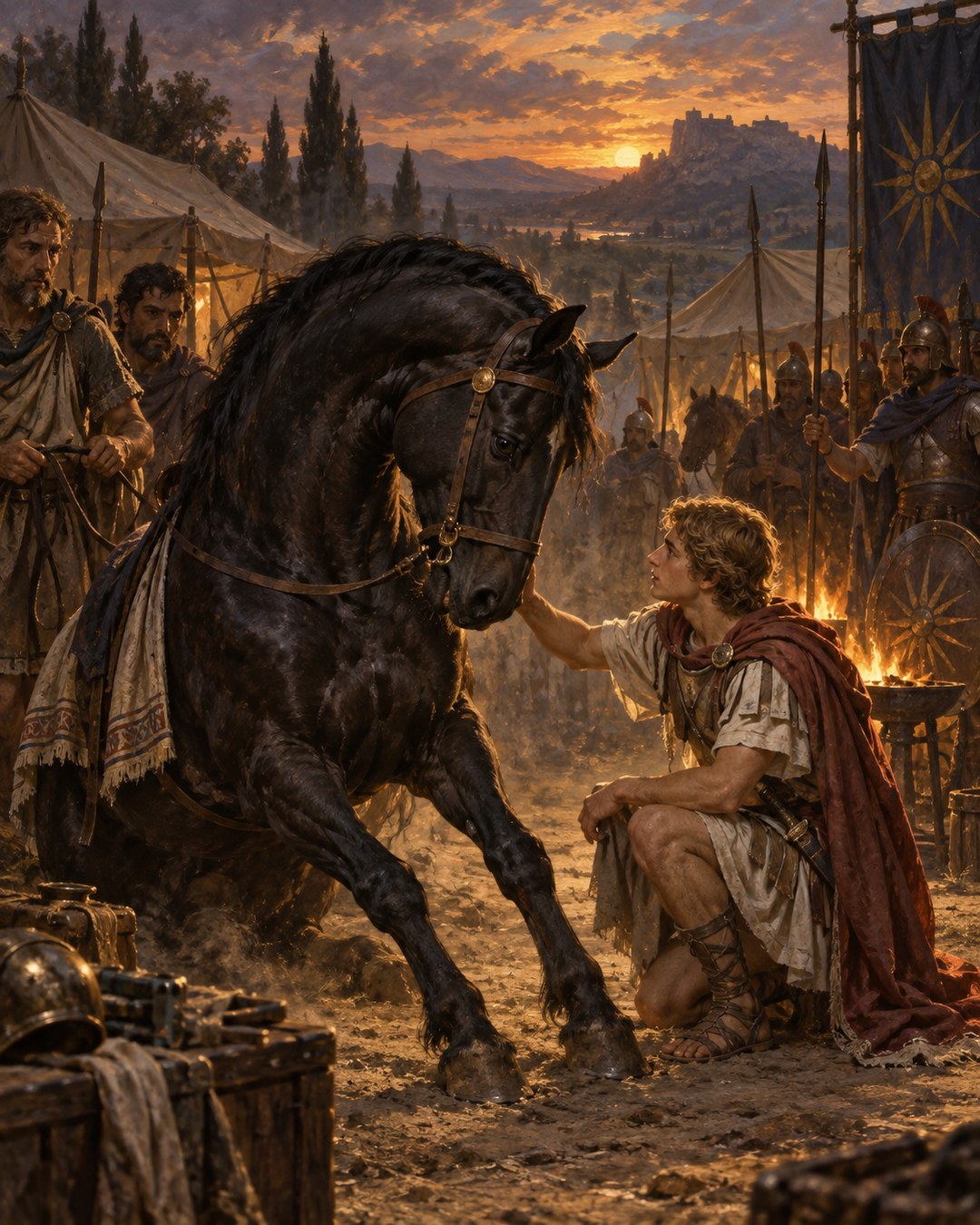
Bucephalas had been bought, priced and given to a king. None of that guaranteed he would carry the man placed on his back.
When armed for battle, Aulus Gellius says, the horse allowed no rider except Alexander. That refusal made an expensive animal into something more difficult to command: a partner who appeared to choose the person he served.
In India, the choice became lethal. Weapons struck Bucephalas in the neck and side after Alexander drove too far among the enemy.
The horse did not fall until the king was beyond their reach.
A Name Began with the Shape of a Head
Gellius opens with the name. Bucephalas, he says, was so called because of the shape of his head. The explanation fixes attention on the animal’s body before it reaches price, battle or legend.
Ancient reports about the name vary outside this passage, and Gellius does not offer measurements or a breed. His narrower point is enough: the horse carried a visible distinction that people converted into an identity.
The name mattered because the animal would later become a name on a map. A bodily feature first distinguished one horse from others; Alexander’s memorial foundation then projected that individual identity onto a city.
Gellius attributes the price to Chares. Bucephalas had been bought for thirteen talents and given to king Philip. For Roman readers, Gellius rendered the sum as three hundred and twelve thousand sesterces.
The conversion invited comparison. Talents belonged to the Greek account; sesterces translated astonishment into Roman financial scale. The horse entered the story already surrounded by royal expenditure.
Another expensive horse appears in the ill-fated purchase of the horse of Seius. There, price fed a proverb about ownership and disaster. With Bucephalas, price establishes rarity but does not explain the bond that follows.
Battle Equipment Triggered the Refusal
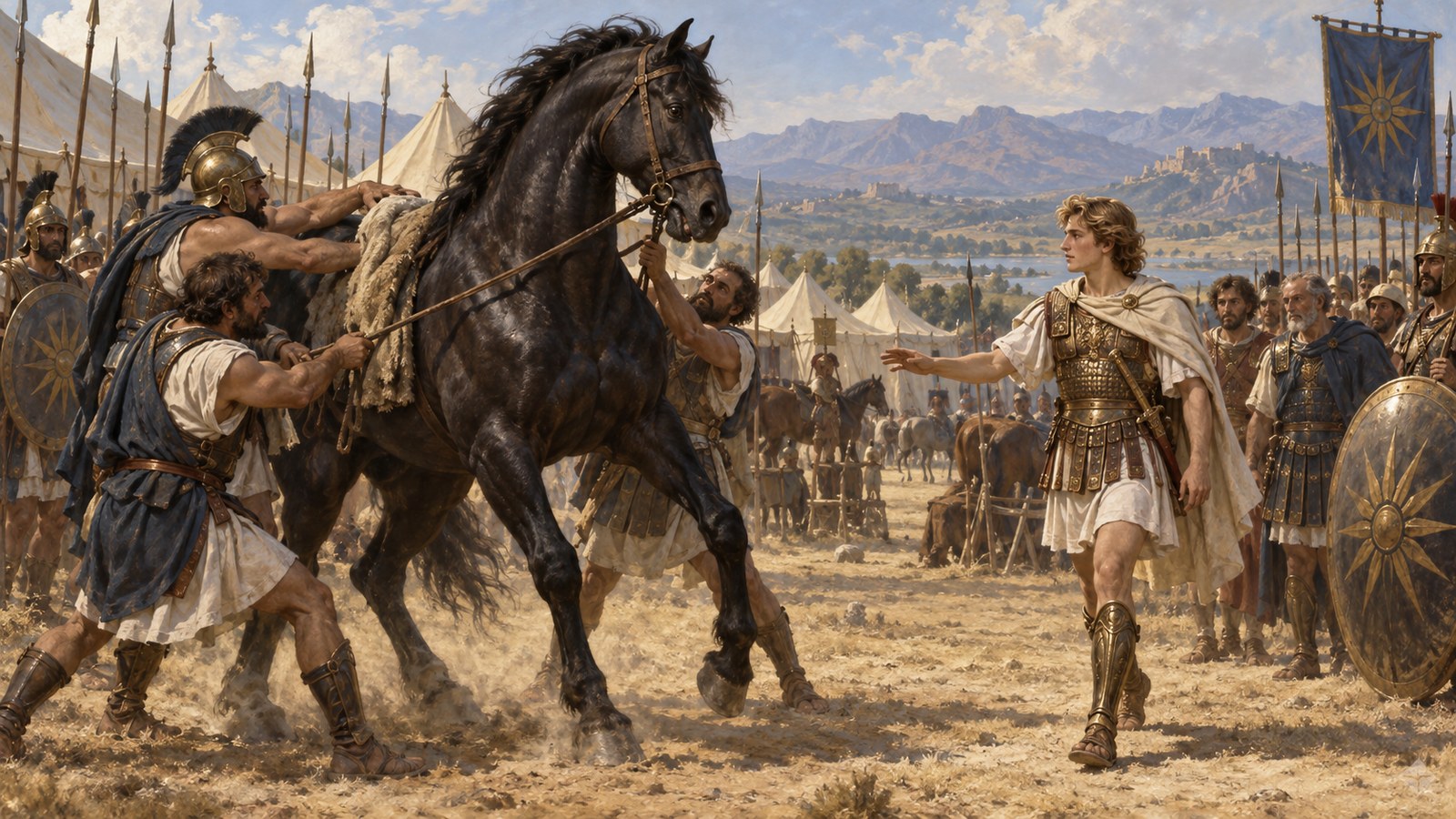
The horse’s celebrated restriction was specific. Gellius says that when Bucephalas was armed and equipped for battle, he would not permit anyone other than Alexander to mount him.
That detail anchors the behavior in a charged setting. Harness, weapons, handlers and the expectation of violence changed the act of mounting. The horse was not merely choosing who could sit during exercise.
For a king, exclusive access carried two meanings. It displayed exceptional command, because others could not use the mount prepared for war. It also exposed dependence, because the king’s mobility rested on cooperation that attendants could not reproduce.
Royal ownership usually imagines control flowing downward. Gellius reverses the final step. Money could buy the horse and the court could equip him, but the animal still decided whether the rider reached the saddle.
This is where the story differs from a technical account of cavalry equipment. Roman four-horn saddles stabilized riders without stirrups, but no saddle could solve refusal. Hardware shaped the seat after consent to mounting had already been won.
Gellius does not tell us how the exclusivity was tested, trained or interpreted by handlers. He preserves the result that made the horse memorable: in battle gear, Alexander alone was accepted.
The King Rode Past the Margin of Safety
The final episode takes place in the war against India. Alexander, mounted on Bucephalas and performing valorous deeds, drove the horse too far into the enemy ranks.
Gellius attaches the danger to Alexander’s action. The horse is not described as bolting or carrying the king out of control. The rider disregarded his own safety and pressed beyond a safer distance.
That choice turned exclusivity into exposure. Because only Alexander rode Bucephalas in battle, the king’s appetite for risk and the horse’s body became inseparable in the account.
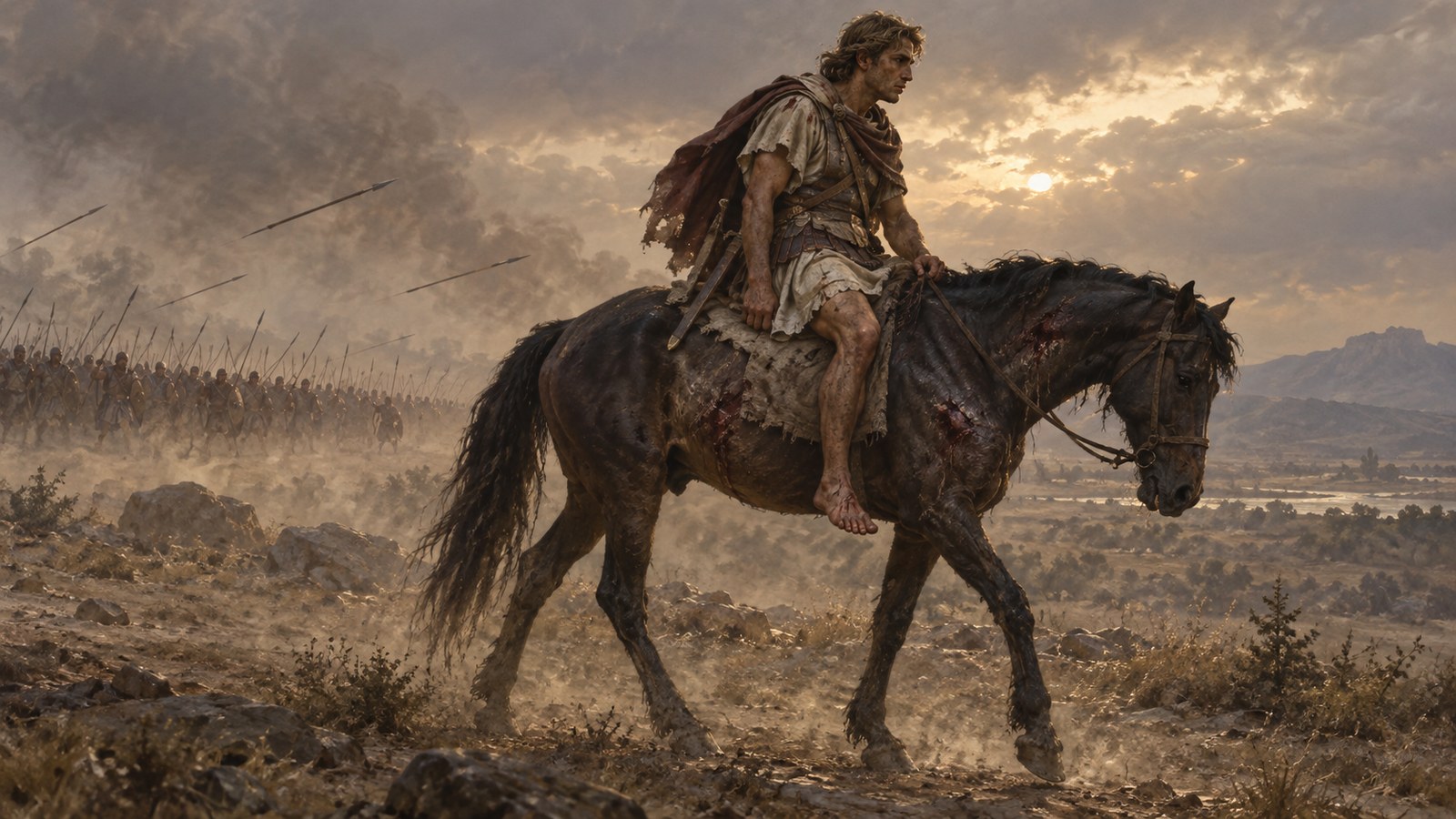
Weapons were hurled from every side at Alexander. They struck the horse deeply in the neck and flank. The targeting is important: missiles aimed into the royal pair did not need to hit the king to threaten him.
A mounted commander concentrates mobility and vulnerability in two bodies. The rider can see, direct and fight, but the animal supplies the speed that keeps both from being surrounded. Wound the horse and the king’s range collapses.
Gellius avoids a tactical catalogue. He does not identify formations, distances or the type of every weapon. He narrows the scene to the consequence of riding too far: Bucephalas was dying, and Alexander still stood within reach of the enemy.
Mortal Wounds Became an Extraction
The horse had lost so much blood that Gellius calls him almost exhausted. Yet Bucephalas continued at the fastest pace he could manage and carried Alexander away from the hostile weapons.
The sequence is the heart of the story. Wounding comes first. Escape follows. Collapse waits until the range of the weapons has been crossed.
That order gives the animal apparent purpose without supplying speech or supernatural intervention. Gellius reads the final effort through its timing: the horse remained upright for the dangerous distance and fell as soon as the king had been delivered.
The account says Bucephalas breathed his last with signs of relief that were almost human, satisfied to have saved his master. The comparison is Gellius’s interpretation, and it should remain attached to him rather than turned into a veterinary fact.
Still, the observable structure explains why the interpretation was compelling. An exhausted animal can continue under momentum, training and stress. To spectators or later narrators, collapse immediately after safety looked like completion.
The king who had ignored his own safety survived because the mount absorbed the cost. Alexander’s valor therefore remains entangled with an animal’s endurance. The farther the rider pushed into danger, the more decisive the horse’s return became.
Gellius offers no triumphant speech over the body. The emotional claim sits in the horse’s last movement: out of range, then down.
A Victory Turned the Horse into Geography
Alexander won the battle. Afterward, Gellius says, he founded a city in the region and called it Bucephalon in honour of the horse.
The foundation changed the scale of remembrance. Tack, price and wounds belonged to one animal’s life. A city could carry the name through administration, travel and repeated use by people who had never seen the horse.
Alexander had been offered another route to architectural memory in the proposal to carve Mount Athos into his likeness. He rejected that colossal design. Bucephalon memorialized something smaller in body but closer to survival.
The name also completed a circle. Bucephalas was first identified by the shape of his head. At the end, the same individual designation was detached from the body and fixed to a settlement.
Royal commemoration often centers the ruler who orders it. Here Alexander used his capacity to found and name a city to preserve the animal that had carried him. The act still demonstrated royal power, but it directed that power toward a dependent partner.
Gellius’s compressed narrative makes price, refusal, danger and memorial build upon one another. The costly purchase establishes value. Exclusive mounting establishes relationship. The retreat establishes debt. The city acknowledges it.
None of those stages alone would produce the same story. A costly horse could be replaced. A loyal horse could remain private. A battlefield death could be forgotten. A city name joined all three into public memory.
Bucephalas could not choose the monument. Yet Gellius depicts him choosing the rider and sustaining that choice past the point when strength should have failed.
Alexander entered the enemy ranks as the commanding figure. He left them because the body beneath him kept moving. The last service of Bucephalas transformed ownership into obligation—and the king answered by placing the horse’s name on the land.
Sources
Aulus Gellius, Attic Nights, book five, chapter two.