
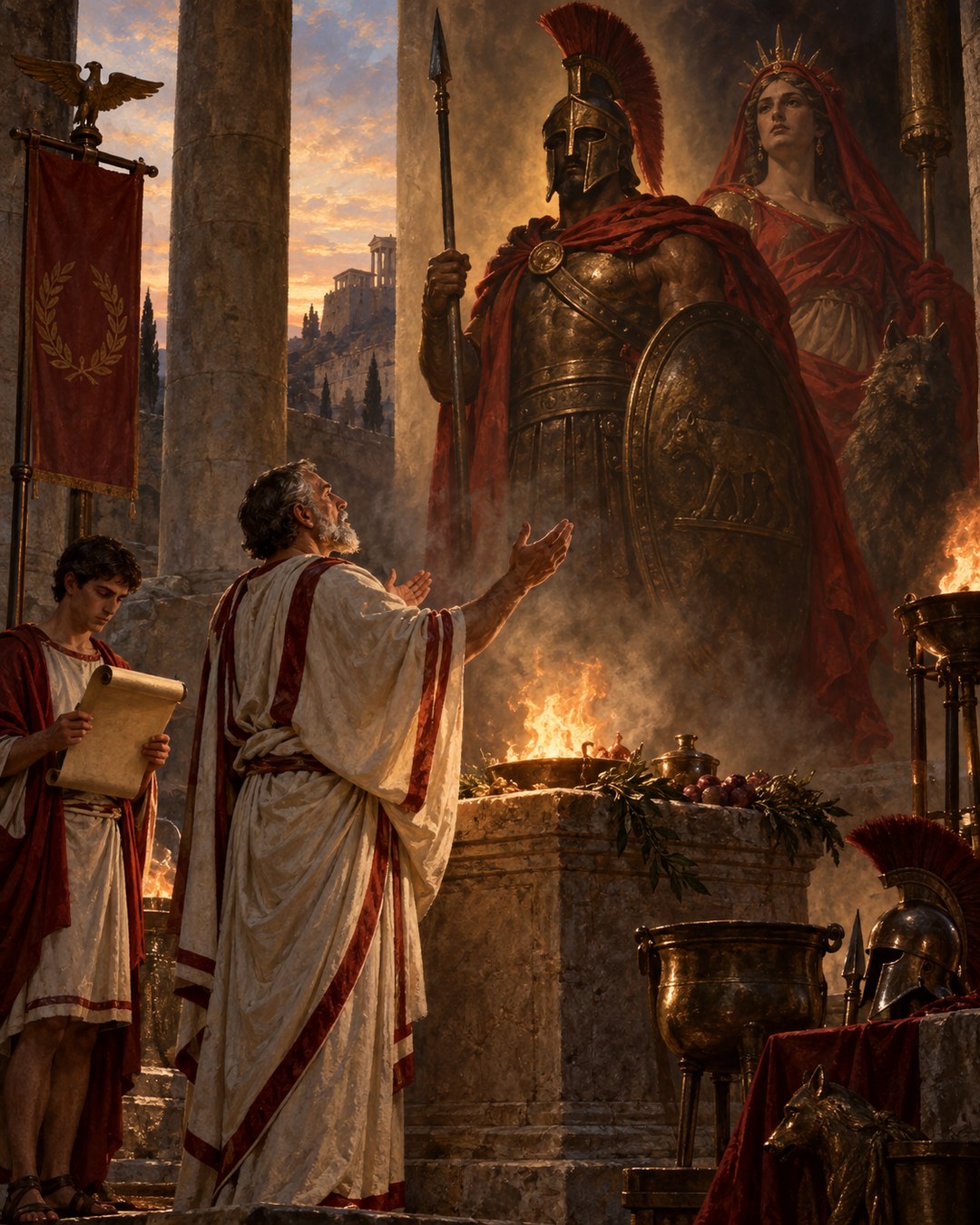
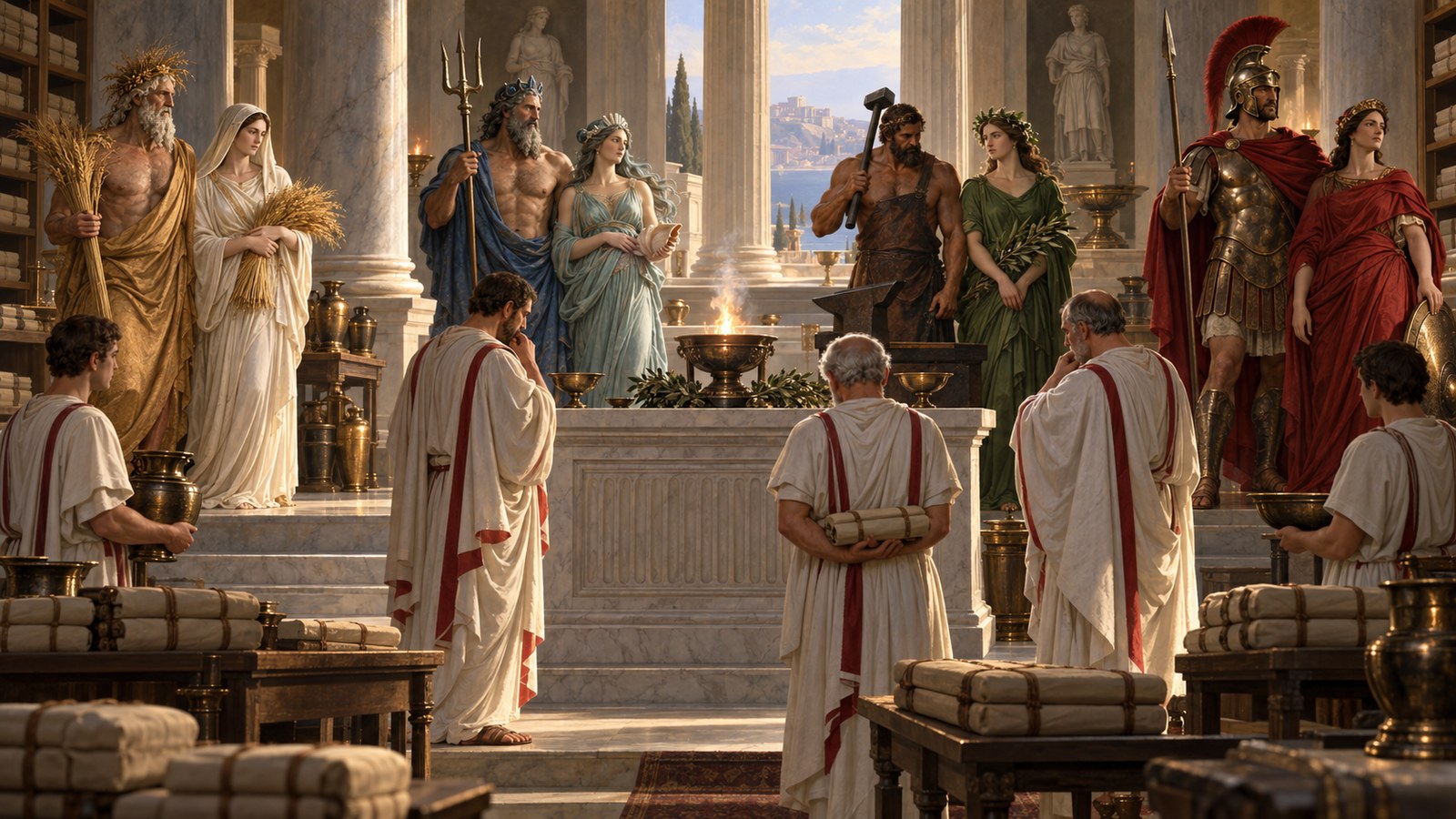
In an old Roman prayer list, Mars did not stand alone. Moles and Nerio appeared beside him, just as Salacia appeared with Neptune and Maia with Vulcan.
Aulus Gellius tried to explain what one of those pairings meant. His answer split in two directions. Nerio could be the strength and power of Mars. She could also be his wife.
The disagreement was not an embarrassment to erase. It was the trail by which a ritual name acquired grammar, story and personality.
Priestly Books Preserved a Chain of Paired Names
Gellius begins with texts used in Roman ritual. Prayers to the immortal gods, he says, were set down in the books of the Roman people’s priests and in many early collections of prayers.
Those books preserved combinations unfamiliar even to many ancient readers. The list included Lua of Saturn and Salacia of Neptune. Hora and the Virites belonged with Quirinus; Maia with Vulcan; Heries with Juno; Moles and Nerio with Mars.
Gellius does not present the list as a tidy family tree. The repeated construction links one name to another, but it does not by itself specify whether the second is a spouse, an aspect, an associated force or a separate recipient.
That ambiguity is the engine of his chapter. A formula can survive because priests repeat it correctly even while later speakers become uncertain about the being it names.
The paired powers also make divine action more precise. Mars as a broad god of war could be approached through names that emphasized weight, force, vigor or some other quality. Roman prayer often depended on exact address because exact address identified the power being requested.
Lost Eagles has examined the four people assigned to protect the wording and performance of a Roman prayer. Nerio reveals why such care mattered. If an old name became obscure, the formula could preserve it long enough for scholars, poets and worshippers to argue over what it meant.
Pronunciation Became Evidence about Divine Identity
Before interpreting Nerio, Gellius attends to sound. He had heard many people pronounce the name as though it resembled the Greek word for Nereids. He believed more accurate speakers placed the long vowel elsewhere.
The discussion may seem distant from religion, but vowel length determined which linguistic family the name appeared to belong to. A Greek-sounding pronunciation invited one association; an old Italic form invited another.
Gellius cites Varro using the vocative Nerienes in verse. He then compares the declension to that of the river Anio. Grammatical endings become fragments of historical evidence because the ritual books do not pause to explain their vocabulary.
He calls the word Sabine and says it signified valour and courage. The claim lets him connect Nerio with the strength and power of Mars and with a certain majesty belonging to the war-god.
His etymology also reaches toward Greek words for sinews and toward Latin nervi. Modern readers need not accept every ancient derivation as historical linguistics. What matters for Gellius’s argument is the path: bodily tension and strength made Nerio intelligible as an active quality of Mars.
On that reading, the paired name does not require a divine marriage. Nerio identifies what Mars possesses or manifests. The prayer addresses a power with enough precision to distinguish force from the god in his widest form.
The archive’s portrait of the many restrictions surrounding Jupiter’s priest shows ritual identity carried through clothing, movement and daily prohibition. Gellius approaches a comparable problem through language: a sacred role can persist in an exact name after its explanation has become contested.
Plautus Turned the Power of Mars into a Wife
Comedy supplied another answer. In Plautus’s Truculentus, a soldier says that Mars comes home and greets his wife Nerio.
Someone known to Gellius had dismissed the line as a joke placed in the mouth of an ignorant, rough soldier. On that view, the comic character misunderstood an old ritual title and converted it into a domestic relationship for laughter.
Gellius resists that easy separation between learned ritual and popular comedy. He looks for evidence that Plautus drew on a real tradition rather than inventing a blunder.
An early comedy by Licinius Imbrex also called Neriene the wife of Mars. Ennius used the name in his Annals. Meter complicated pronunciation, but the repetition showed that the figure lived outside one Plautine joke.
The shift from quality to spouse is understandable without being simple. Paired names invite relationship. Once a force beside a god is imagined as a distinct female figure, marriage gives the pairing a narrative form that audiences recognize.
Yet the marital story does not necessarily erase the older function. A divine spouse can embody what the god requires, restrains or expresses. Gellius preserves both explanations because each accounts for part of the evidence.
This is a different process from inventing a new deity on a single afternoon. Ritual language, poetic meter and dramatic character accumulated around a name. The result was layered rather than uniform.
Hersilia Asked Nerio to Turn War toward Marriage
Gellius’s strongest evidence for the marital tradition came from the third book of the Annals of Gnaeus Gellius. It placed the name inside a prayer attributed to Hersilia.
Hersilia pleaded before Titus Tatius and asked Neria of Mars to grant peace. She also asked that the women carried off by the Romans be allowed lasting and happy marriages, so that they could raise children and descendants for the people.
The prayer called Mars Nerio’s lord, which Gellius interprets as husband. That relationship made Nerio especially suited to a request joining the end of conflict with the stabilization of marriage.
The scene turns the name’s meanings back toward each other. If Nerio expressed the power of Mars, Hersilia asked that martial power be redirected. If Nerio was Mars’s wife, she could mediate between the war-god and women seeking peace within new households.
Gellius notices that the annalistic passage used the form Neria, not precisely the same form found elsewhere. Variation in ending and vowel length did not persuade him that the traditions were unrelated. It gave him more material to compare.
The prayer also shows why literary evidence mattered to an antiquarian. Priestly lists supplied names but little narrative. Annals preserved a scene in which one of those names performed a specific task.
The story of two neighbors bringing separate offerings to one boundary stone at Terminalia likewise shows ritual relation created through action. Nerio’s relation to Mars was less stable, but prayer made it practical: she was addressed because war, peace and marriage had to be joined.

One Name Survived Several Explanations
At the end of the chapter, Gellius records yet another interpretation. Servius Claudius connected Nerio with the idea of being without anger, so that worshippers using the name prayed for Mars to become mild and calm.
Gellius does not endorse that explanation as strongly as his account of strength and power. He includes it because it reveals how readers tried to recover purpose from a word whose ritual authority outlived easy understanding.
The three principal possibilities are not interchangeable. Nerio as force intensifies Mars. Nerio as wife relates him to a partner. Nerio as calmness restrains his anger. Each makes the prayer do different conceptual work.
Roman religious language could hold those possibilities because it did not depend on a single systematic mythology. Priestly practice, Sabine vocabulary, Latin grammar, comedy and annalistic narrative each preserved a different angle.
That does not mean any interpretation was equally acceptable. Gellius tests pronunciation, grammatical forms, quoted verses and parallel traditions. His method is argumentative even when the evidence refuses one clean result.
The survival of Nerio is therefore a story about archives as much as gods. A name copied in a ritual book became a problem for later readers. Their attempts to solve it generated new links without destroying the old formula.
Mars’s strength and Mars’s wife can look like rival identities. In Gellius’s hands, they become successive ways Romans made an inherited pairing speak. The prayer kept the name alive; language and story kept changing what listeners saw beside the war-god.
Sources
Aulus Gellius, Attic Nights, book 13, chapter 23.