
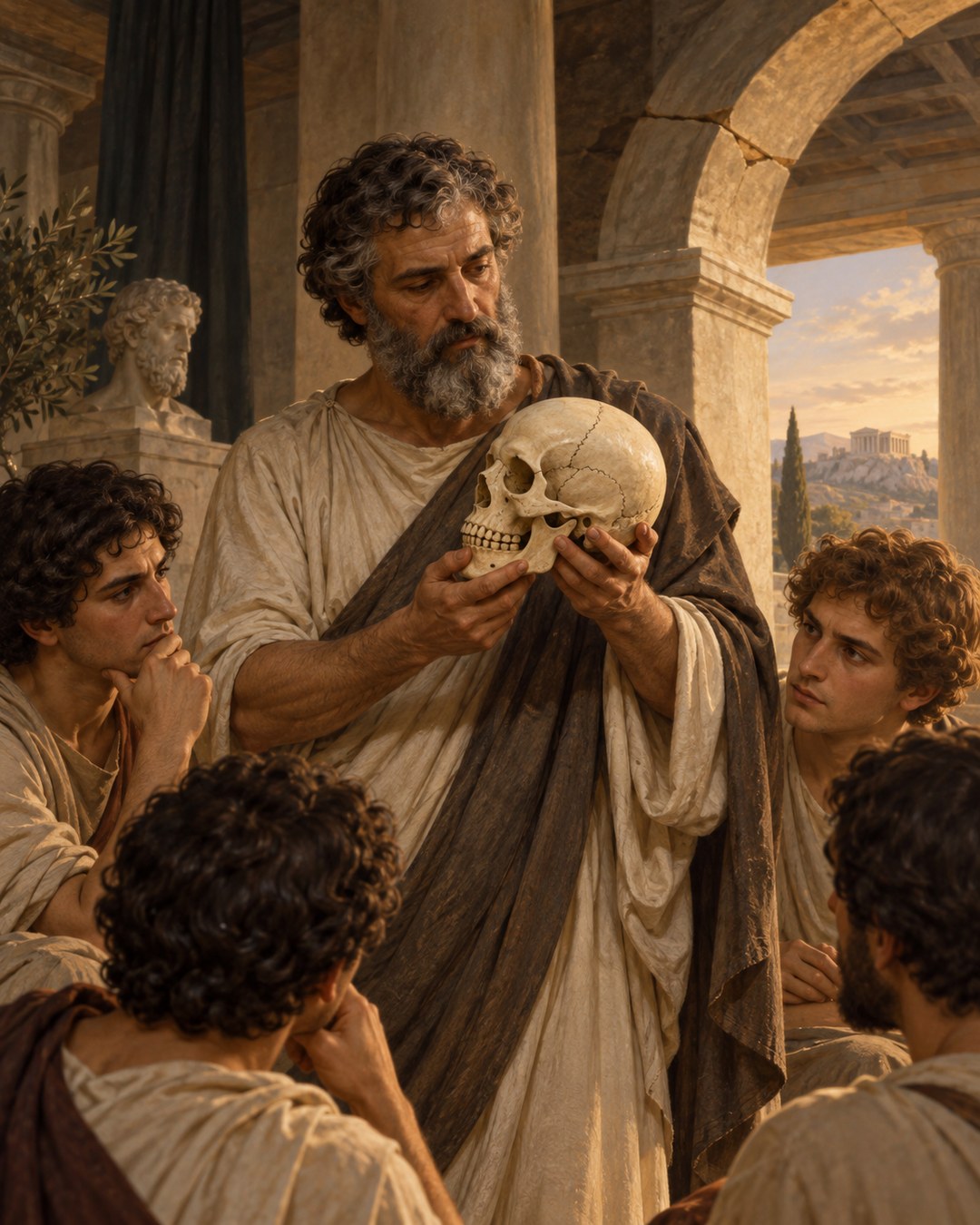
A philosopher defending Providence did not point to an invulnerable human body. He pointed to the skull.
Its bones were small and delicate because the head required a particular kind of structure. The same choice left that vital part lightly protected against blows.
For Chrysippus, vulnerability could travel beside usefulness without becoming nature’s original aim.
The Objection Began with an Apparently Bad World
Aulus Gellius opens with critics who denied that divine Providence governed human affairs. Their challenge was direct: if Providence existed, there would not be so much evil.
The argument pressed an apparent contradiction between rational care and experienced suffering. A world supposedly made for gods and human beings still contained trouble, bodily weakness and moral failure. Quantity sharpened the complaint. This was not one accidental inconvenience but a landscape crowded with harms.
Chrysippus answered from within Stoic philosophy. Gellius attributes the discussion to the fourth book of his work On Providence, preserving an argument rather than a report of medical experimentation.
His first response concerns concepts. Good and evil stand as opposites, he says, and an opposite cannot be conceived without something that opposes it. Remove one side completely and the other loses the contrast through which it is understood.
Justice makes the structure visible because injustice supplies its contrary. Courage appears against cowardice, temperance against intemperance, wisdom against folly. The argument does not make a cruel act good. It claims that moral categories take shape through opposition.
Chrysippus widened the pairs: truth and falsehood, happiness and unhappiness, pain and pleasure. He invoked Plato’s image of extremes bound together. Good was not a lone object placed in an empty field; it belonged to a field of differences.
The recent story of a Stoic turning pale in a storm before reason recovered also separates an involuntary event from the judgment that follows it. The Providence argument asks for a larger separation: what reason intends versus what necessarily accompanies embodied outcomes.
Moral Opposites Did Not Yet Explain a Broken Body
Conceptual contrast answers only part of the challenge. A bruised head is not merely the word “health” gaining meaning from its opposite. Disease and injury happen to bodies whether or not a philosopher needs contrasting terms.
Gellius therefore records Chrysippus asking a second question. Did nature herself create disease, weakness and bodily infirmity when she formed humanity?
Chrysippus refused to call disease nature’s original intention. In his account, nature was the source and mother of good things. Deliberately designing sickness as an end would conflict with that role.
Yet denial of intention could not become denial of existence. Illness still had to fit somewhere in an ordered cosmos. His answer was that troubles emerged at the same time as useful things and remained closely connected with them.
The timing in the argument is logical rather than chronological. Chrysippus was not imagining health flourishing for years before disease was later invented. Once the kind of body capable of health existed, the conditions for bodily failure existed with it.
He described them as attendant consequences. The language matters because attendance is neither independent invention nor complete accident. The harm follows beside a chosen structure because the structure cannot be made real without bringing certain exposures with it.
This idea changes the demand placed on Providence. The question is no longer whether a rational world contains only locally pleasant results. It becomes whether useful embodied forms can be created without every consequence that their material arrangement allows.
The Skull Turned Metaphysics into a Mechanical Trade-Off
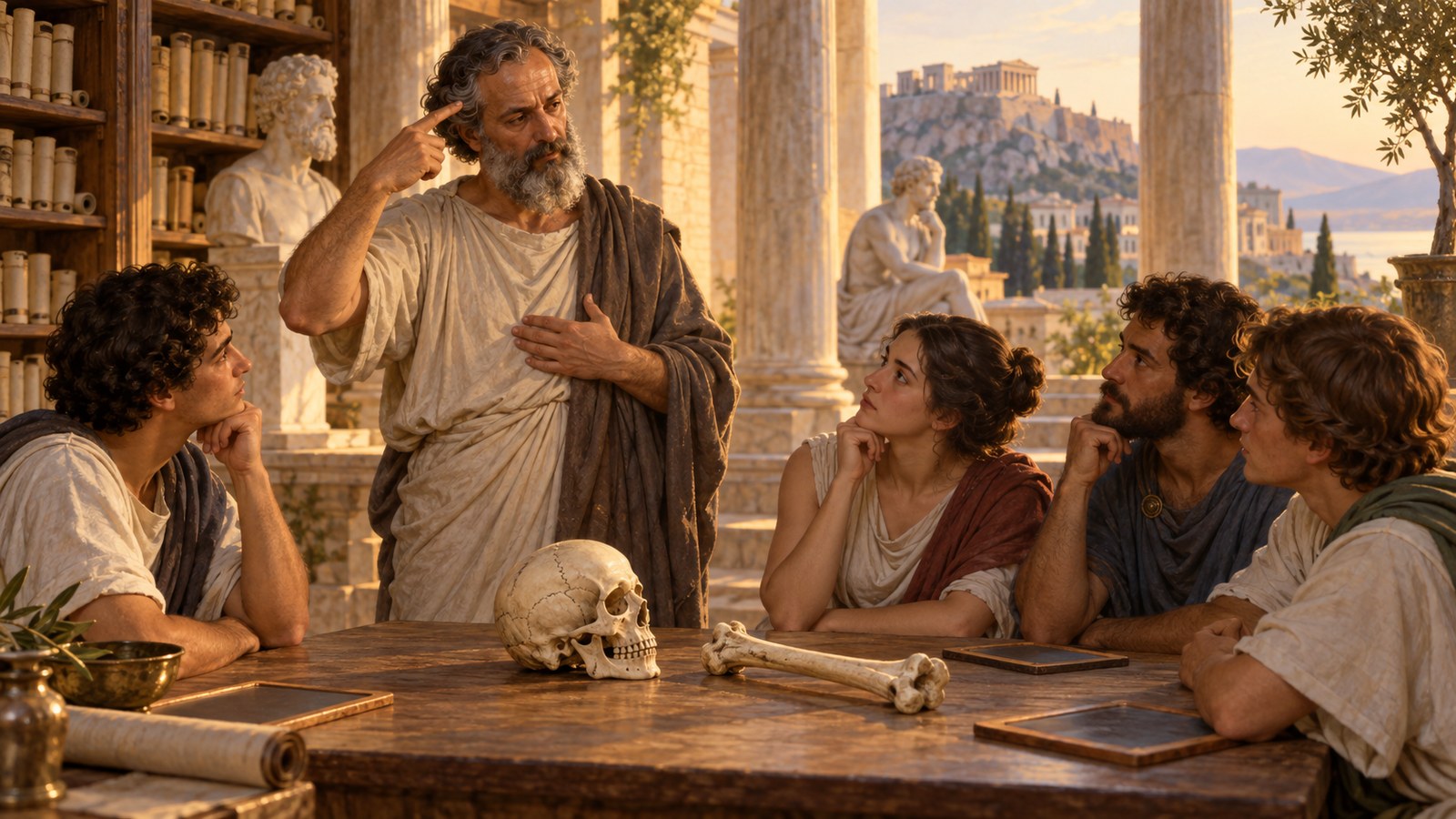
Chrysippus chose the human head as his concrete example. Higher reason and the usefulness of what nature was making required the head to consist of very delicate and small bones.
Gellius does not provide a full ancient anatomy lesson, and the passage should not be inflated into modern neuroscience. Its force lies in the physical contrast Chrysippus selected: useful delicacy against protective mass.
The disadvantage followed immediately. The head was only lightly protected and could be damaged by relatively slight blows and shocks. The valuable structure and the exposure belonged to the same design.
A much heavier enclosure might resist impact, but it would not be the same head. Chrysippus’s example assumes that changing one property changes the useful whole. Protection cannot simply be increased without cost or limit.
This is why the skull does more work than a vague appeal to mystery. It supplies a mechanism. Small delicate bones permit one set of advantages; those bones also break or transmit force more readily than a fortress wall.
The example also limits the defense. A trade-off must be connected to the good it accompanies. Calling every remote cruelty an “attendant consequence” without showing that connection would abandon the mechanical clarity that makes the skull persuasive.
The claim is not that every particular injury was necessary. No specific falling object or careless action receives absolution. The necessity belongs to vulnerability: once a delicate embodied form exists, some range of shocks can harm it.
The ancient example also keeps philosophy close to touch. Readers could feel bone beneath skin and know the consequences of a blow. Providence was defended through the fragility people carried above their shoulders.
Health and Disease Arrived Together without Equal Purpose
Chrysippus extended the skull’s logic to disease. Illness came into existence at the same time as health, he argued, but not as an equally desired goal.
That asymmetry is central. “At the same time” does not mean “for the same reason.” Health belongs to nature’s useful production. Disease accompanies the conditions under which living bodies can be healthy, grow, exchange material and eventually fail.
Gellius’s short report does not specify pathogens, heredity or treatment. Those modern mechanisms must not be read back into the chapter. Chrysippus offers a philosophical category for connected harm, not a clinical catalogue.
The category nevertheless refuses two easy positions. It does not call every pain an independently chosen good. It also does not treat the presence of pain as proof that rational order is impossible.
The case of a stone blow erasing only alphabetic memory records the ancient fascination with sharply selective bodily damage. Chrysippus approached the body from the other direction, asking why a useful organ remained damageable at all.
His answer preserves cost inside benefit. The world need not be badly arranged simply because useful forms are not armored against every possible force. Finitude enters through the same boundaries that give each form its capacities.
Vice Completed the Argument by Returning to Choice
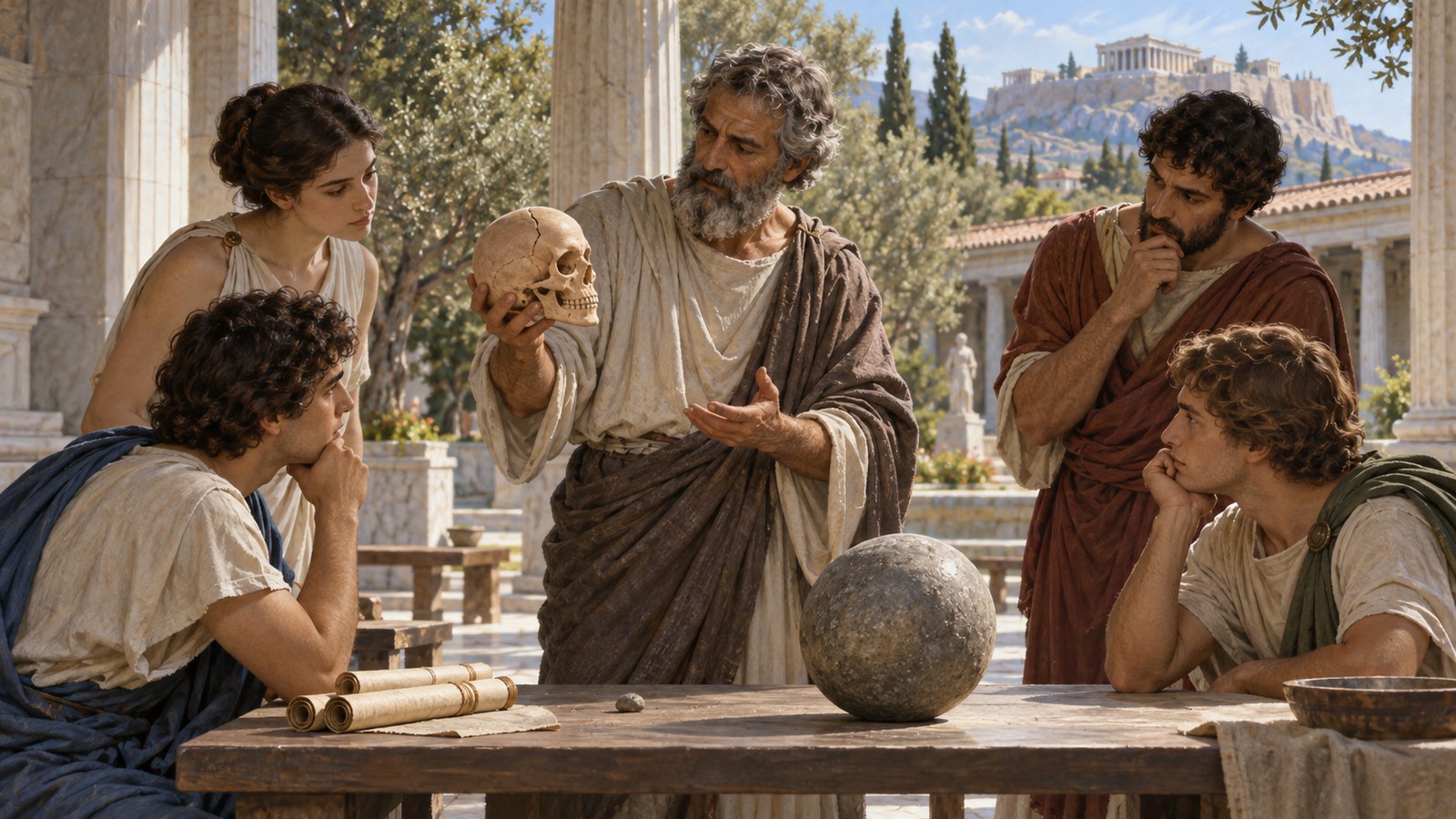
At the end of Gellius’s extract, Chrysippus returns from bodies to character. Vices arise beside virtue through their relationship to the opposite quality.
This final analogy does not make physical illness and moral failure identical. It links them within the wider claim that valuable conditions can generate or reveal contrary possibilities.
Virtue matters in a creature capable of acting otherwise. A mechanical object that cannot choose cowardice does not possess courage in the same sense as a person who faces fear. Moral excellence belongs to a field in which failure remains possible.
The two halves of the chapter therefore use different forms of connection. Moral opposites define one another. Physical harms attend useful material design. Both resist the fantasy that good can be detached from every contrary, risk and consequence without becoming a different thing.
Gellius does not settle the problem of evil for all readers. His Chrysippus offers a disciplined distinction: intended good is not the same as every consequence that appears with it.
The skull makes that distinction difficult to forget. Reason’s useful design did not fail because bone could break. The possibility of breaking belonged to the kind of light, delicate structure that reason had chosen to build.
Sources
Aulus Gellius, Attic Nights, book 7, chapter 1.