
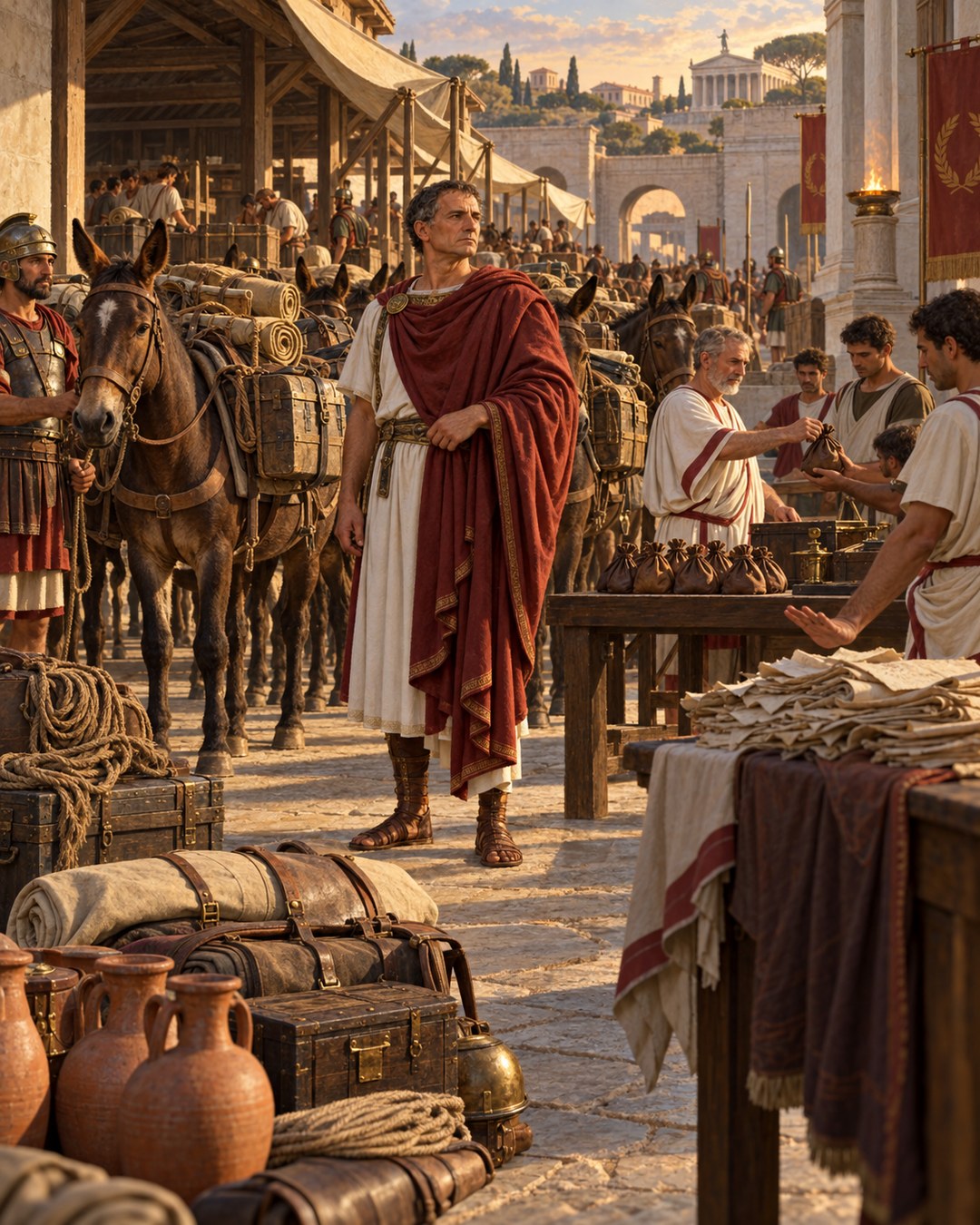
Mules and tents rarely stand at the center of a constitutional story.
For Augustus, they belonged there.
A fixed travel allowance was one small part of a broader effort to decide who controlled money, when officials moved, and which office owned each public task.
A Provincial Departure Acquired a Boundary
Suetonius lists several innovations together. Magistrates were no longer to leave immediately for provincial commands after completing office at Rome.
The delay interrupted a direct transfer from one source of authority to another. It created distance between the relationships, decisions, and ambitions of a magistracy and the power exercised in a province.
Suetonius does not give the length of the interval in this chapter. Its administrative purpose can still be read at the level of sequence: departure was no longer automatic at the first possible moment.
Travel itself also changed. Proconsuls were to receive a fixed sum for mules and tents.
Previously those necessities had been contracted for and charged to the state. The old custom made the final public cost depend on procurement claims attached to each journey.
A fixed allowance moved the boundary earlier. The state determined its contribution before the animals were hired and tents assembled.
That did not make provincial travel cheap. Pack animals, handlers, tack, shelter, and baggage remained real requirements. It changed who carried the risk of exceeding the allowance.
The proconsul and his staff now had a stronger reason to fit the travelling establishment to the sum rather than fit the public bill to the establishment they chose.
Roman finance repeatedly struggled with the point at which public purpose ended and private advantage began. Trajan later refused to force municipal cash on unwilling borrowers merely to keep funds earning interest. Both episodes show an emperor treating procedure, not just intention, as a financial safeguard.
The mules and tents make the Augustan change tangible. Budget control began where leather, fodder, wheels, ropes, and sleeping arrangements met a claim on the treasury.
Treasury and Court Duties Changed Hands
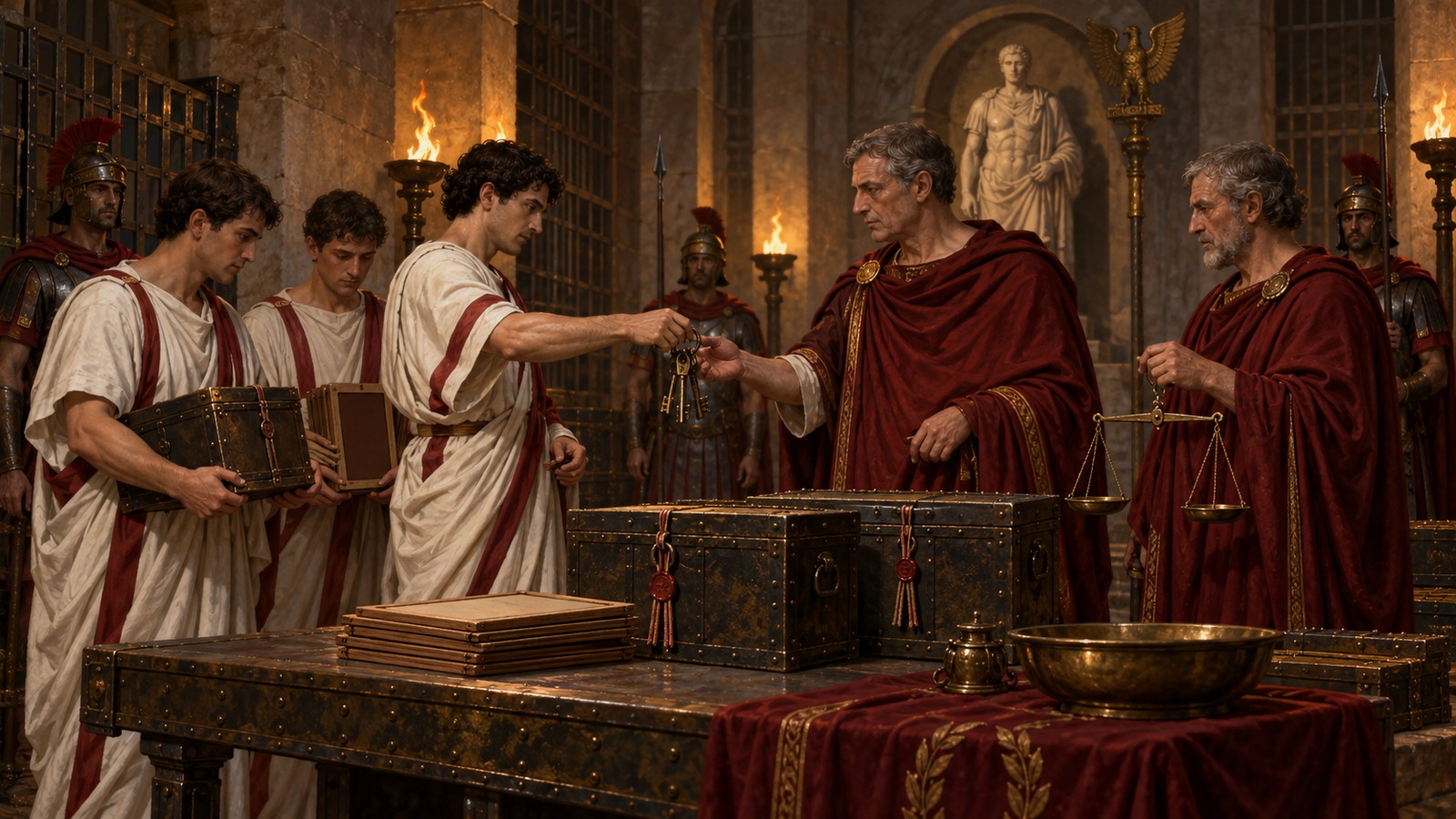
Augustus also reassigned management of the public treasury.
City quaestors lost that responsibility. Former praetors or serving praetors received it instead.
The change raised the level of experience attached to custody. A treasury was not only a room of coin; it was a chain of authorizations, deposits, withdrawals, records, and personal accountability.
Moving the task altered whom senators and officials had to answer to when public money changed hands.
Another transfer affected the centumviral court. Former quaestors had customarily summoned it; under the new arrangement the Board of Ten did so.
Convocation sounds clerical until it fails. A court cannot decide cases if no recognized authority calls the judges, organizes the session, and starts the procedure.
By naming a board, the reform made the opening act of the court belong to a continuing institution rather than follow automatically from a former office.
The treasury and court changes shared a logic without being identical. In one, custody moved upward toward praetorian experience. In the other, summoning moved sideways to a designated board.
Both reduced ambiguity about ownership of a task.
That mattered in a political culture where personal prestige could overwhelm routine audit. Scipio’s destruction of demanded accounts turned bookkeeping into a confrontation over honour. Augustan reassignment could not abolish prestige, but it could make the responsible office harder to mistake.
Suetonius also says the proceedings of the senate were no longer to be published. That measure moved in a different direction: it restricted the outward circulation of institutional business even as internal responsibilities became more explicit.
Administrative clarity inside government did not necessarily mean transparency outside it.
Public Systems Became Named Portfolios
The next chapter broadens the picture from transfers to new offices.
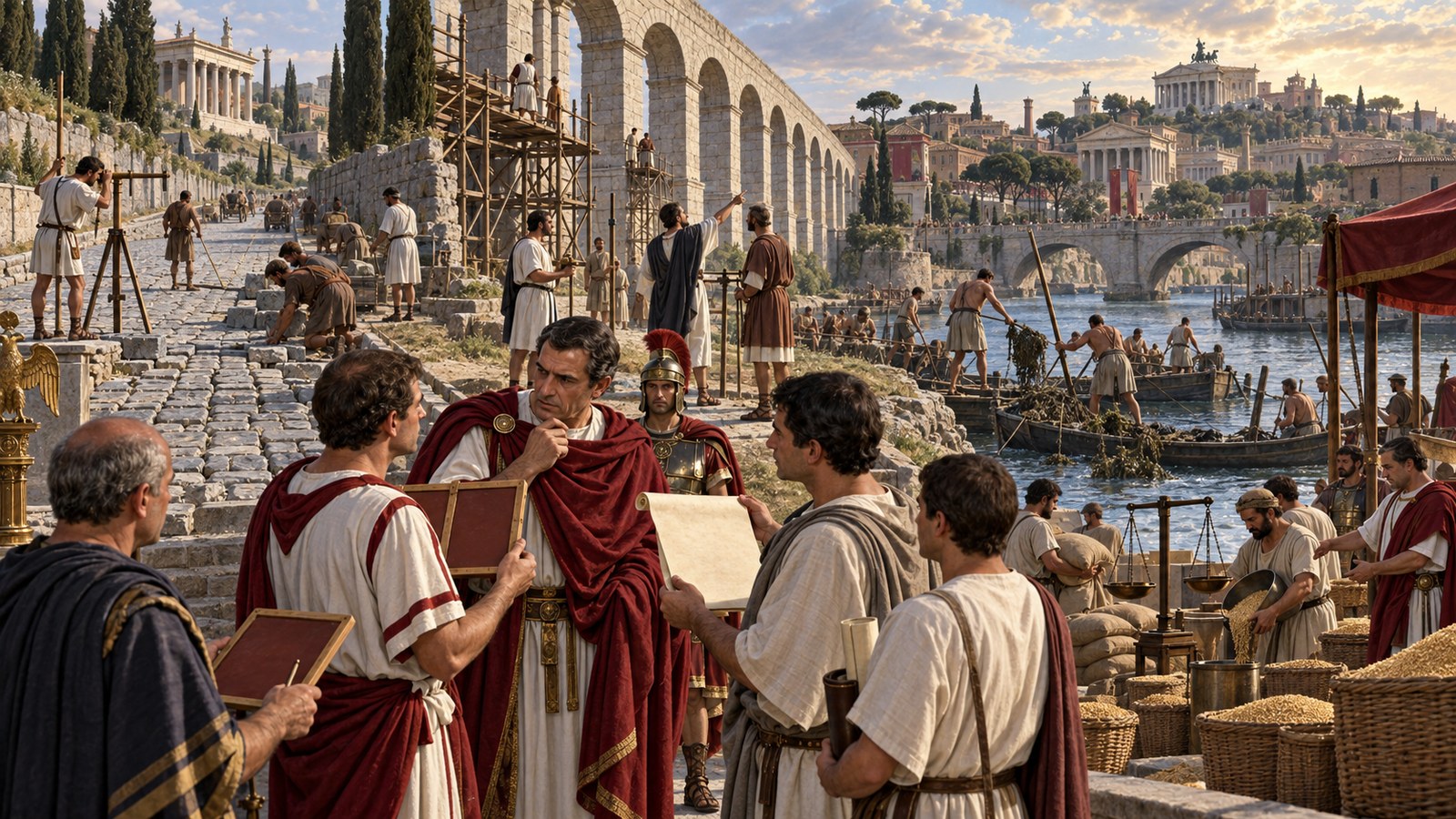
Augustus created responsibility for public buildings. Structures used by the city now had a named administrative home.
Roads received a charge of their own. Their maintenance joined distant movement to continuous local inspection, repair, drainage, and contracting.
Aqueducts formed another portfolio. Water crossed land, arches, channels, reservoirs, and distributions; failure at one section could disrupt neighbourhoods far away.
The channel of the Tiber also received assigned care. The river was a transport route, boundary, drainage system, and flood threat. Keeping its channel usable demanded attention different from maintaining a road.
Grain distribution became another explicit responsibility. Supply had to be acquired, moved, measured, stored, and issued to a large urban population.
The prefecture of the city appears in the same list. Rome itself required an authority capable of acting across functions that did not fit neatly inside the older annual magistracies.
These were not five versions of one job. Stonework, road surfaces, flowing water, river sediment, and grain crowds created distinct technical and political failures.
Assigning portfolios made it possible to ask a sharper question after failure: which official had the duty to notice, prepare, and respond?
The reform also enabled continuity. Roads and aqueducts do not respect the beginning and end of a single spectacular campaign. Their condition accumulates through ordinary days.
Clear ownership could preserve institutional memory across those days, even when the person holding an office changed.
More Offices Meant More Routes into Government
Suetonius introduces the new responsibilities as a way to let more men take part in administering the state.
Expansion therefore served recruitment as well as control. A larger map of duties created more positions in which elite careers could operate.
A board of three was assigned to choose senators. Another board reviewed the equestrian companies whenever necessary.
Those bodies turned status review into recurring administrative work. Membership in the governing orders required inspection rather than being left entirely to inheritance and reputation.
Augustus appointed censors after the office had long been discontinued. He also increased the number of praetors.
Old titles and new portfolios could coexist. The regime did not replace the Republican vocabulary with one imperial ministry. It redistributed work through a mixture of revived, expanded, and newly focused posts.
That mixture offered political advantages. Innovation could appear as restoration when an old office returned, while a practical problem could receive a new custodian without announcing an entirely new constitution.
The resulting administration was still personal and unequal. Augustus remained the organizer who decided that responsibilities needed to move.
Yet the changes mattered beyond personality because they attached recurring tasks to positions: a sum for travel, a pause before provincial command, praetorian custody of treasury, a board for court summonses, and named care for infrastructure and supply.
Mules and tents reveal the method at its smallest scale. An open reimbursement became a boundary. At larger scales, roads, aqueducts, grain, and the river became portfolios.
The empire was not governed by abstractions alone. It was governed by deciding which purse paid, which hand held the key, which board called the court, and whose office received the complaint when water, roads, or grain failed.
The measures also changed the evidence that failure would leave behind. A fixed allowance could be compared with the authorized sum. Treasury custody could be traced to a named class of magistrates. A court summons belonged to a defined board. A broken road or neglected channel pointed toward an assigned charge rather than an indistinct obligation shared by everyone and owned by no one.
Clearer ownership did not guarantee competent work, honest accounts, or adequate funds. It did make excuses more specific. The official responsible for an aqueduct could not answer as though the water system were merely one incidental burden among dozens, and a proconsul could not treat every travel expense as an unlimited public claim.
Sources
Suetonius, Augustus, chapters 36–37.