
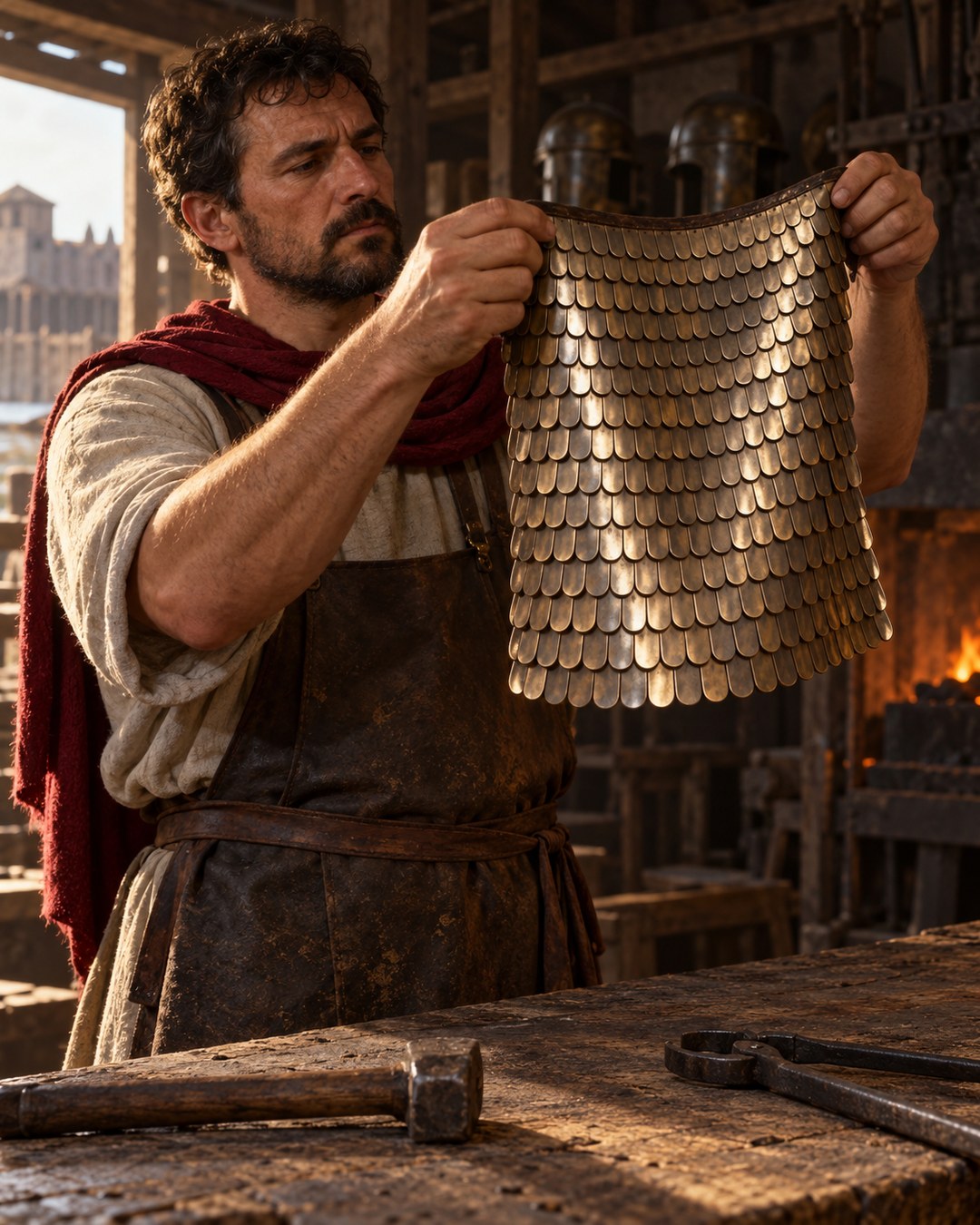
A scrap of armour can be more revealing than a complete parade suit. The London Museum holds a copper-alloy scale only 30 millimetres long and 21 millimetres wide. It has no surviving wearer, no named legion and no secure battlefield story. What it does have is a precise set of working features: three holes across the top, a raised border, a frame around those holes and a ridge running vertically down the face.
Those details turn the fragment into a lesson in construction. A scale cuirass was not simply a heap of metal leaves. Each small plate had to join its neighbours, overlap them, flex with a body and present a useful surface to the outside. The London scale makes that engineering visible at the size of two fingertips. It also preserves a pale metallic treatment: the copper alloy was tinned.
This is not the familiar story of Roman armour told through a dramatic helmet or an intact breastplate. It is the quieter story of repetition. One plate was weak and easy to lose. Hundreds arranged by a disciplined craft process could become wearable protection.
The holes were part of the armour, not damage
The museum describes three holes pierced horizontally through the scale. Their regular placement matters. They are not corrosion pits or accidental breaks. They provided controlled points where a cord, wire or other fastening could hold the scale in relation to a backing and to the plates around it.
The raised border continues around those holes as a frame. That feature is easy to miss in a photograph, but it gives the upper part of the plate a deliberately organised face. The maker did not treat piercing as an afterthought. The holes belonged to a designed zone, and the border visually and physically separated that zone from the rest of the plate.
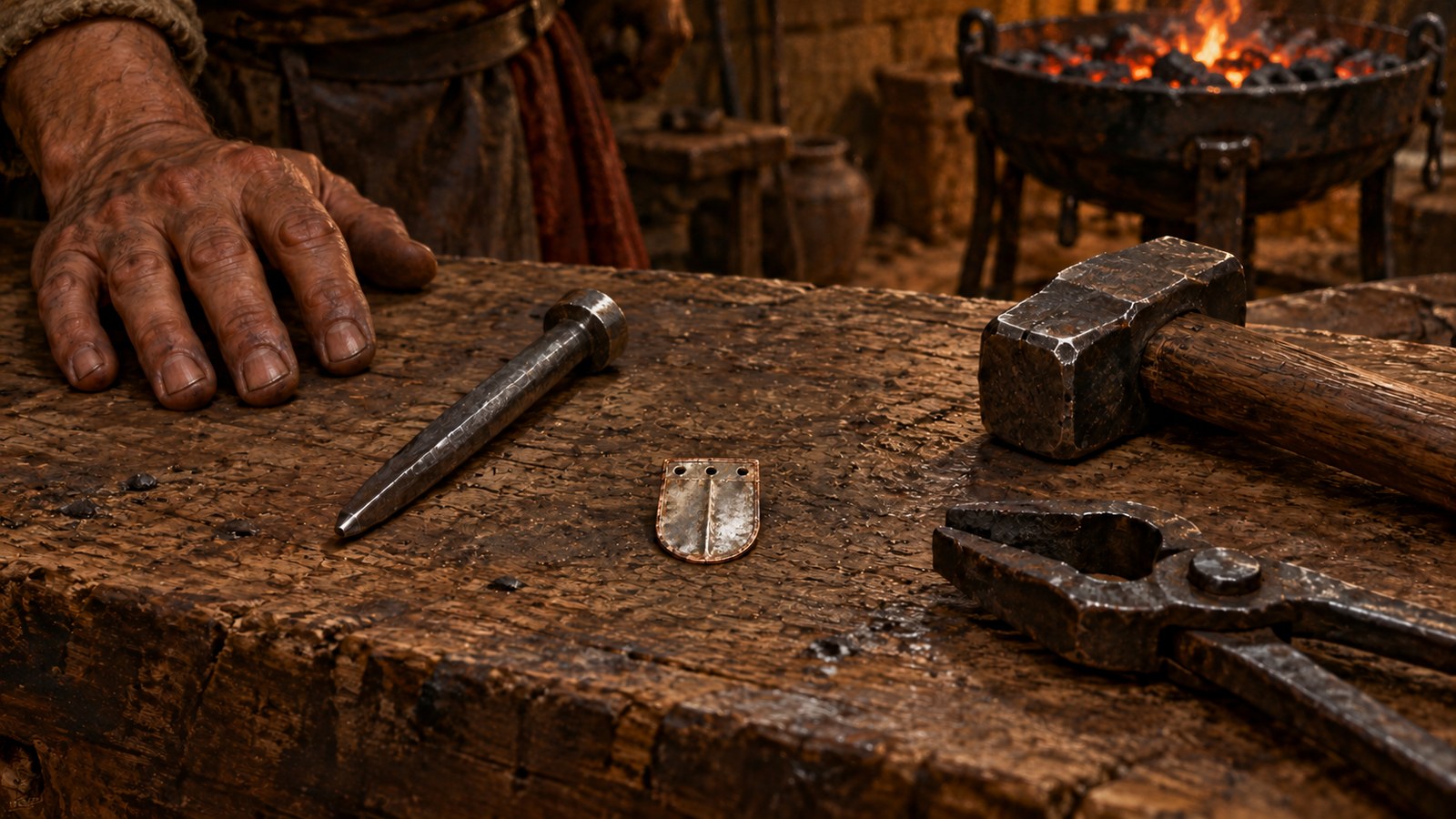
The vertical central ridge adds another controlled line. A ridge can stiffen a thin object without requiring the whole piece to become thick and heavy. The museum record does not claim a single proved function for this ridge, so it is safer to read it as part of the scale’s deliberate geometry rather than invent a test result. Holes, border and ridge together show a plate shaped for assembly rather than a random offcut pressed into service.
The dimensions reinforce the point. At 30 by 21 millimetres, the London piece was small enough that a cuirass required sustained repetition. The armourer had to make many related parts, keep their holes useful, and arrange them in rows. The labour was distributed across the whole garment.
Tinning changed what copper alloy presented to the eye
The scale is copper alloy, but its surface was tinned. That means the visible face did not necessarily present the warm brown or green colour that the surviving object has today. A tinned surface could give the plate a paler, silvery appearance. On many overlapping pieces, that treatment would have altered the visual effect of the cuirass as a whole.
It is tempting to turn that observation into a story of dazzling uniforms. The record does not tell us how bright this scale remained, how often it was cleaned, or whether every neighbouring plate had exactly the same finish. The useful conclusion is narrower: surface treatment was part of the object. Protection and appearance were not separate stages in our modern sense. The working plate was also a finished visible plate.
That combination helps explain why a tiny fragment is worth studying. Metal choice, hole layout and surface finish all survive together. The scale records several decisions that an armourer had to make before anyone could wear the result.
Masada offers a comparison, not a perfect twin
The London Museum notes that close parallels for this type are rare in the west. It then points to similar scales excavated at Masada. The comparison is valuable precisely because the pieces are not identical. The Masada examples were proportionally taller. They had four holes arranged as two pairs, rather than London’s single horizontal row of three.
Their central ridge also ran the full length of the object, and they lacked the London scale’s frame around the holes. Those contrasts warn against treating “scale armour” as one fixed template. Makers could solve the same broad problem with different proportions and fastening plans.
Material analysis adds another layer. The Masada pieces were cast from bronze and brass, and the museum says at least some may have been tinned. Yet their historical identity remains uncertain. They may have been Roman, Jewish, or Roman objects reused by Jewish rebels. The uncertainty is not a flaw to be filled with a confident label. It is part of the evidence.
Comparison therefore does two jobs. It gives the London object a wider technical setting while preserving the differences that make it distinctive. Three holes are not interchangeable with four. A framed hole zone is not the same as an unframed one. A short central ridge is not automatically equivalent to one running the full length.
A cuirass was a system of small dependencies
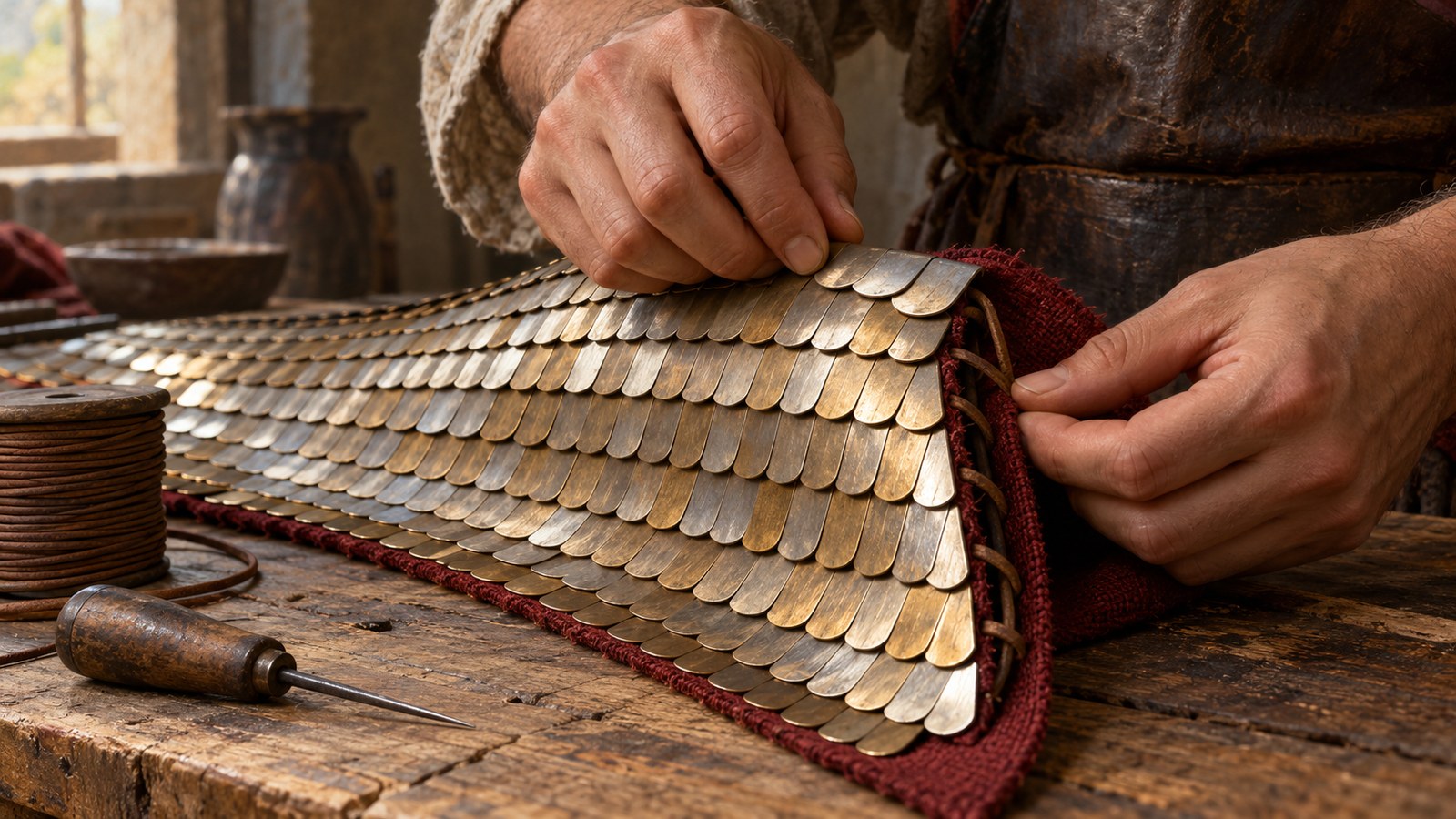
A single scale could not protect a torso. Its usefulness depended on neighbours, overlap, backing and fastening. That makes scale armour a particularly clear example of Roman craft as system-building. Each component was modest; the arrangement did the larger work.
This also makes damage easier to imagine without pretending to know this object’s biography. A broken fastening did not necessarily mean that every plate failed. A missing scale did not erase the whole garment. Repair could be local because construction was modular. At the same time, poor alignment repeated across many rows would multiply into a larger problem. Consistency mattered.
The site’s account of armour reconstructed from the Corbridge hoard shows a different solution built from larger articulated components. Another object, the small iron fitting that supported a helmet crest, shows how one compact part could alter military display. The London scale belongs beside those stories, but it should not be collapsed into them. Its particular mechanism was the repeated overlap of many pierced plates.
The fragment asks us to look below the silhouette of a soldier. Roman military equipment depended on people who selected alloys, cast or shaped small parts, pierced regular holes, finished surfaces and assembled flexible sheets. The cuirass began long before it reached a body.
The London piece also corrects the scale of our imagination. Thirty millimetres is not the height of a heroic breastplate; it is the length of one repeated unit. Twenty-one millimetres is the width that had to meet the next unit without leaving the arrangement arbitrary. Looking at those numbers makes the armourer’s problem concrete. A row had to remain orderly across curves in the body, and the next row had to overlap it while preserving movement.
Tinning added another repeated task. The museum record identifies the surface treatment but does not specify the workshop sequence, so there is no basis for narrating a precise recipe. Even so, the finish had to belong to the scale before the plate could contribute its pale face to the assembled cuirass. A garment made of many pieces magnified every local decision: where to pierce, where to raise the border, where to run the ridge and how to treat the visible metal.
That is why the Masada comparison is most useful at the level of exact differences. Four holes in two pairs create a different fastening map from three in a row. A full-length ridge divides the face differently from the London design. Those are not cosmetic footnotes. They are evidence that scale armour was a family of constructed solutions, not a single pattern stamped across the empire.
Sources
London Museum, “Scale armour”.