
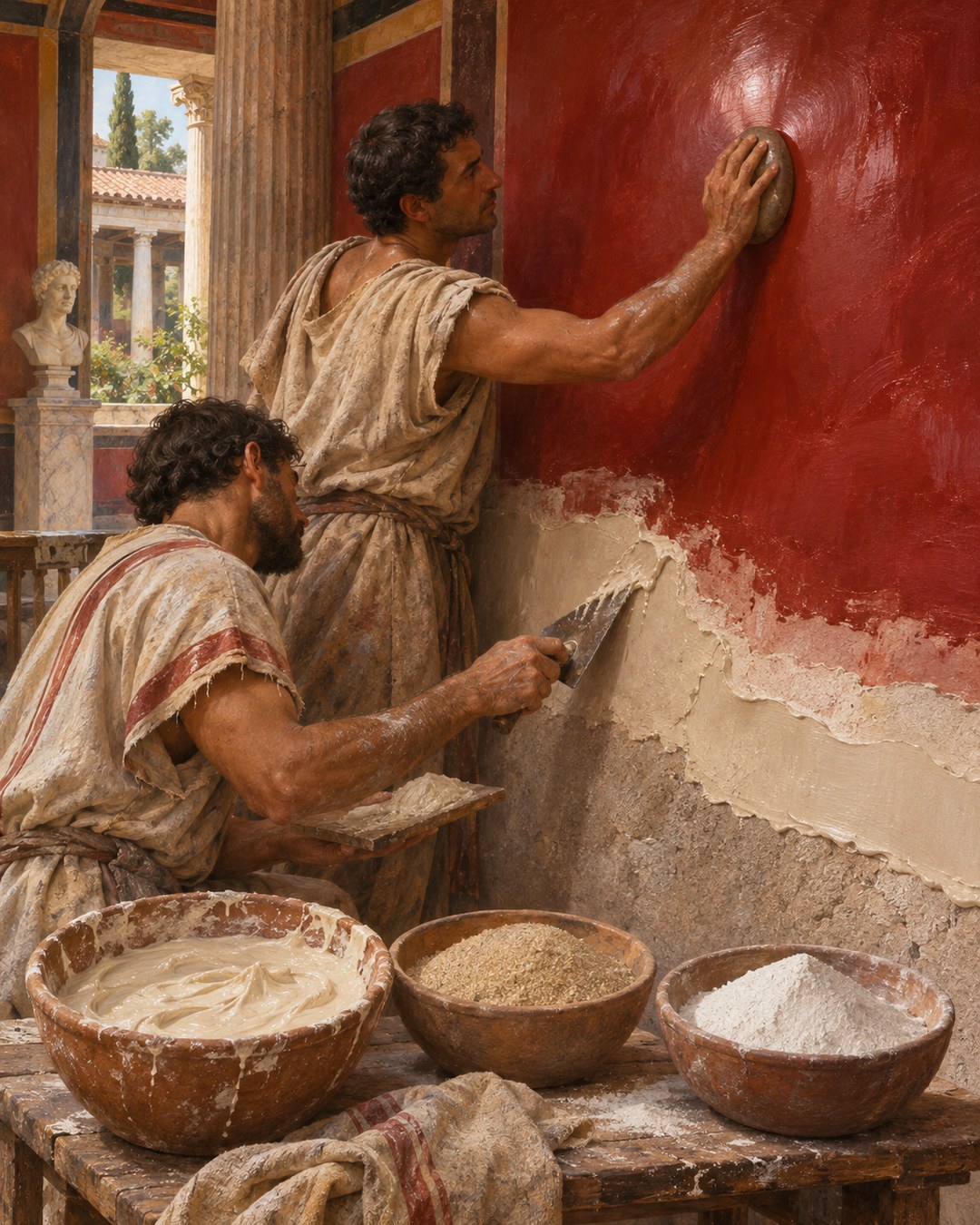
A Roman wall could shine strongly enough for Vitruvius to compare its brilliance with a mirror. The effect did not begin with paint. It began with a heap of lime prepared long before a colored surface existed.
The lime had to slake thoroughly. A plasterer chopped it with a hatchet, feeling for hard pieces and watching what clung to the iron. Only then did work proceed through a rough coat, at least three sand coats and three increasingly fine layers made with marble dust.
Color entered while the final plaster remained moist. Repeated polishing compressed the surface until pigment and wall set together. What looked like decoration was the exposed face of a carefully built section.
Vitruvius’s instructions make appearance inseparable from timing, thickness and moisture. A luminous room depended on hidden layers that no guest would ever see.
The First Test Happened in the Lime Heap
Freshly burned lime did not become safe plaster merely because water had touched it. Vitruvius wanted the best lime tempered for a long time so incompletely burned particles could finish reacting before they entered a wall.
If preparation was rushed, crude pieces continued to change after spreading. They produced blisters that broke the surface and destroyed its smoothness. A defect concealed in the heap could therefore emerge only after expensive finishing work covered it.
The plasterer tested consistency with a tool associated more readily with timber. A hatchet chopped through the mass. If its edge struck lumps, slaking was incomplete. If the blade emerged dry and clean, the lime was poor and weak.
Rich, well-tempered lime behaved differently. A glutinous film adhered to the iron. The test translated chemistry into touch and sight. Workers did not need a written percentage to know that a batch remained risky.
Time in the heap was part of construction. The wall’s schedule began before scaffolding rose, and no polish could repair lime that had been hurried at the start.
Roughness Prepared the Wall for Precision
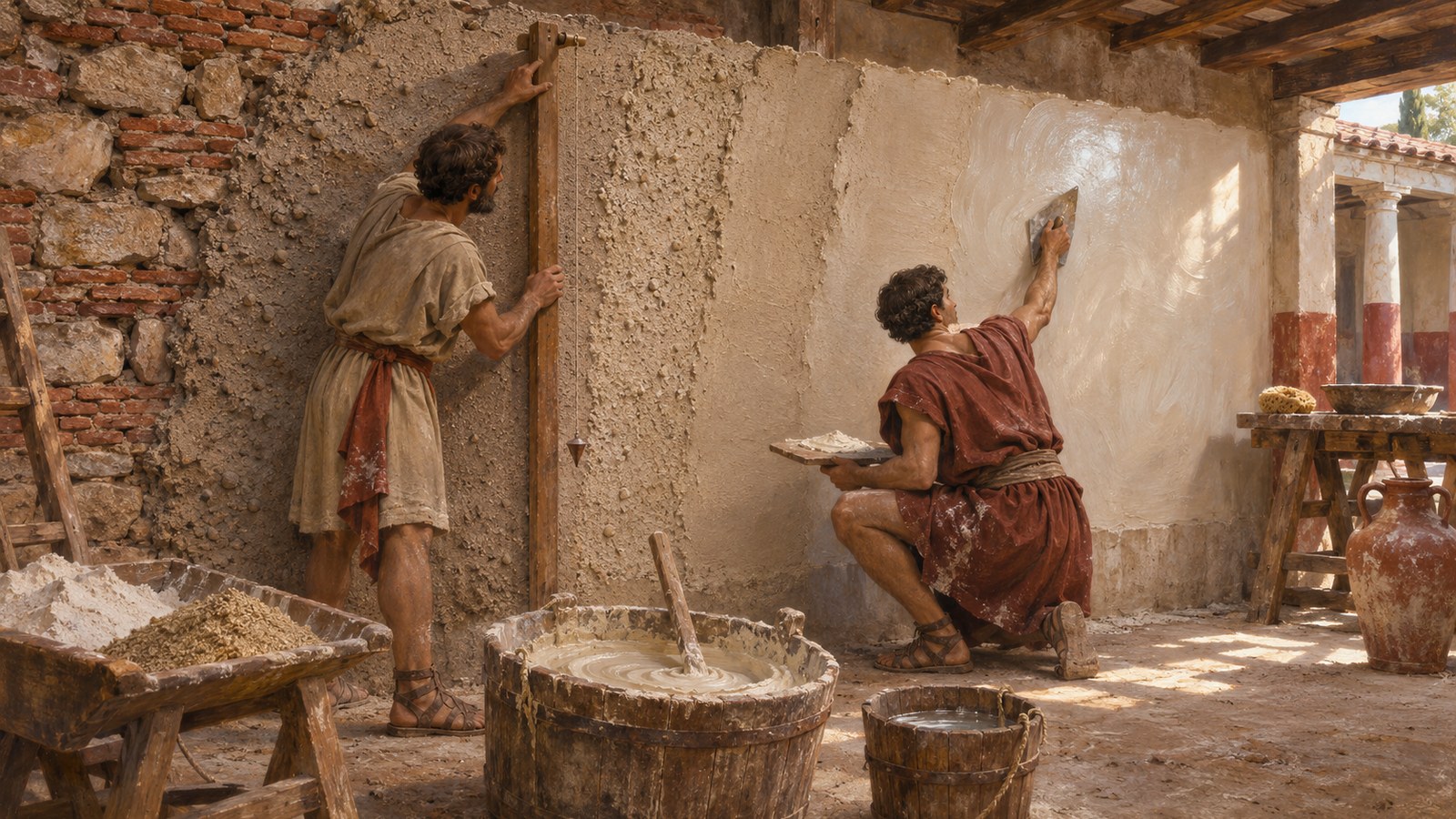
The first coat on masonry was laid as roughly as possible. That surface gave later material something to grip. Smoothness arrived by accumulation, not by making every layer delicate.
While the rough work dried, sand plaster was added and checked in three directions. A rule controlled length, a plumb line controlled vertical alignment, and the corners were brought square. Decoration needed a disciplined plane beneath it.
Vitruvius calls for a second and then a third sand coat. The more solid this body became, the more durable the finished wall. Several coats distributed shrinkage and allowed a craftsman to correct irregular masonry gradually rather than hiding everything under one thick skin.
This layered logic differs from the long weathering test used to select exposed building stone, but both processes made time reveal weakness before final use. One left quarry blocks outdoors; the other allowed prepared materials and coats to settle in sequence.
The wall was now straight and sound, yet still not ready to shine. Sand created the body. Marble would create the working face.
Marble Dust Made a Surface Dense Enough to Polish
The first marble-dust mixture had to release cleanly from the trowel. Vitruvius then describes progressively finer material: a coarse marble layer, a middle grade and a final fine coat.
He pairs three sand coats with three marble coats. Together with the first rough application, the instructions describe a deep build rather than a token skim. Durability came from enough body to resist cracking and enough fine material to close the surface.
Each grade did a different job. Coarse particles bridged the transition from sand plaster. Finer particles reduced pits and accepted compression. The last coat provided a continuous field in which color could sit without being isolated from the wall.
Marble here was not necessarily a prestigious slab. Crushed stone entered as aggregate, allowing craftsmen to borrow its pale density and capacity for polish. An ordinary masonry wall gained a marble-like face by process rather than by cladding.
The transformation can be compared with Vestorius’s conversion of sand and copper into blue pigment. Both crafts relied on prepared mineral particles, but the wall demanded that color and support meet at precisely the right state.
Wet Color Became Part of the Wall
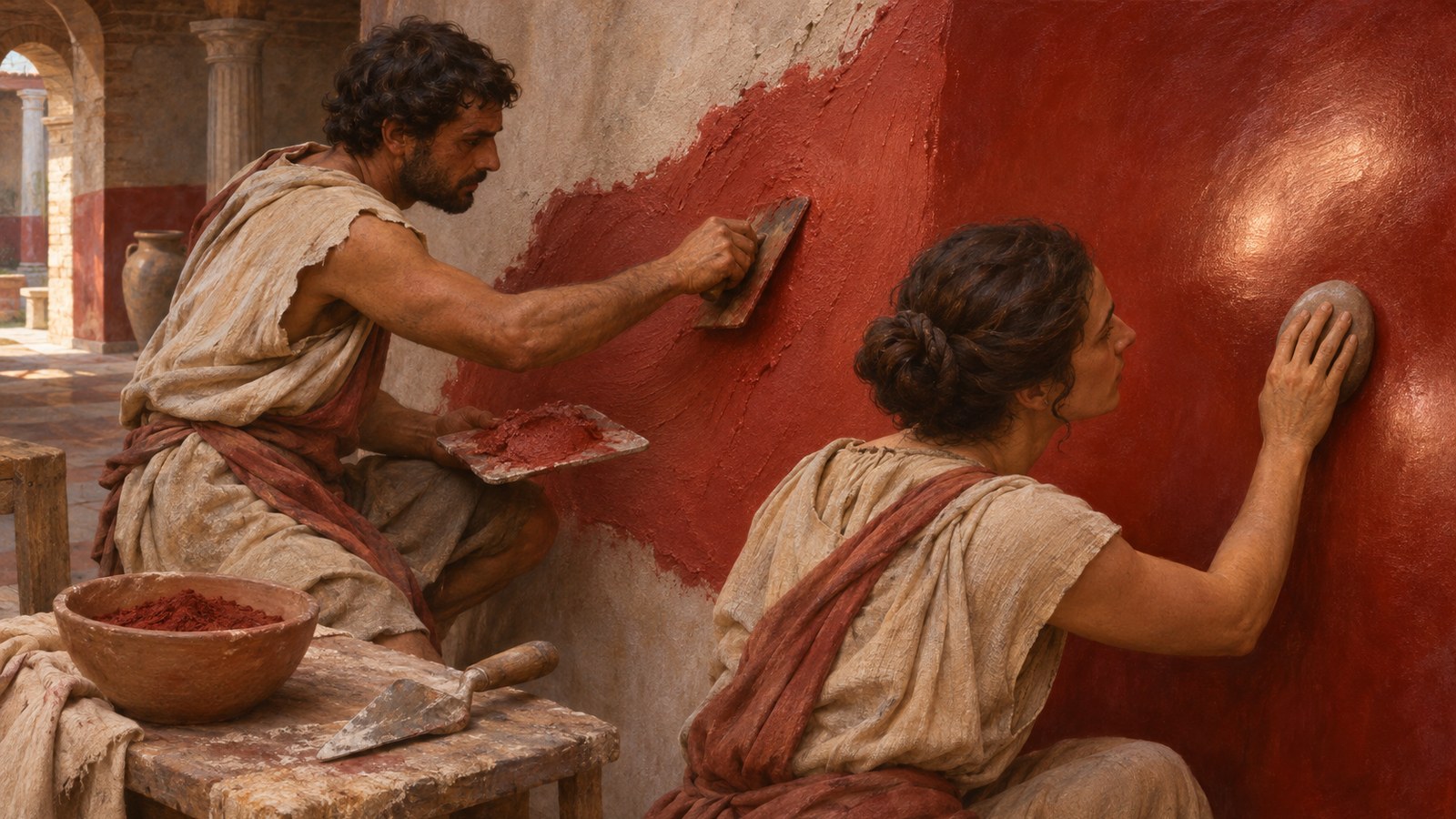
Vitruvius insists that pigments applied to moist plaster do not fade in the same way as color placed on a dry surface. Lime still carrying moisture binds the color as it sets.
The distinction is structural. Dry painting puts a colored film onto a completed support. Wet work lets pigment enter the finishing layer while that layer is still becoming solid. The boundary between image and wall is less abrupt.
Timing controlled the available area. A plasterer could not leave an entire room wet indefinitely. The team had to prepare a workable section, apply color before its surface closed and polish while the material still responded.
The wall therefore coordinated trades. Mortar preparation, leveling, pigment grinding, drawing and polishing could not proceed as independent jobs with unlimited delay between them. One crew’s moisture became another crew’s deadline.
Vitruvius’s confidence should not make every surviving Roman painting identical. Sites reveal repairs, varied recipes and different levels of finish. His text offers a demanding technical ideal and explains what an architect believed made superior work endure.
Polishing Rewarded Every Hidden Layer
Repeated polishing brought the final brilliance. Pressure compacted fine marble and lime, closed pores and made the colored surface respond evenly to light.
A thin decorative coat over a weak body could not withstand that treatment. The tool would expose movement, cracks or unevenness below. The mirror-like result was therefore evidence that earlier stages had succeeded.
Vitruvius says walls built with sufficient sand and marble coats would resist cracking and hold their polish. He even reports that old Greek plaster was cut into panels and reused, its surfaces valued after the original building context had changed.
That claim gives finished plaster the status of a material worth salvaging. Decoration was not always disposable skin. Dense, well-made work could become an object in its own right.
Smoke and room use still mattered. Elsewhere in the same book Vitruvius warns that delicate white work soils easily and recommends plain forms where fire or many lamps make cleaning necessary. Technical excellence did not suspend ordinary household grime.
The finished wall concealed its own history. A visitor saw red, black, yellow or painted architecture and perhaps a soft reflection. Behind it lay a lime heap tested with iron, rough adhesion, three squared sand coats and three grades of marble.
Its shine was not painted on. It was built inward from the masonry and brought outward by moisture and pressure. Roman plaster endured when every layer arrived ready for the next one.
The section also explains why shortcuts were hard to diagnose after completion. A blister on the visible face might begin in badly slaked lime far below it; a crack might record insufficient body; dullness might expose coarse finishing material or mistimed polishing. Surface failure carried the history of buried preparation.
For the workshop, quality meant controlling transitions: hot lime to tempered paste, rough masonry to square sand body, coarse marble to fine, wet ground to fixed pigment. Each transition narrowed the chance to correct the previous one. The final reflection was a compressed record of every earlier decision.
The hatchet test also shows why the recipe cannot be reduced to a list of ingredients. Lime, sand and marble dust were not enough on their own. The plasterer had to judge when each material had reached the condition required by the next operation. A clean dry blade warned that the lime lacked the rich adhesion Vitruvius wanted; surviving lumps warned that slaking remained incomplete. Later, a marble mixture that left the trowel clean signaled another usable transition. The finished brilliance depended on these workshop decisions, made before anyone could see the wall’s color.
Sources
Vitruvius, De Architectura 7.2–3.