
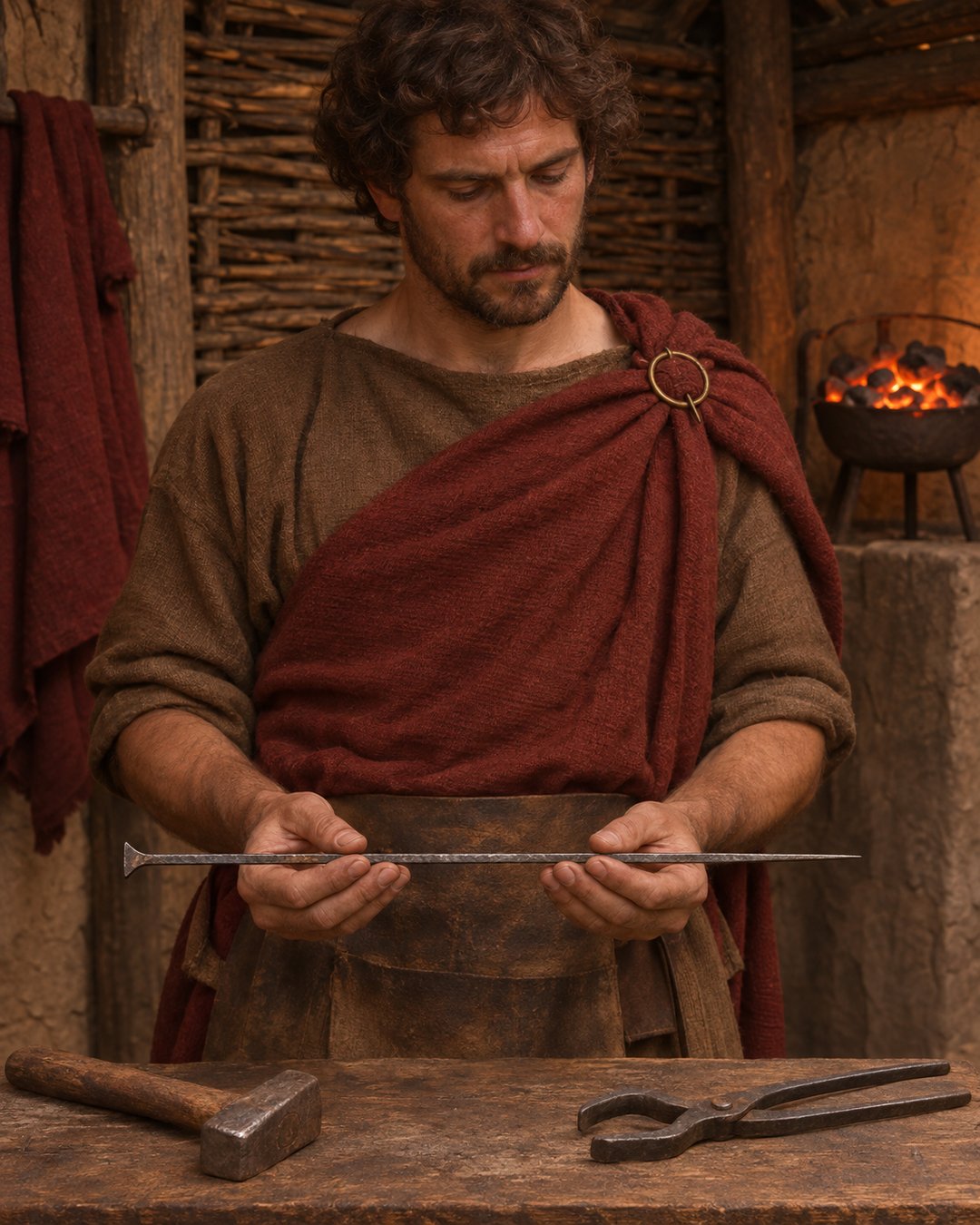
The iron rod is 285 millimetres long. One end narrows to a point. The other spreads into a flat triangular head only 14.5 millimetres wide, with marked shoulders where the head meets the shaft.
London Museum catalogues it as a Roman skewer or spit, dated broadly from AD 43 to 410. Yet the head creates an immediate complication: its form is identical to that used on certain Roman nails.
This is not a failure of identification. It is the reason the object is useful. A small tool could borrow a familiar workshop shape without becoming the same thing. The skewer asks us to read length, section, taper and endpoint together rather than trust one recognizable feature.
A 285-Millimetre Rod Had to Work as One Continuous Form
The museum describes the shaft as a flat rod of rectangular section. That wording matters. This was not a round wire with a decorative cap, and it was not a broad knife blade. Its cross-section gave the iron a particular combination of stiffness and narrowness over almost thirty centimetres.
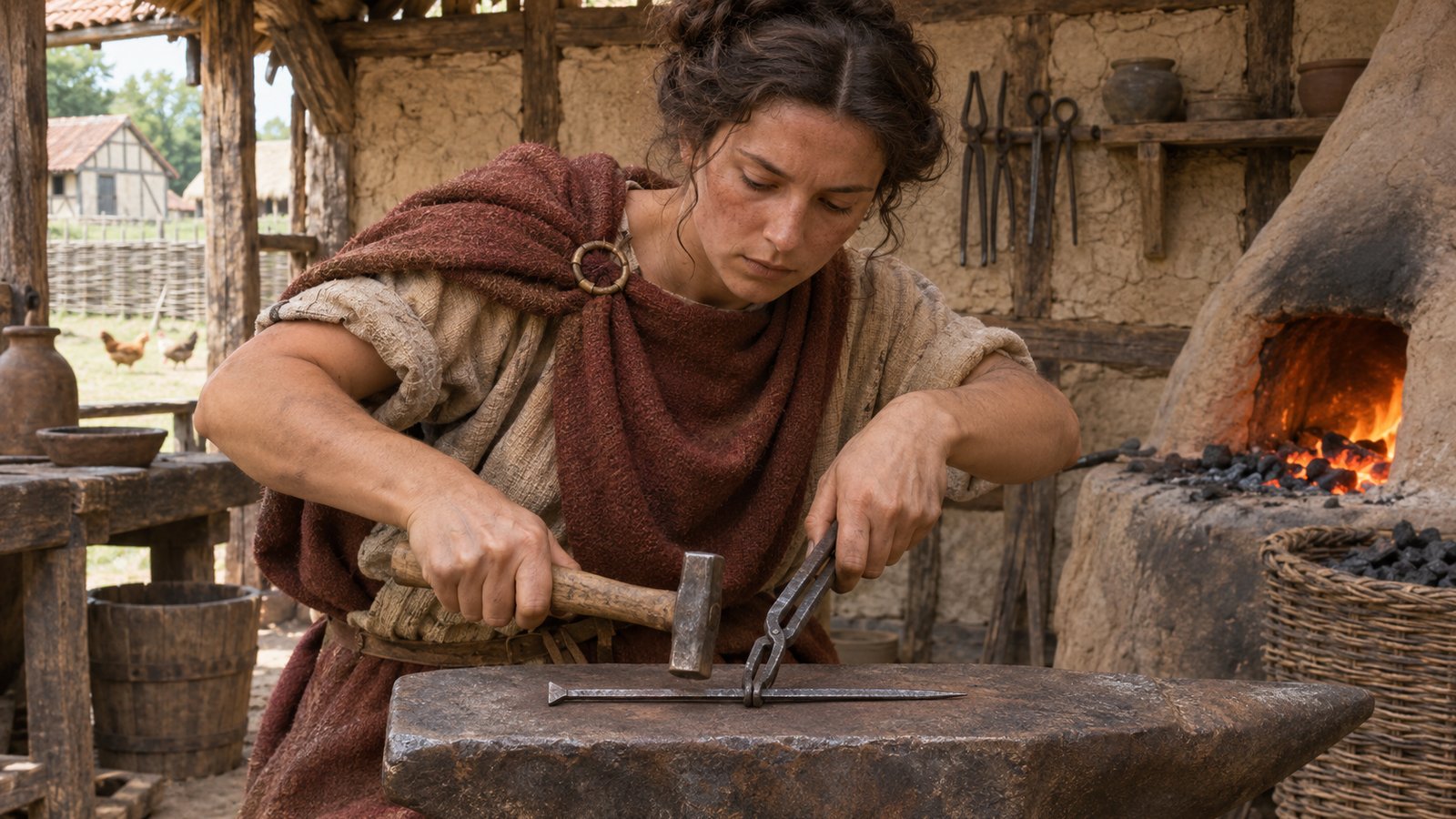
From the triangular head, the rod passes through marked shoulders and tapers toward the lower point. Each part can be described separately, but the object worked because those transitions remained continuous. The point concentrated force. The long shaft carried it. The broader head gave the upper end a clear termination.
The catalogue allows two closely related names: skewer or spit. Both identify a long pointed implement, while leaving the precise scale of use open. “Spit” can suggest roasting; “skewer” can suggest piercing, holding or arranging smaller material. The record does not force a scene that the iron itself cannot prove.
That caution is especially important for an uninscribed tool. No surviving label names its owner or task. The useful evidence is physical: iron, rectangular section, triangular head, shoulders, taper, point, length and width.
The result is an object that looks simple only until each decision is noticed. A smith had to preserve enough metal for the head, establish the shoulders, draw out the shaft and finish a point without making the long rod too weak for handling.
The Triangular Head Repeated a Shape Used on Roman Nails
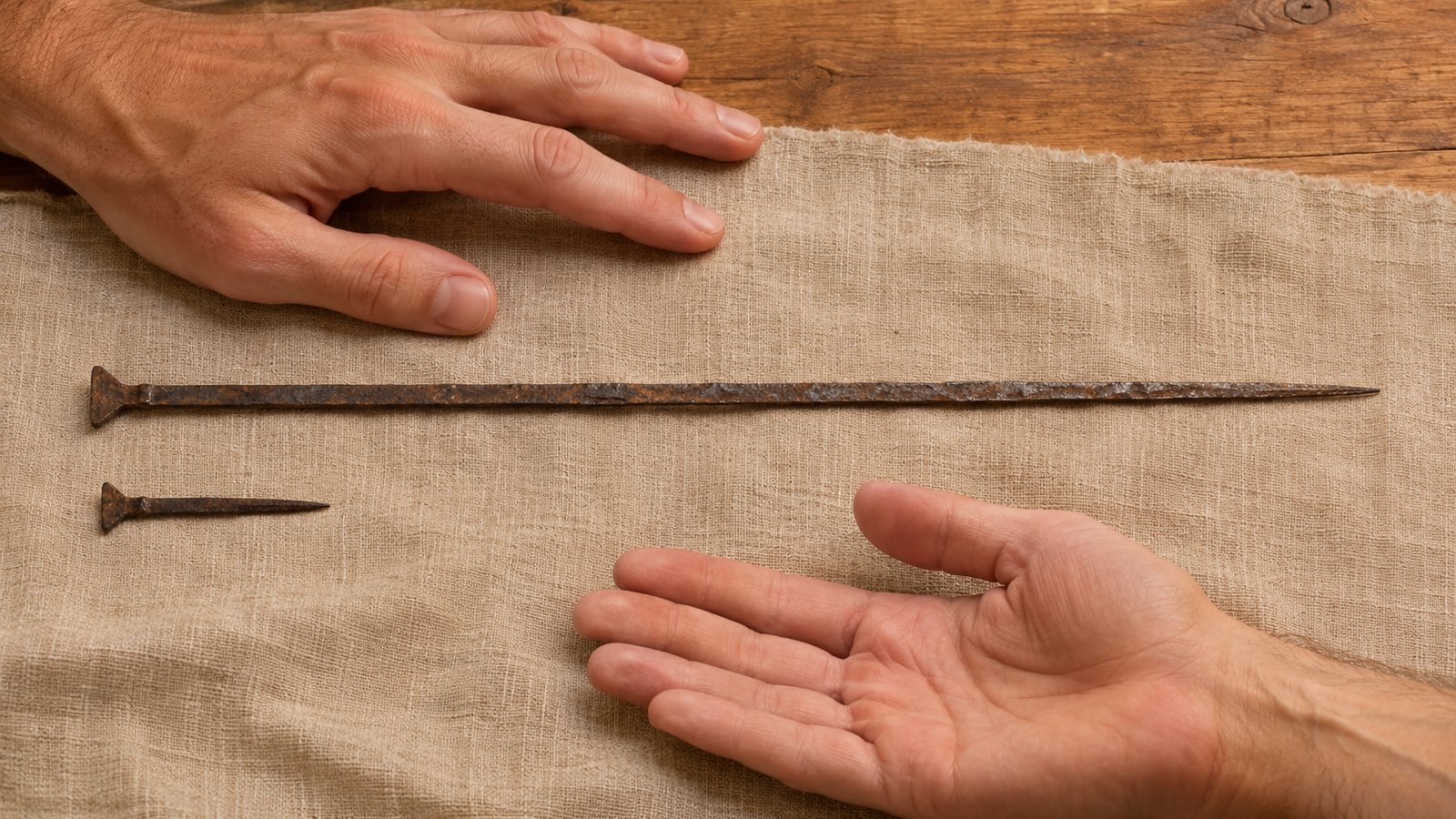
The museum compares the head with Roman nails classified by W. H. Manning as Type 2. It says the form is identical and notes that this triangular shape is characteristic on Roman fittings and tools.
That comparison does not turn the skewer into a nail. A nail is interpreted through the entire object: a head made to receive blows, a shaft intended to enter material and dimensions suited to fastening. Here, the long tapered rod and the catalogue’s skewer-or-spit identification change the reading.
The shared head instead reveals a workshop vocabulary. Roman ironworkers did not need to invent a unique terminal shape for every implement. A flat triangle with marked shoulders was familiar, legible and practical across more than one object class.
Repetition also helps archaeologists. When corrosion obscures surfaces and an object survives without its original setting, comparison can reconnect a fragment with known manufacturing habits. The museum’s description moves from this specimen to Manning’s nail type, then back to a wider family of fittings and tools.
That method resembles the care needed to understand two Roman folding knives whose blades disappeared into their handles. In both cases, an ordinary label becomes convincing only after geometry and movement are reconstructed. “Knife” is not enough without the pivot and folded blade; “skewer” is not enough without the long rectangular rod and pointed taper.
The nail-shaped head therefore carries two histories at once. It belongs to this implement, and it preserves a form repeated elsewhere in Roman ironwork.
Marked Shoulders Separated the Hand End from the Point
The shoulders are easy to pass over because the point seems more obviously functional. Yet they mark the place where the broad triangular end narrows into the rod. That break in outline gives the object orientation before any use is imagined.
One end is visibly finished as a head; the other is progressively reduced. The distinction matters on a tool that otherwise has no handle of wood, bone or horn recorded by the museum. Its iron shape itself tells the user which end is not meant to pierce.
The 14.5-millimetre width of the head is modest beside the 285-millimetre overall length. The proportions keep the object linear. The triangle stops the rod without dominating it, while the taper spends most of the length preparing the point.
Those proportions also prevent a misleading heroic scale. This was not a spear and not a heavy architectural spike. It was a hand tool narrow enough to belong among the implements of work and preparation. The museum tags it with trades and workers as well as Roman London.
The measurements sharpen that distinction. At 285 millimetres, the object is more than nineteen times the recorded width of its head. Width is concentrated at one terminal while length belongs to the shaft. A spearhead would make the piercing element visually dominant; this implement makes reach dominant and lets the working point emerge only at the end of a prolonged taper.
The rectangular section adds another clue. A circular rod can turn without presenting a preferred face. A flat rectangular rod has edges and planes that remain perceptible in the hand. The museum does not state exactly how the implement was gripped, so the effect should not be overstated. Still, section was part of the tool’s usable form, not a measurement accidentally left by corrosion.
Iron suited this continuous construction. It could be forged into a head, shoulders, a long shaft and a point without requiring separate pieces to be joined. The catalogue does not describe a surviving attachment, ornament or inscription. What remains is the working outline.
A related lesson appears in the Roman copper pan whose form made quantity visible. Neither object needs elaborate decoration to communicate its task. The pan’s body and handle organize measuring and pouring; the skewer’s head, shaft and point organize grip, reach and piercing.
The Catalogue Preserves Uncertainty Without Making the Tool Vague
The production date spans Roman Britain, from AD 43 to 410. That range does not identify a single household, decade or meal. It places the implement in a long material tradition and keeps the interpretation proportional to the evidence.
“Skewer or spit” is similarly disciplined. The two terms overlap around a pointed rod but imply different scales and scenes. Choosing one too confidently would add information the record does not supply. Keeping both does not erase what is known.
We know the material is iron. We know the length and head width. We know the rectangular shaft, triangular head, marked shoulders and lower point. We know the head matches a documented Roman nail form and that the shape recurs among fittings and tools. Those details create a strong object identity even while one word remains open.
This is how archaeology often becomes most precise: not by eliminating every alternative, but by defining the limits of each one. The object is not “mysterious” merely because it can be called by two related names. Its uncertainty is bounded by form.
The permanent collection record also preserves an uncelebrated category of Roman evidence. Emperors and battles rarely depend on a 14.5-millimetre triangular head. Daily work does. A long iron rod survives because somebody shaped a common metal into a very specific sequence of surfaces.
Seen whole, the implement is more than a point. Its nearly thirty-centimetre length, rectangular shaft and nail-like head make a coherent tool. Seen carelessly, the familiar triangle could pull interpretation toward the wrong object. The Roman skewer teaches the value of reading every part before naming the thing.
Sources
London Museum, “Skewer” collection record; W. H. Manning, Roman ironwork typology cited by the museum.