
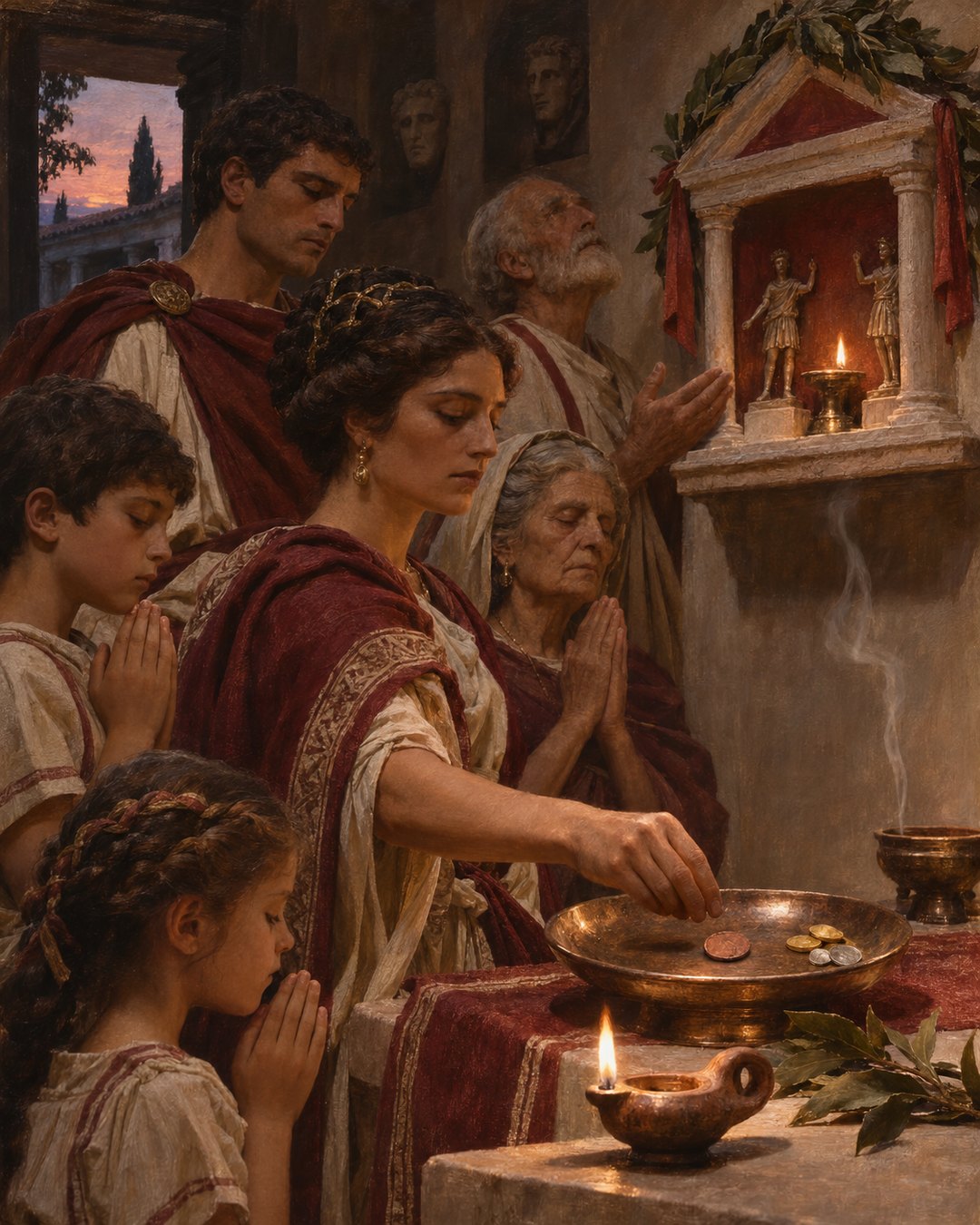
A small copper coin sat at the centre of one Roman family’s future. It was not valuable because copper rivalled gold. It mattered because the Servilii believed this inherited object could consume richer metals and reveal whether their household was about to rise or fall.
Pliny the Elder found the story strange enough to preserve and too strange to explain. In Book 34 of the Natural History, he described a sacred triens that the Servilian family “nourished” with gold and silver. Once each year, the household approached it with a carefully conducted sacrifice. Then came the anxious observation: the coin was said to grow or shrink, and its changing size foretold the family’s advancement or decline.
This was not a coin acting as ordinary money. It was an heirloom, a ritual participant and a household barometer. Its authority came from repetition. Every annual ceremony renewed the relationship between living family members, their ancestors and a material object whose alleged appetite could not be reduced to its face value.
The Object Was a Denomination Before It Became an Heirloom
A triens was traditionally one-third of a Roman as. The name belonged to a monetary fraction, but Pliny’s wording moves this particular specimen out of everyday exchange. He does not describe anyone spending it, weighing it in a market or reading its design. He calls it sacred and attaches it to the Servilii, a family he presents as illustrious in Roman history.
That distinction matters. Coins normally pass from hand to hand. The Servilian triens acquired force by not circulating. Its continuity depended on custody: the same family retained it, returned to it and interpreted it over time. A transferable piece of copper became a fixed point around which generations could organize memory.
Pliny gives no reliable date for its creation and no description of its images. He does not say where it was kept or how large it appeared. Those silences prevent a modern reconstruction of its physical history. What survives is the relationship built around it. The coin belonged to the family, received a rite and produced a sign.
That makes it closer to the domestic practices behind the Roman rite of seven black beans than to a purse of loose change. In both cases, an ordinary material gained power from exact handling, spoken or inherited meaning, and repetition within a household setting.
The Family Fed Metal to Metal Once a Year
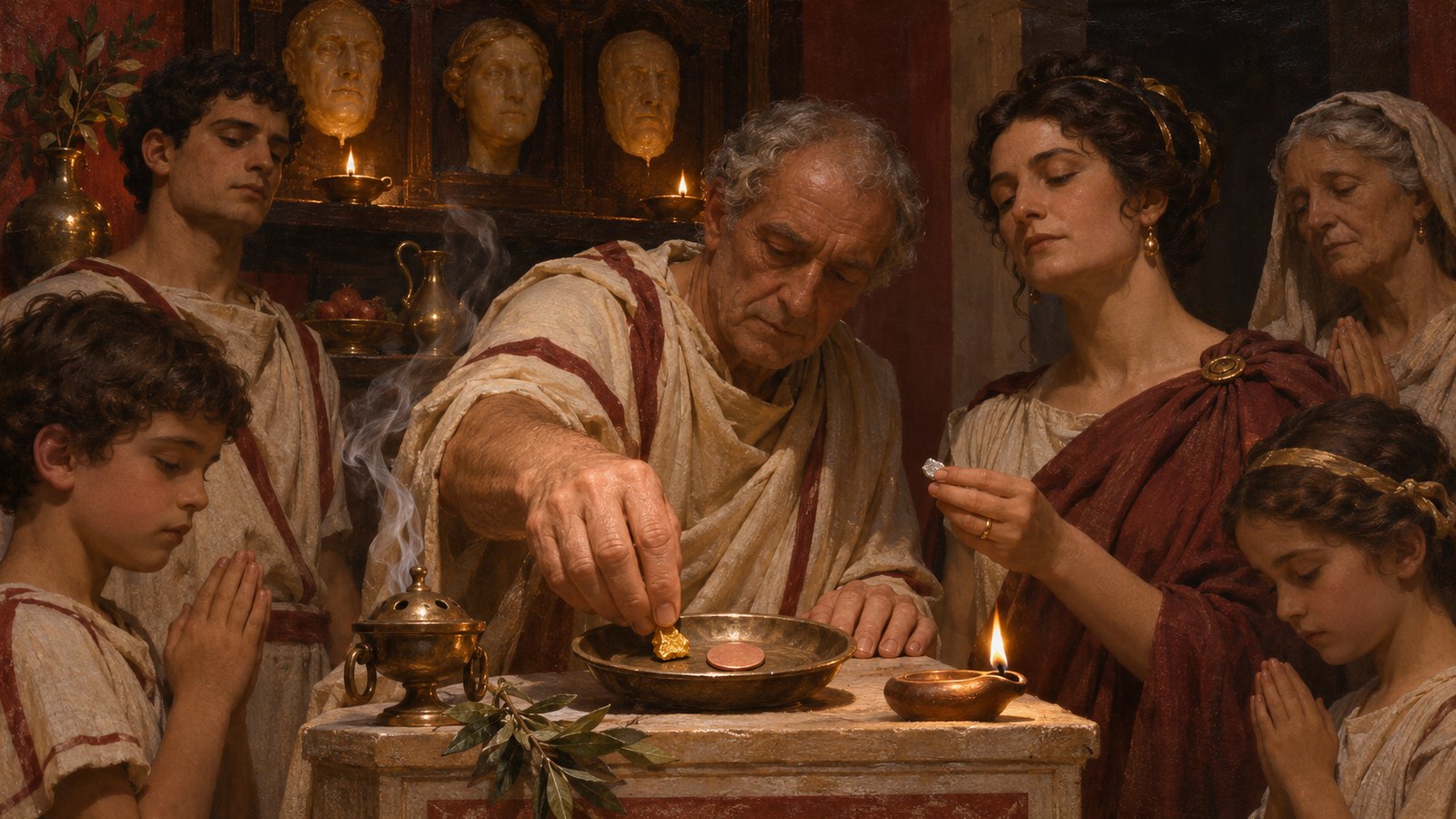
Pliny’s most arresting verb is the one that makes the copper seem alive. The Servilii “nourished” it with gold and silver. The statement does not tell us what physically happened to those offerings. They may have been placed beside it, attached to it or consumed through some process now lost. Pliny himself refused to pretend that he understood the object’s origin or nature.
Instead, he quoted Messala’s account. That older testimony said the family offered a sacrifice every year with great care and magnificence. The annual rhythm turned custody into an obligation. An heir did not simply inherit a curious coin; the heir inherited the responsibility to maintain a ceremony and recognize what followed.
Gold and silver sharpened the hierarchy of the scene. The base-metal object received metals conventionally valued above it. Yet the ritual reversed ordinary market logic. The precious substances served the copper because the copper carried the family’s sacred history. Its importance could not be calculated by melting the pieces down and comparing their prices.
The rite also joined wealth to vulnerability. A family able to make magnificent offerings still submitted its prospects to a tiny inherited object. The richer metals did not guarantee a favourable answer. They were part of the question.
A Change in Size Became a Forecast
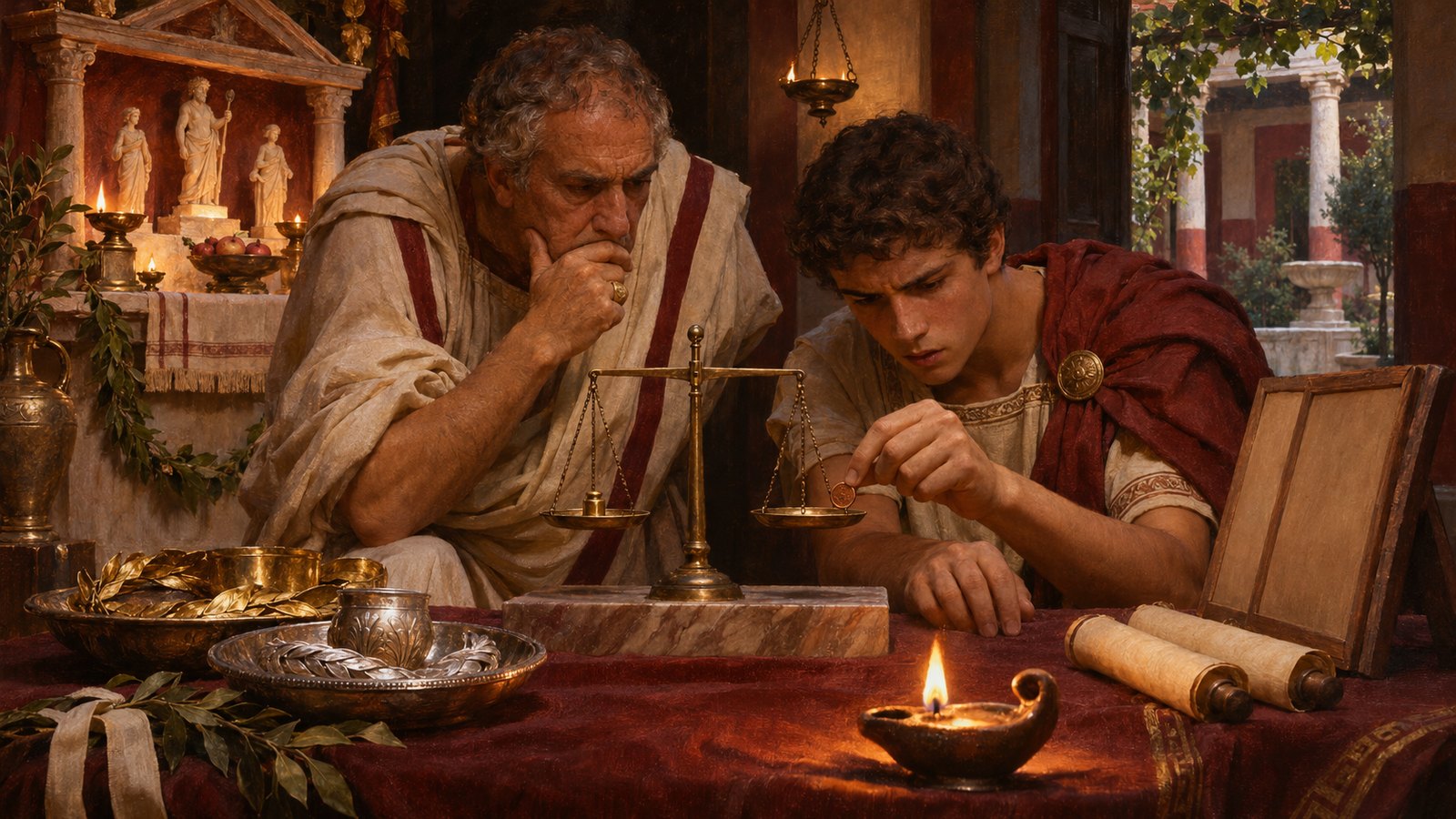
After the sacrifice, the triens was said sometimes to increase and sometimes to diminish. Messala’s explanation was direct: growth indicated coming advancement for the Servilii, while shrinkage announced decadence or decline. The object translated an uncertain political and social future into a change that family members believed they could observe.
The mechanism is unknown. Ancient alloys could corrode, accrete deposits or change appearance after handling, but Pliny supplies no measurements and no experiment. He does not claim that a balance proved the alteration. A responsible reading therefore stops short of manufacturing a chemical solution for a story whose physical circumstances have vanished.
What can be seen clearly is the interpretive system. The sign had two directions and two outcomes. Larger meant ascent; smaller meant decline. That simple pairing made the object useful in a world where elite fortunes could turn through elections, prosecutions, military commands, marriages or imperial favour.
The coin did not need to identify the event. It only needed to tell the family how to read change. Like the woodpecker omen offered to Aelius Tubero, the sign forced human ambition into a ritual frame. Success was not merely achieved; it could be anticipated, authorized or shadowed by an encounter with the sacred.
Pliny Preserved the Puzzle Instead of Solving It
Pliny often records wonders, technical recipes and claims that sit uneasily beside one another. Here he marks his own limit unusually plainly. The origin and nature of the Servilian triens were incomprehensible to him. That admission is part of the evidence, not an obstacle to be removed.
By naming Messala and quoting the earlier account, Pliny shows how the story reached him. He is not reporting that he watched the coin grow. He is preserving a family tradition transmitted through another Roman author. The chain of testimony gives the episode historical value while leaving its physical claim unverified.
That tension explains why the passage is so useful. It reveals an educated Roman willing to distinguish between a reported custom and an understood mechanism. Pliny neither deletes the marvel nor supplies false certainty. He allows inherited prestige, annual ritual and material mystery to remain entangled.
The family’s interpretation may have mattered more than any measurable alteration. Each year provided a moment to assess the household’s position. If members expected ascent, a perceived increase confirmed hope. If danger loomed, diminution could make decline feel legible. The object gathered anxiety into one place and gave collective attention a fixed form.
Roman Copper Could Carry Gods, Condemnation and Memory
Pliny places the story in a book about copper and bronze, not in a separate catalogue of private superstition. Nearby, he says that Rome’s first brass image of a deity represented Ceres. Its cost came from the property of Spurius Cassius, who had been put to death for allegedly aspiring to kingship. Metal could therefore carry a god’s image while also preserving the political meaning of confiscation and punishment.
Pliny adds that brass images later moved from gods to human beings. The material crossed boundaries between worship, public honour and remembrance. The Servilian triens worked on a more intimate scale, but it depended on the same ability of metal to outlast one life and accumulate stories.
Copper was durable enough to pass between generations, yet reactive enough to change colour and surface. It could be counted as money, shaped as an image or guarded as a sacred possession. The Servilii did not need those uses to remain separate. Their triens began as a denomination and endured as something a market could not price.
The extraordinary claim was that it ate gold and silver. The more revealing fact is that a powerful family returned to a small copper object every year, performed its obligation and waited for the household’s future to become visible. In that ceremony, inheritance was not passive. It had to be fed, watched and interpreted.
Sources
Pliny the Elder, Natural History, Book 34, chapters 9 and 38.