
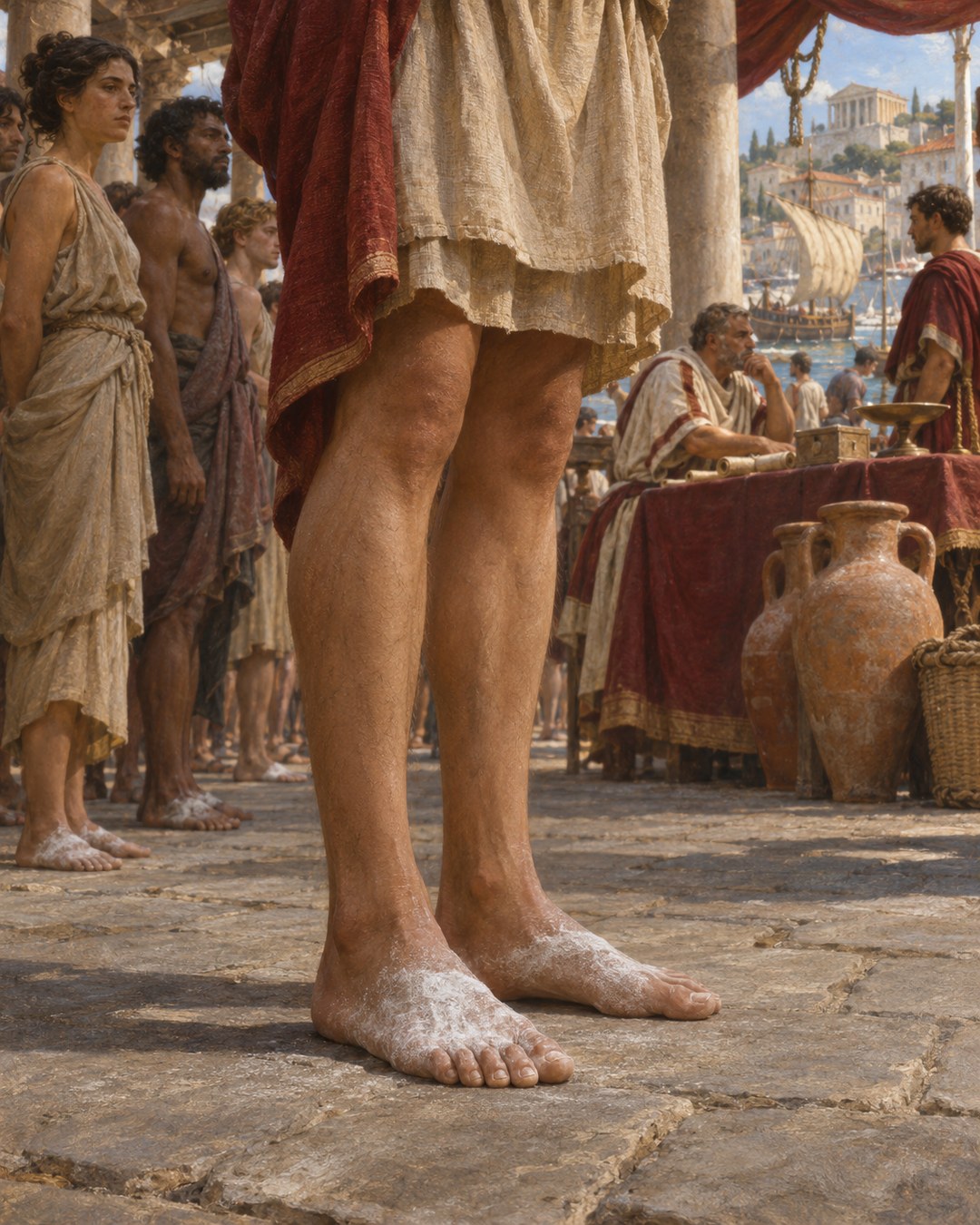
A buyer in a Roman slave market could read a person’s origin from dust on the body. Pliny the Elder says imported enslaved people had their feet marked with a low-grade chalk. Before a name, talent or future entered the bargain, whitened feet announced that the captive had come from overseas.
The mark was cheap, visible and temporary. That was precisely why it worked. Chalk could turn geography into a sales label without changing the person permanently, while the market converted forced movement into property.
Pliny makes the detail more disturbing by following three marked arrivals beyond the sale. Publilius Lochius became a founder of Roman mime, Manilius Antiochus cultivated astronomy, and Staberius Eros taught grammar. The feet that advertised foreignness belonged to people whose knowledge would later enter Roman cultural memory.
The Market Put Origin Where Everyone Could See It
Pliny places the practice in a discussion of cretaceous earths. The poorest chalk, he says, had two public uses: tracing the victory line in the Circus and marking the feet of enslaved people brought from overseas. One substance therefore helped spectators see a finish and buyers identify a category of human merchandise.
The source does not describe a permanent brand. It describes a surface mark. Chalk was bright against skin and footwear could not conceal it while the feet remained on display. The signal needed only to last through inspection and sale.
“Imported” was not a neutral travel note. It told buyers that capture, trafficking or resale had carried a person across the sea into a Roman market. The mark compressed that violent route into one commercial fact. A crowd did not need to hear the seller recite the journey before recognizing the claim.
Roman sale depended on making distinctions legible. Property could move through formal ritual, as another Lost Eagles article shows in the ceremony where bronze, a scale and five witnesses transferred ownership. Here the distinction was applied directly to a human body. Chalk turned the body into part of the market’s signage.
Pliny does not tell us who applied it, how thickly, or at what stage between ship and auction. Those details should remain unknown. What his sentence establishes is enough: overseas origin was advertised visibly at the point of sale.
Three Marked Arrivals Refused to Stay Anonymous
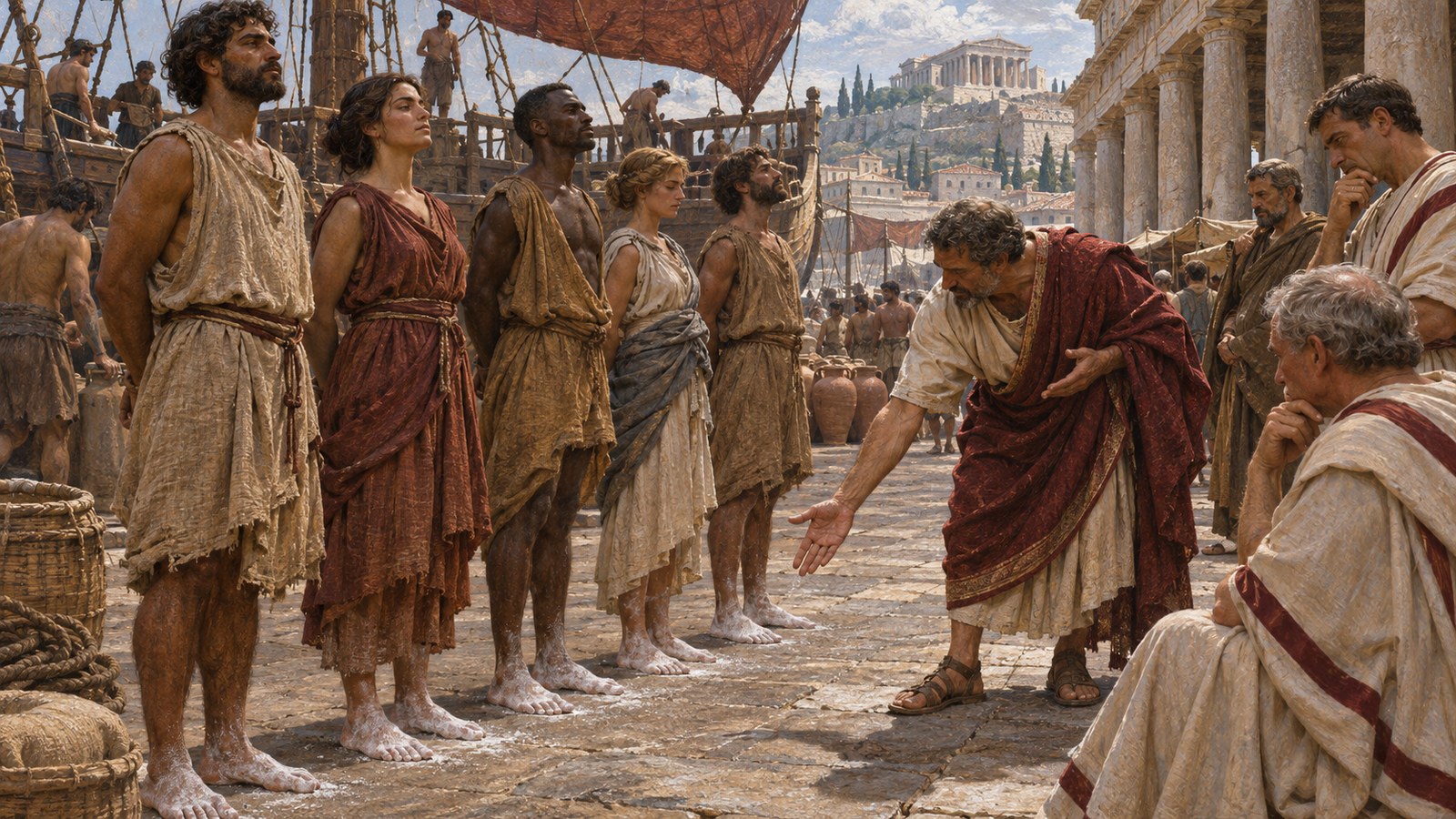
Pliny immediately names Publilius Lochius, Manilius Antiochus and Staberius Eros. He says Romans had seen all three brought over in the same ship. That shared arrival is a datable mini-scene only in the broadest sense: one vessel discharged people whose feet identified them as foreign merchandise, while no one at the quay could yet see the reputations they would acquire.
Publilius became associated with the establishment of mime on the Roman stage. Manilius became known for astronomy. Staberius became a grammarian. Pliny chooses intellectual and performative achievements because they reverse the market’s first judgment. The chalk sorted bodies by origin; later memory sorted these men by work.
The passage does not prove that talent softened slavery or that social ascent was typical. Naming exceptional survivors can hide the far larger population whose lives left no literary trace. Pliny’s examples matter precisely because he treats their rise as striking.
Even their surviving names require care. Ancient accounts often preserve freedmen through the households, patrons and cultural fields that made them visible to elite writers. We know the outcome Pliny wanted to emphasize, not complete biographies of the men who stepped off the ship.
Still, the three names break the anonymity of the sales device. Chalk treated overseas people as one class. Pliny’s list restores differences in occupation, skill and reputation that the white mark could not express.
Chalk Worked Because the Label Could Disappear
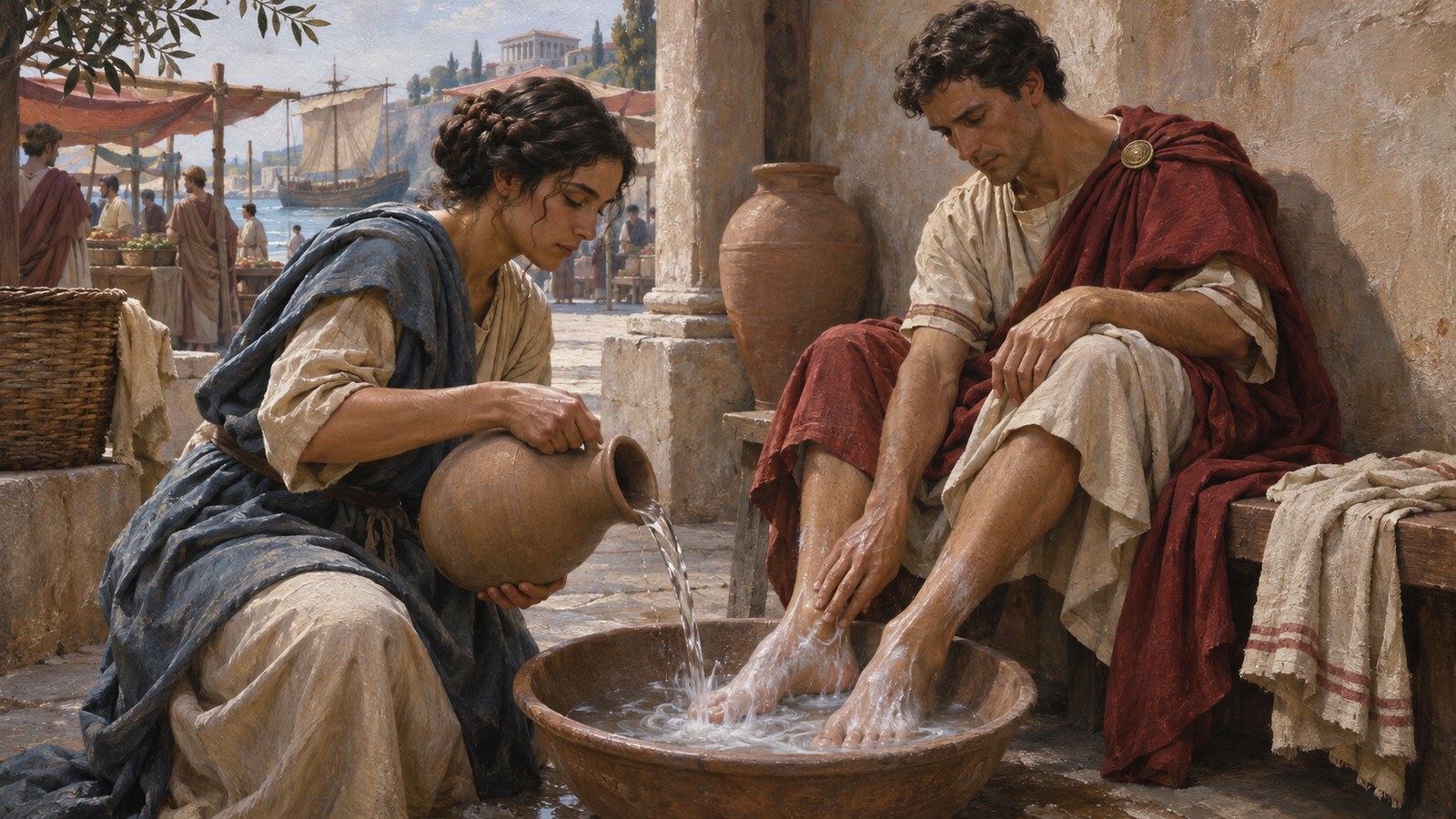
A temporary mark has a particular commercial advantage. It can make a classification obvious during a transaction and vanish afterward. The buyer acquires the person; the market no longer needs the label. Washing removes the mineral while legal ownership remains.
That difference separates chalk from restraints, scars or documents. It did not have to preserve an identity for years. It only had to coordinate the seller’s claim and the buyer’s gaze for a short interval.
The body carried the information because literacy could not be assumed among every observer and because visual inspection was central to the sale. Feet whitened with chalk could be noticed across a crowded space. The same mineral’s use for a Circus line suggests how effectively a pale streak could organize attention.
Pliny calls this chalk the most inferior kind. The low value of the material sharpened the hierarchy of the scene. A cheap earth marked people whose prices, labour and future earnings could be substantial. The label cost almost nothing compared with the transaction it enabled.
Nothing about its removability made the classification harmless. Temporary signs can produce durable consequences when they guide a sale. Once ownership changed hands, the chalk had finished its work.
Freedmen Could Rise Without Erasing the Sale
Pliny expands from the three shipmates to other freedmen who reached influence: Chrysogonus under Sulla, Amphion connected with Quintus Catulus, Demetrius connected with Pompey, Hipparchus under Mark Antony, and Menas and Menecrates under Sextus Pompey. His list moves from cultural accomplishment into political power.
The passage is not an uncomplicated celebration. Pliny condemns some men for enriching themselves through proscription and Roman blood. He also describes the senate granting praetorian decorations to powerful freedmen under Agrippina. His tone mixes fascination, resentment and moral criticism.
That elite hostility is evidence too. A freedman’s ascent disturbed observers who expected legal origin to determine social ceiling. Honours, wealth and access could place a former slave near symbols reserved for magistrates, even while memory of the market remained available as an insult.
Rome repeatedly used objects and display to stabilize rank. Public images could carry a dead officeholder back into political view; the Lost Eagles account of funeral masks returning former consuls to the Forum shows ancestry performed as authority. Freedmen possessed no comparable chain of aristocratic faces. Their careers had to work against an origin that elite writers could reduce to chalked feet.
Freedom therefore changed legal condition without deleting biography. Patronage, specialized knowledge and political upheaval could open routes upward. The memory of sale could still be summoned whenever an author wished to question whether the ascent was proper.
The White Feet Exposed Rome’s Contradiction
Pliny ends with a bitter image. People once sent to market with whitened feet could receive honours and return in state toward the places from which they had come, now accompanied by the insignia of office. The visual reversal is deliberate: chalk at one end of the life, ceremonial distinction at the other.
Yet the second procession does not redeem the first. Exceptional advancement depended on a system that continued to move anonymous people through markets. The same society could value a grammarian’s teaching or an administrator’s usefulness while preserving slavery as the legal foundation beneath his earlier sale.
The practice also reveals how Roman categories were manufactured. Overseas origin was not simply known; it was displayed. Inferiority was not merely assumed; it was staged with a mineral mark. Later honour was likewise staged through decorations, attendants and public recognition.
Both moments relied on spectators. Buyers had to understand the chalk. Citizens had to understand the insignia. Status became real in public partly because bodies and objects made it readable.
Pliny’s three shipmates prevent the first label from becoming the whole story. A theatrical innovator, an astronomer and a teacher arrived beneath the same crude sign. Their achievements do not make the market humane. They show how little the market’s visible category could say about the people forced to wear it.
The chalk washed away, but the transaction did not. That is the article’s central mechanism: a fleeting surface mark could direct a permanent transfer, while later Roman memory struggled with people whose lives exceeded the classification it had used to sell them.
Sources
Pliny the Elder, Natural History, Book 35, chapters 57–58.