
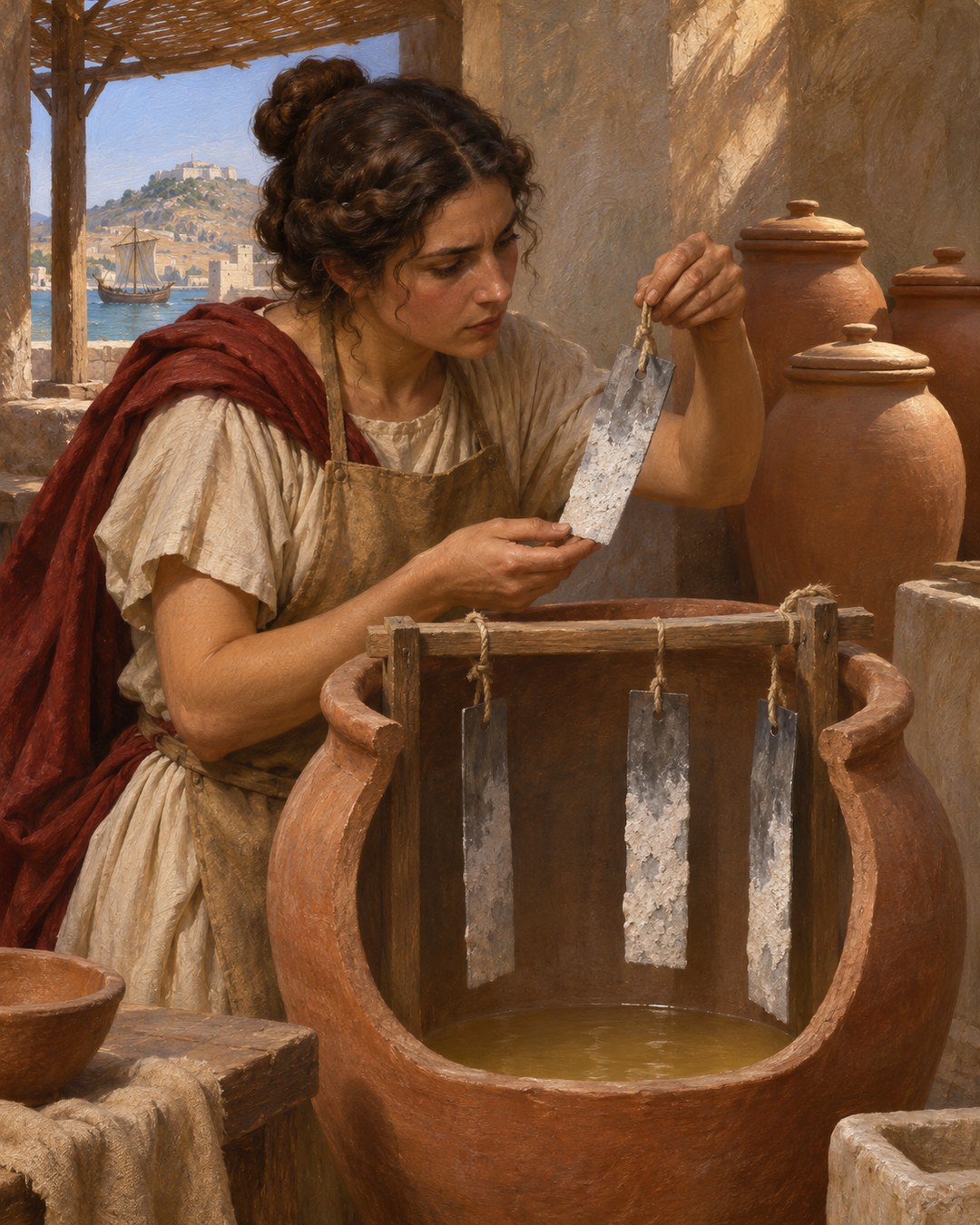
Roman white pigment did not begin as a clean powder. Pliny the Elder describes lead shavings suspended over exceptionally strong vinegar, closed jars left for ten days, a crust scraped from the metal, and repeated cycles that continued until the lead was consumed. The finished material looked simple only after a long chain of corrosion, grinding, washing and drying.
The substance was called psimithium, or ceruse. Pliny ranked the product from Rhodes highest, but his account is more valuable than a place-name. It preserves two manufacturing routes and enough workshop detail to show how colour was built by controlling exposure rather than by merely crushing a naturally white stone.
Rhodes Sold a White Made from Metal
Pliny introduces ceruse as a product of lead-working. That origin matters because the pigment was not treated as raw earth dug from a hillside. A workshop took a dense grey metal and used vinegar to create a new material on its surface. The whiteness was manufactured.
Rhodes supplied the most esteemed version in his account. A reputation like that could attach value to process knowledge as much as to geography. Buyers saw tablets of pigment; the decisive work had already happened in vessels where metal, acid, air and time were arranged by craftspeople.
The first method started with very fine lead shavings placed over a vessel filled with the strongest vinegar. The wording describes separation as well as contact. The lead did not simply disappear into an open vat. Vapour and liquid acted within a deliberately arranged container, and the material that fell into the vinegar was recovered.
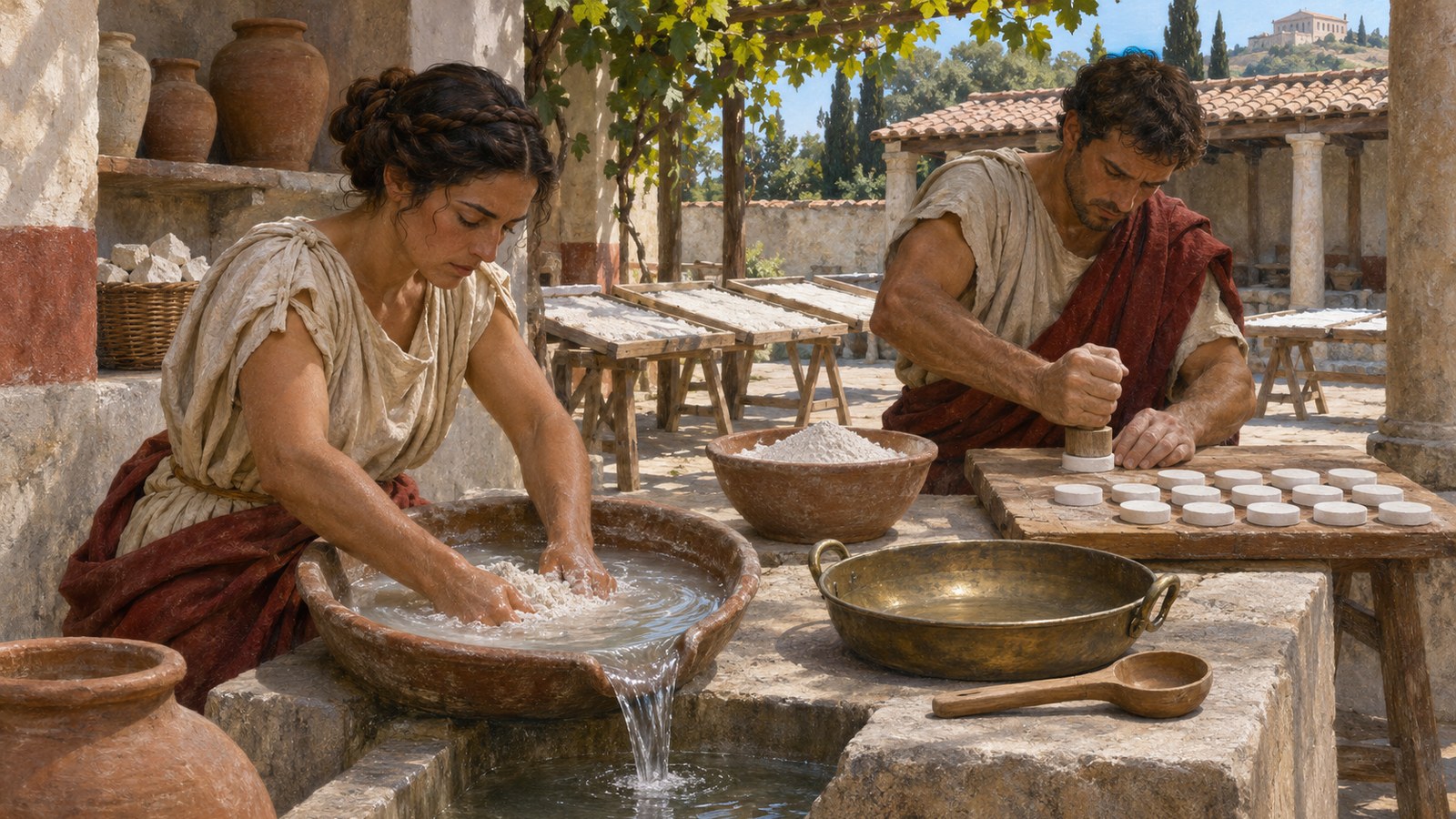
That recovered substance was dried, pounded and sifted. It was then mixed with vinegar again, divided into tablets, and dried in the summer sun. Each verb marks a quality-control step: remove moisture, reduce lumps, sort particles, expose them again, portion them, then use predictable seasonal heat.
A Closed Jar Counted Out Ten Days
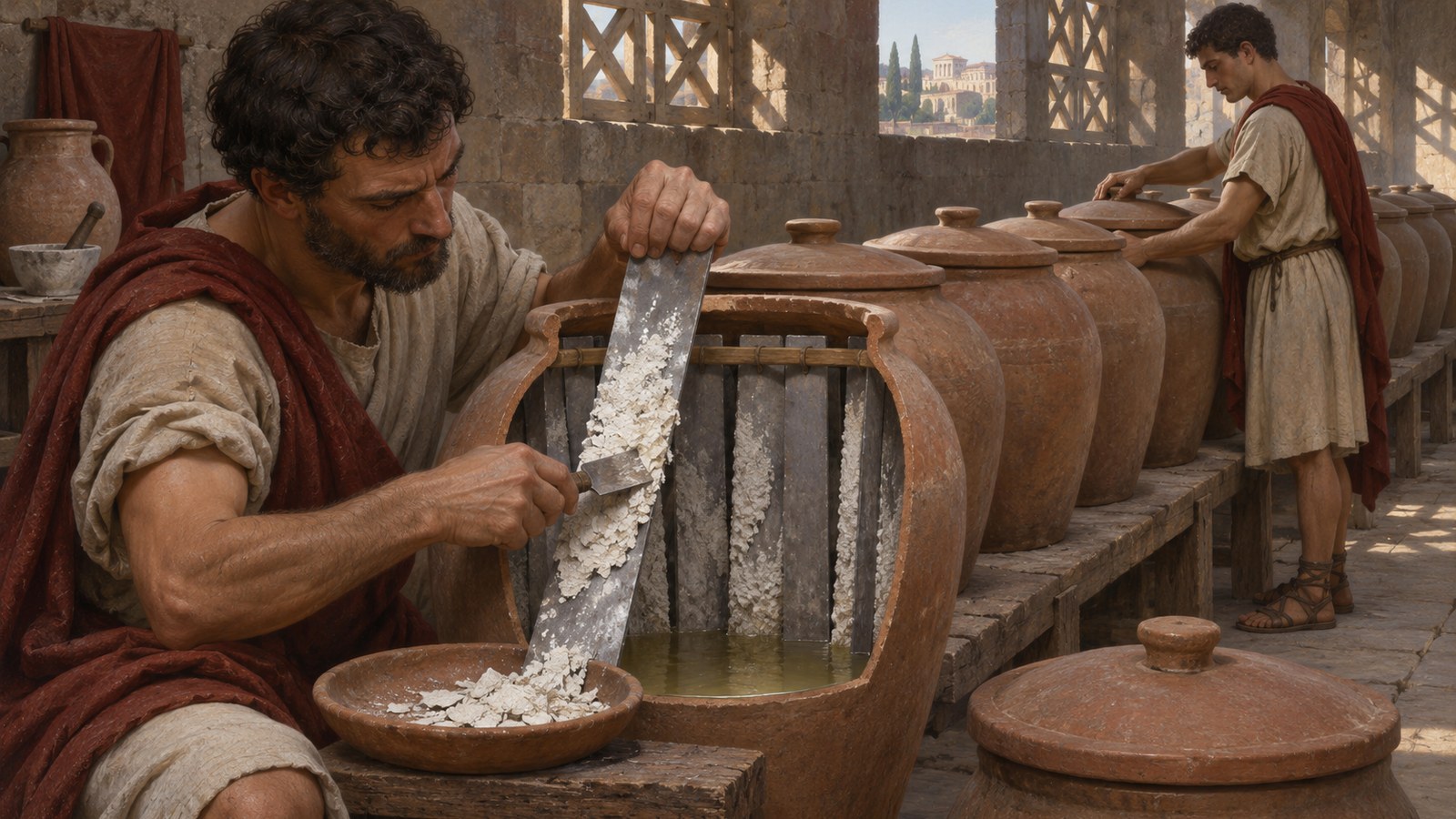
Pliny’s second route used jars filled with vinegar. Lead was put inside, the jars were closed, and the workshop waited ten days. When they were opened, a mould-like layer had formed on the metal. That coating, not the remaining lead, was the immediate product.
The worker scraped the layer away and returned the lead to the vinegar. The cycle continued until the whole piece of metal had been consumed. Production therefore depended on repetition. One ten-day interval did not finish a batch; it created a harvestable skin and exposed fresh metal for the next interval.
The closed jar made time part of the apparatus. A craftsperson had to remember when each vessel had been sealed, resist opening it early, and distinguish the useful surface growth from the lead beneath it. A row of jars was also a row of staggered deadlines.
Consumption of the original metal offered another measure of progress. Pliny does not say to stop after a fixed number of scrapings; he says the lead returned to vinegar until it was used up. The batch ended when no core remained to expose. Material accounting and surface inspection therefore worked together: each pale crust was removed, while the shrinking grey strip showed how much production was still possible.
This was chemically dangerous work even though Pliny did not possess modern toxicology. Lead compounds can poison through inhalation or ingestion, and strong vinegar did not make the workshop benign. The description should be read as evidence for an ancient process, not as instructions to reproduce it.
The repeated surface harvest resembles another Roman metal process in which vinegar vapour turned copper plates green. The colours differed, but both workshops made a saleable pigment by letting an acidic atmosphere alter metal and then collecting what formed.
Grinding and Washing Made the Crust Usable
After scraping, the coating was triturated and sifted. These operations converted irregular flakes into a more even powder. A painter needed material that could mix predictably with a binder; gritty fragments or pieces of unreacted metal would spoil both colour and handling.
Pliny then describes heating the material in shallow vessels while workers stirred it with ladles. The shallow form increased the exposed surface and made constant movement possible. The colour changed during this stage, becoming red and taking on the appearance of sandarach.
The red stage is one of the passage’s most striking details. The same lead-derived material could move from white toward red through further heating. Colour was not a permanent identity hidden inside the ore. It was an outcome of treatment.
Fresh water followed the fire. Workers washed the material until the cloudy impurities disappeared, then dried it again and divided it into tablets. The water was not merely a final rinse. Its changing clarity gave the worker a visible stop condition: continue washing while the liquid still carried unwanted cloudiness.
That combination of heat, motion and washing belongs beside the more dramatic process in which red ore released quicksilver before becoming wall pigment. Roman colour production could require vessels, controlled heat and repeated separation long before a brush touched plaster.
Tablets Hid the Messy Workshop Sequence
Pliny twice ends with tablets. Portioning the dried pigment gave a workshop units that could be stored, moved and sold. The compact form also concealed the awkward intermediate stages: wet scrapings, dusty grinding, cloudy wash water and repeated acid exposure.
A tablet was not proof that every batch had been handled equally well. The account itself implies several points where quality could diverge. Lead shavings could be coarse or fine. Vinegar could be weak or strong. A jar could be opened before ten days. Scraped material could be badly sifted, overheated or insufficiently washed.
Rhodes’s reputation becomes easier to understand in that context. Consistency meant reproducing the same transformations across many vessels and many cycles. The valuable knowledge lay partly in judging surfaces and liquids: when the crust was ready, when the powder was fine enough, and when the wash water had lost its cloudiness.
Summer sunlight was another production condition. Pliny explicitly places the drying of the first method in the summer sun. Seasonal warmth offered energy without a furnace, but it also tied output to weather, workspace and the availability of an exposed drying area.
The Whitest Product Carried the Darkest Risk
Pliny says ceruse was used by women to whiten the complexion. He also calls it a deadly poison. Those statements sit together in the same chapter, exposing a contradiction between desired appearance and bodily danger.
His phrase that it was the mildest preparation of lead did not make it safe. “Mildest” ranked one hazardous substance against others in the lead-worker’s catalogue. Modern readers should not turn a relative ancient classification into reassurance.
The cosmetic use also changes how the workshop should be imagined. Ceruse did not remain on distant architectural surfaces. It could be ground, traded, opened and applied close to the mouth, nose and skin. The pale finish depended on a corrosive process whose risks travelled with the tablet.
Pliny adds that melting ceruse a second time made it red. A merchant’s white tablet and a painter’s red material could therefore belong to the same technical family. Heat altered both colour and commercial purpose.
The chapter’s real subject is transformation. Grey lead became a pale crust; the crust became powder; powder became a tablet; reheating could make it red. Vinegar, ten-day waits, scraping, sifting, ladles, fresh water and summer sun were not background details. They were the machinery of Roman colour.
What looked like whiteness on a face or wall was the end of that machinery, not its beginning. Pliny’s compact recipe lets the hidden labour reappear—and, with it, the poison that refinement could not wash away.
Sources
- Pliny the Elder, Natural History, Book 34, chapter 54
- Perseus Digital Library, Bostock and Riley translation of Pliny