
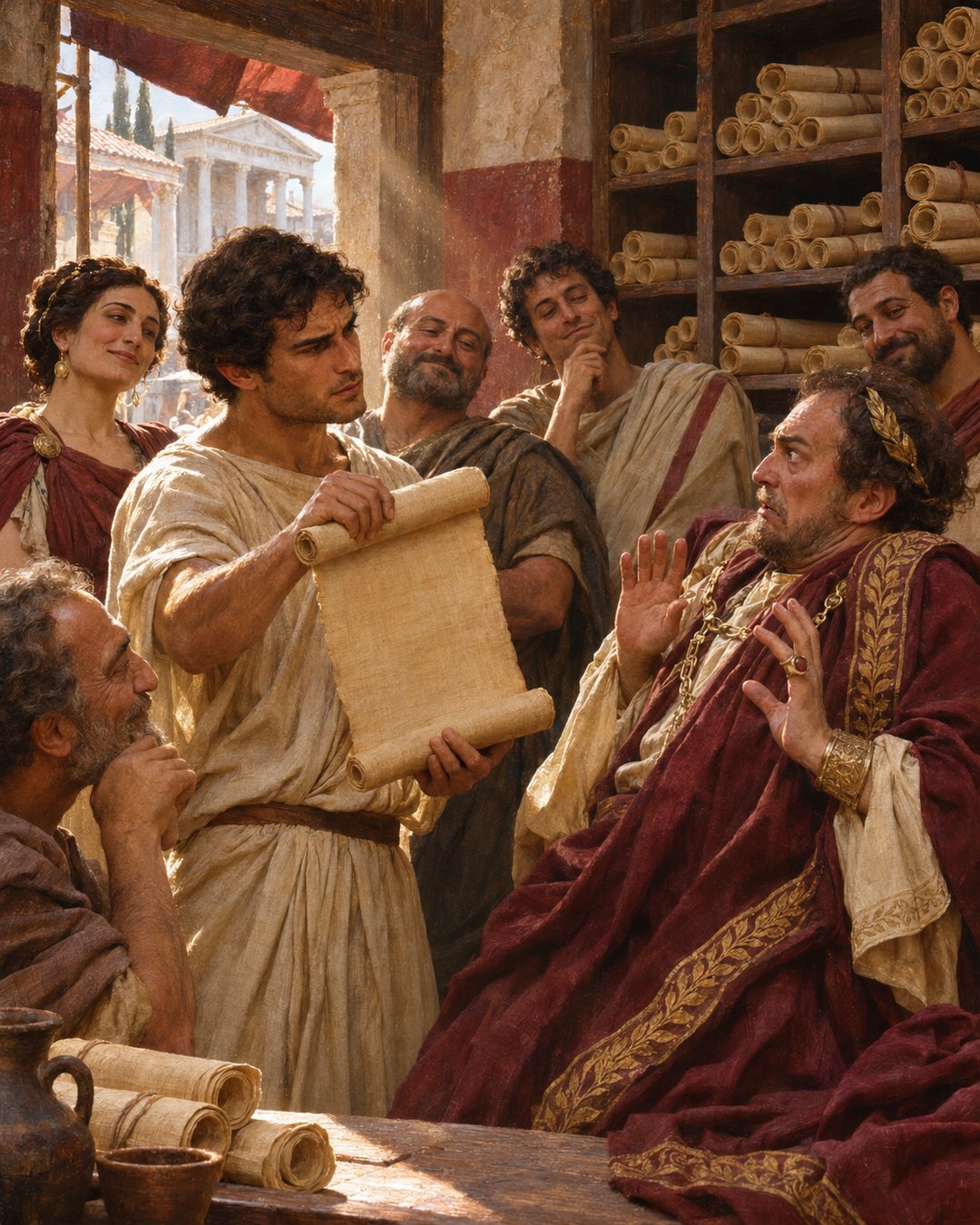
A man in a Roman bookseller’s shop announced that nobody under heaven could explain Marcus Varro’s satires as he could. Aulus Gellius happened to be carrying one of those books. He did not answer the boast with a rival speech. He opened the old copy, placed a short passage before the man, and asked what two ordinary Latin words meant together: caninum prandium, “a dog’s lunch.”
The question exposed more than one failed definition. It turned a public claim of expertise into a live reading test, complete with an audience, an excuse about damaged eyesight, and a hurried exit. Yet Gellius did not preserve the scene only to mock a fraud. The phrase at its centre connected a Roman joke about dogs to a compact scheme of wine—dark, pale and tawny; new, old and in between. His chapter shows how a meal with no drink could become the key to interpreting a learned text.
The Bookseller’s Shop Had an Audience
Gellius begins with a performance. The unnamed man was sitting in a shop that sold books, praising himself and advertising a rare competence. Varro’s satires, Gellius explains, could be called Cynical or Menippean. The man claimed that he alone could interpret them, then demonstrated his ability with passages that Gellius considered easy. His authority rested on confidence before listeners rather than on a difficult result.
The location matters because the challenge could be checked immediately. This was not a private dispute in which each participant could later improve his version. Books, readers and witnesses occupied the same space. Gellius also had the right volume with him, a satire whose Greek title meant The Water Dog. He approached the boaster with a proverb: music kept hidden has no value. If the man possessed the skill he advertised, he should make it audible.
The expert tried to reverse the test. He told Gellius to read out whatever he failed to understand so that an explanation could follow. Gellius refused the arrangement on practical grounds. A reader who did not understand the passage might deliver it indistinctly, confuse its sense and distract the interpreter. The other people in the shop agreed and repeated the request. What began as one reader’s challenge became a small public demand for evidence.
That scene belongs beside Gellius’s other glimpses of learned life, including his report of an argument about wind and waves preserved in his notebook. In both, knowledge is not presented as a clean list detached from people. It arrives through a conversation, a setting and a claim that someone else can question.
An Old Copy Became the Test
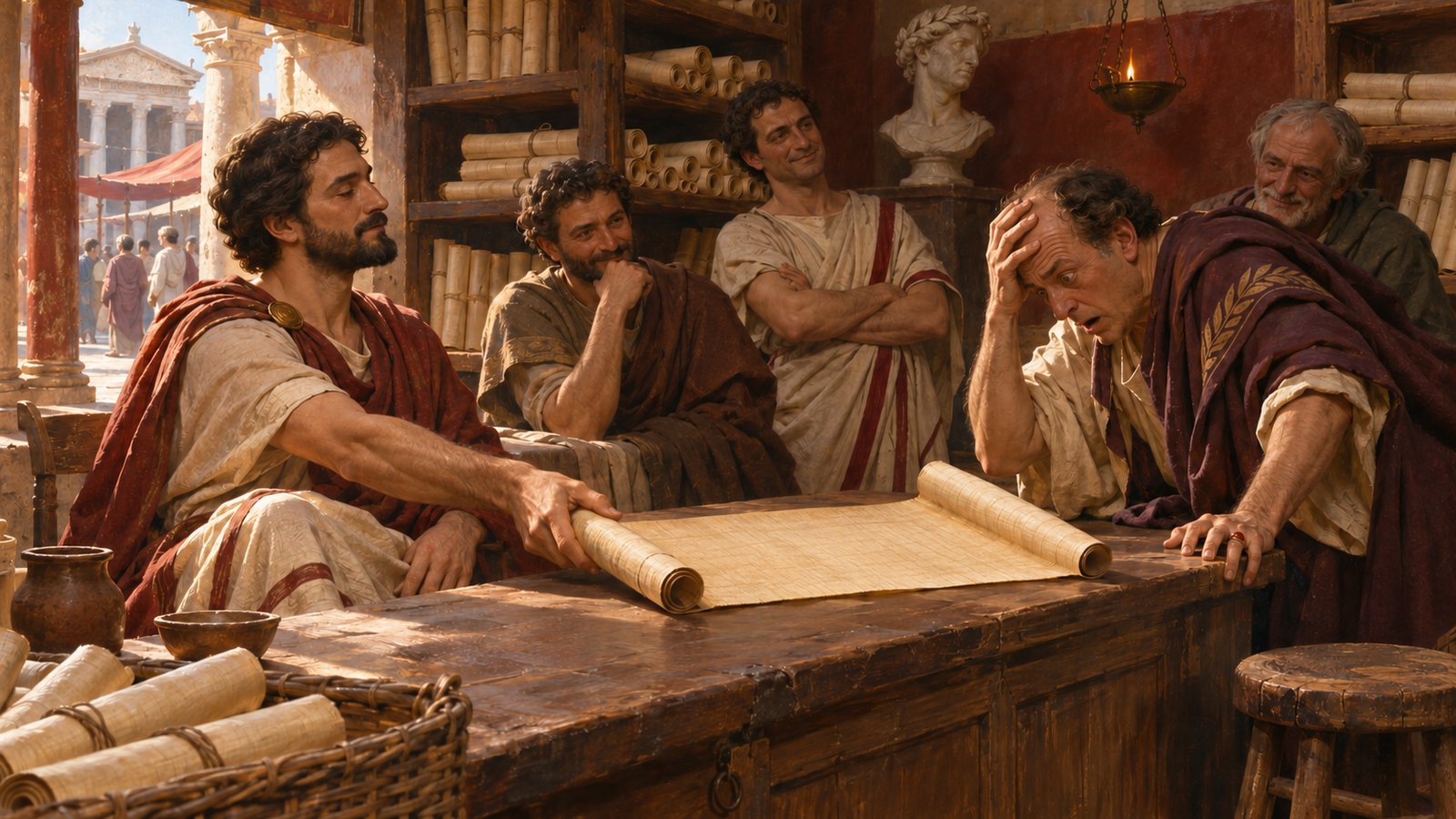
Gellius handed over what he calls an ancient copy of tested accuracy, written clearly. Those details remove the easiest escape routes. The writing was not an improvised note, and Gellius did not blame a damaged or careless exemplar. The physical book was supposed to be good enough for a competent reader. The uncertainty now belonged to the man holding it.
His confidence vanished before he had to explain anything. Gellius says his face became disturbed and worried. The resulting reading was so poor that even ignorant schoolboys could scarcely have made a more ridiculous attempt. Words were pronounced badly and the thought was mangled. The audience began to laugh. A boast about exclusive mastery had collapsed at the first reproducible task.
The man then blamed his eyes. Constant night work, he said, had made them weak and nearly ruined them; he could barely distinguish the shapes of the letters. Once his sight recovered, Gellius could return and hear the entire book. It was a clever excuse because it transformed failure into evidence of scholarly labour. The reader was not unprepared, the explanation implied, but exhausted by too much study.
Gellius removed that shelter with a question that required no reading. He wished the man’s eyes well, then asked him simply to define caninum prandium. The supposed specialist rose and left. He declared that this was no small matter and that he did not provide such instruction free of charge. The exit adds the final turn: a man who had offered public proof without payment suddenly discovered a fee when proof became difficult.
Three Colours and Three Ages of Wine
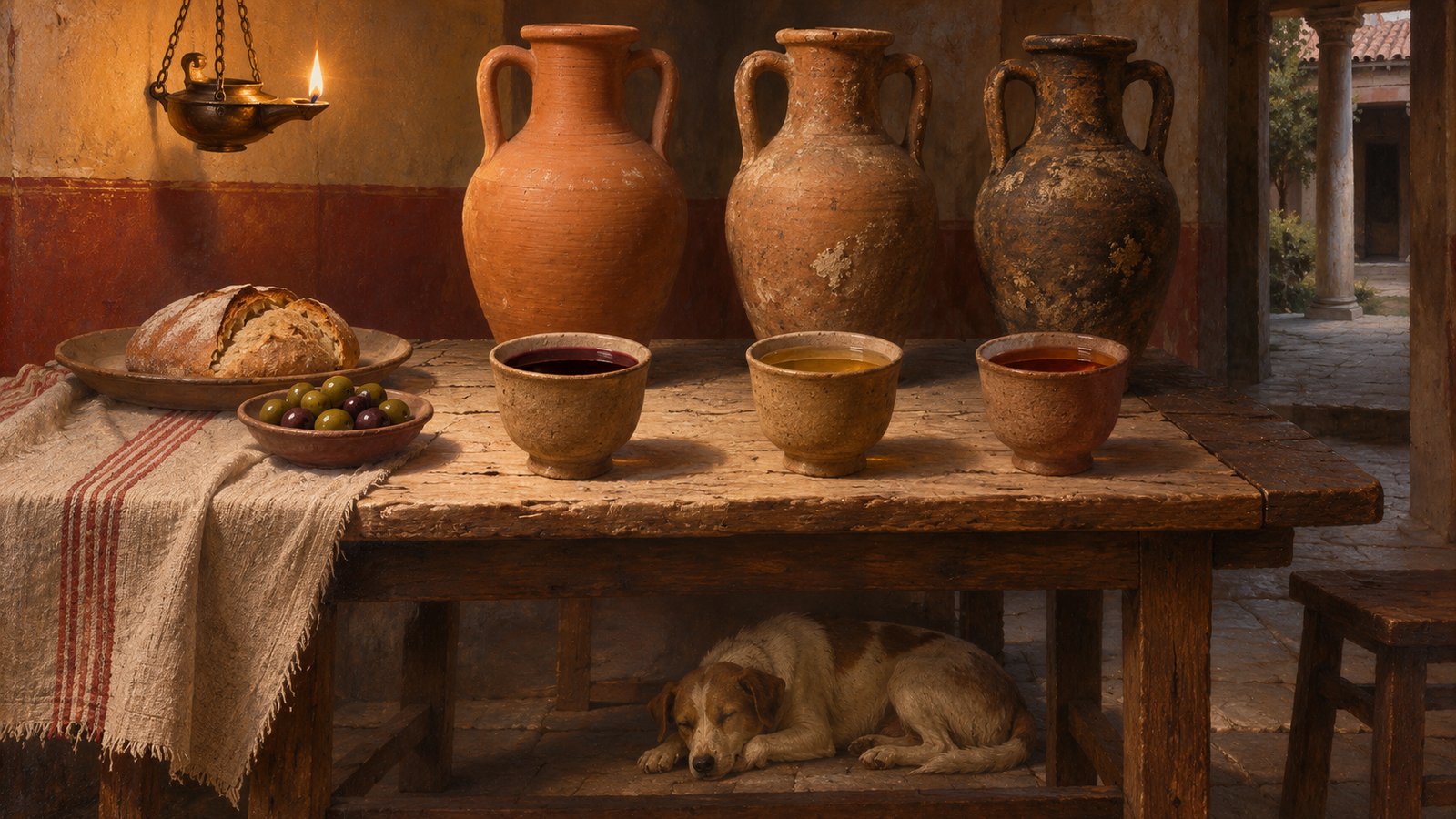
The passage itself begins as a set of classifications attributed to Mnesitheus, a physician whose views Varro had incorporated into the satire. It first sorts wine by appearance. There was a dark kind, a light kind and a middle colour that the Greek terminology described as tawny. Each received a bodily effect: dark wine gave virility, light wine increased urine, and the middle colour aided digestion.
Gellius reports these claims because they are the machinery of Varro’s sentence, not because he pauses to test them as medicine. The parallel arrangement is what matters for the riddle. Three colours form one row, and three ages form another. The wine could be new, old or midway between the two. New wine was said to cool; old wine was said to heat. The middle-aged wine, where a matching effect should appear, was called a dog’s lunch.
The phrase is funny because it interrupts a tidy technical pattern. A reader expects another bodily action. Instead, the text serves a meal to an animal. The shift from classification to proverb is exactly the kind of compact difficulty that could separate familiarity with a few easy lines from the ability to interpret Varro’s wordplay.
Wine also had to be handled as a material substance before it could become literary material. The sequence of age and condition complements accounts of Roman food production such as Columella’s repeated pressing and salting of cheese. Neither text treats food or drink as a timeless label. Its state changes, and the writer’s categories follow those changes.
The Dog Explained an Empty Place in the Scheme
Gellius admits that the expression looks slight, but says he investigated it for a long time and with care. His answer begins at the dining table. An abstemious meal, one at which nobody drank, could be called a dog’s meal because a dog had no need of wine. The phrase therefore pointed not to a canine recipe but to the absence of the drink that distinguished the human table in this joke.
He then fitted that meaning back into the three-age scheme. People commonly spoke as if wine were either new or old. The middle-aged kind in the quoted passage possessed the power of neither extreme: it did not cool like the new or heat like the old. Within the logic of the wordplay, it was not being counted as wine at all. A “dog’s lunch” named the gap—a meal at which wine, for practical purposes, was absent.
This does not make the ancient physiological claims reliable modern guidance. It makes the structure of the ancient explanation visible. The joke depends on paired opposites and an awkward middle. Dark and light leave tawny between them; new and old leave a middle age; cooling and heating leave a substance that does neither. Varro’s comic phrase turns that neutral position into a table without wine.
The chapter also makes interpretation look like work rather than intuition. Gellius did not pretend the answer was obvious when he first saw it. He distinguished the man who claimed universal mastery from his own slower inquiry. The fraud could not read the passage and would not define the phrase. Gellius, by contrast, preserved the wording, described the context, admitted the puzzle’s small scale and explained the reasoning that resolved it.
A Small Proverb Deflated a Large Claim
The bookseller’s shop gives the wine classification a second purpose. It becomes an instrument for judging expertise. The old copy, the listeners and the plain question make the test unusually concrete. Nobody asks the boaster to reconstruct a lost work or settle a damaged line. He only has to read a clear copy and explain two words from the author he claims to own intellectually.
Gellius’s account is not gentle, but its target is precise. He does not attack learning, old books or difficult interpretation. He attacks the performance of certainty without the corresponding labour. The audience laughs when reading fails, yet Gellius still spends time solving the question. The chapter’s punch line and its scholarship point in the same direction: a confident voice is not a substitute for contact with the text.
The dog at the bottom of the explanation is useful because it keeps the answer physical. Imagine a meal, notice the missing cup, and the proverb becomes intelligible. Return to the three ages of wine, and the missing effect also becomes intelligible. The animal does not supply a doctrine. It supplies the everyday comparison that allows Varro’s middle category to land as a joke.
So the boast that filled the shop was defeated by something deliberately modest: an old volume, a short passage and a lunch with no wine. Gellius let the self-proclaimed expert escape, but he did not let the phrase escape with him. He followed it from the shop to the table and back into Varro’s pattern, preserving both the comedy of failure and the patient explanation that the performance lacked.
Sources
Aulus Gellius, Attic Nights, 13.31