
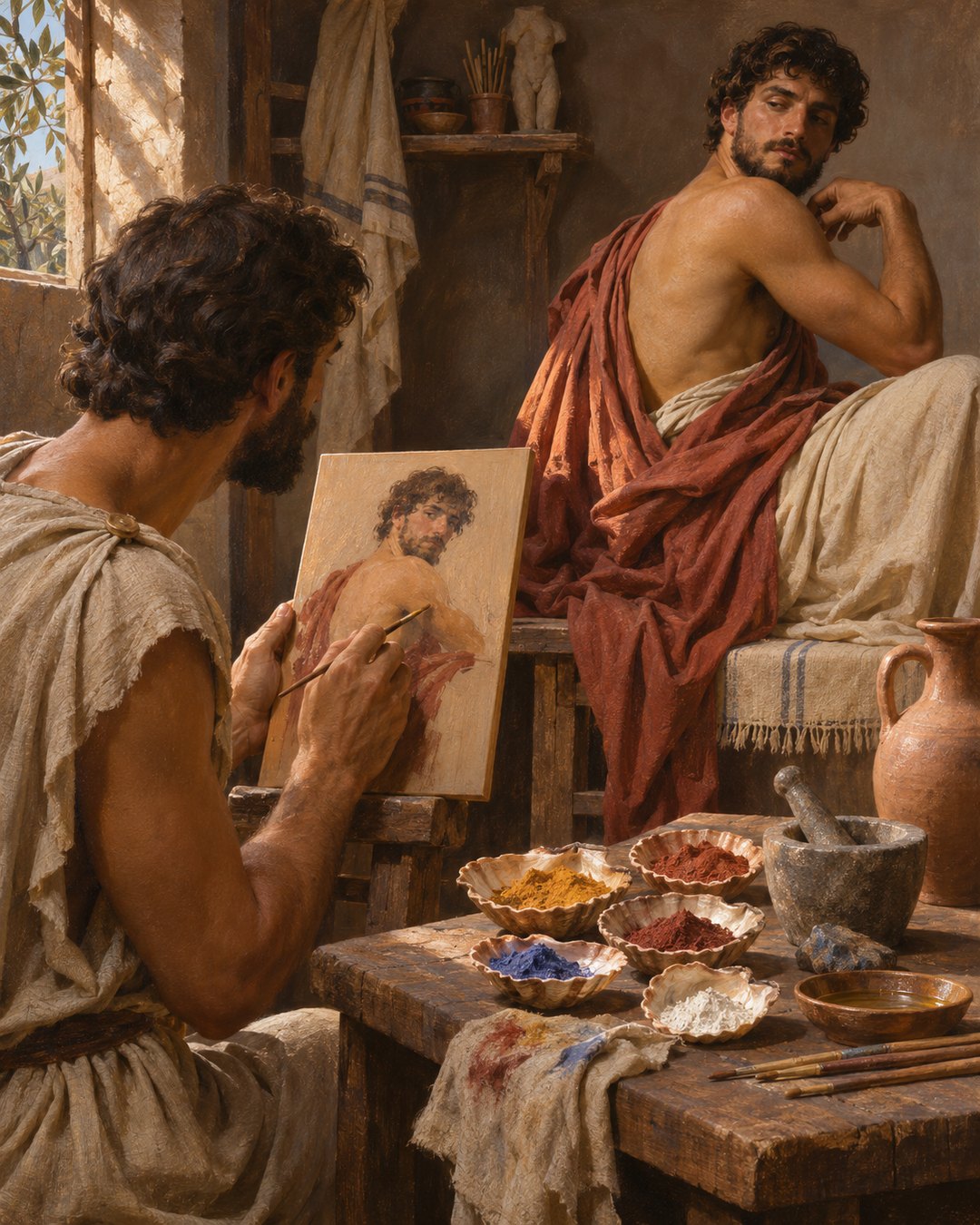
A face turned three-quarters away is easy to overlook. So is a bent elbow, a faint vein, or a fold of cloth that changes direction as the body beneath it moves. Yet Pliny the Elder grouped precisely those details around an early painter named Cimon of Cleonae. In a few compressed lines, his history of art describes a painted body becoming less like a sign and more like a figure occupying space.
Pliny’s list is not a modern biography. It gives no securely identified painting by Cimon, no workshop diary, and no exact sequence of experiments. What it does preserve is a Roman author’s account of which visual problems mattered: an oblique body, a head looking somewhere other than straight ahead, a joint that visibly joins, a vein under skin, and cloth that bends naturally. Read together, those details make Cimon’s achievement a story about direction. The figure could now turn.
Pliny Put Cimon After Eumarus, Not at the Beginning
The passage starts before Cimon. Pliny names Eumarus of Athens and says that he was the first to distinguish the sexes in painting and attempted to imitate every kind of figure. Cimon, from Cleonae, then “improved upon” Eumarus’s inventions. That sequence matters because Pliny did not present art as a miracle performed in one leap. He imagined one painter extending problems that another had already made visible.
The wording also sets a limit on what can safely be claimed. Pliny credits priority, but he does not show us comparative examples by the two painters. His “firsts” belong to an ancient history of invention, not to a complete modern catalogue of every image ever made. Cimon can therefore be treated as the figure to whom Pliny attached these advances, without pretending that every earlier painted surface has been checked and eliminated.
Even within that caution, the transition is striking. Eumarus’s task was differentiation and variety. Cimon’s was orientation and structure. A painter could classify figures, but a body viewed obliquely posed another challenge: parts no longer offered their clearest, fullest outline. One shoulder might overlap the chest. One side of the face might narrow. A limb might point toward or away from the viewer. Pliny’s short notice makes those departures from a frontal display the centre of Cimon’s reputation.
An Oblique View Made the Figure Occupy Unequal Space
Pliny says Cimon first invented “foreshortenings,” which the translation immediately explains as oblique views of the figure. The useful word here is oblique. The figure is not arranged squarely and symmetrically for inspection. It crosses the viewer’s line of sight at an angle.
That angle changes the painter’s problem. A form extending across a flat surface can be shown at something close to its familiar length. A form turning into imagined depth cannot. Its visible proportions must change if the whole body is to appear coherent. Pliny does not provide a technical manual for how Cimon achieved that effect, so brush sequence, pigments, and measuring methods remain unknown. The historical claim is narrower and still consequential: Cimon was remembered for making oblique bodies readable.
Another Lost Eagles article explores how Pausias made a black ox show its length head-on. Pliny’s notice about Cimon belongs to the same broad ancient fascination with solving difficult views, but the mechanism here is different. Cimon’s list is not about one animal pose or one finished composition. It links the angled figure to the face, limbs, veins, and drapery. The entire represented body participates in the turn.
This is why “foreshortening” should not be reduced to a clever trick. In Pliny’s sequence, it reorganizes information. Some parts become prominent; others contract or disappear behind them. A viewer has to infer the whole from an unequal view. The image asks the eye to understand a body that does not offer every part at once.
Backward, Upward, and Downward Gazes Broke the Frontal Mask
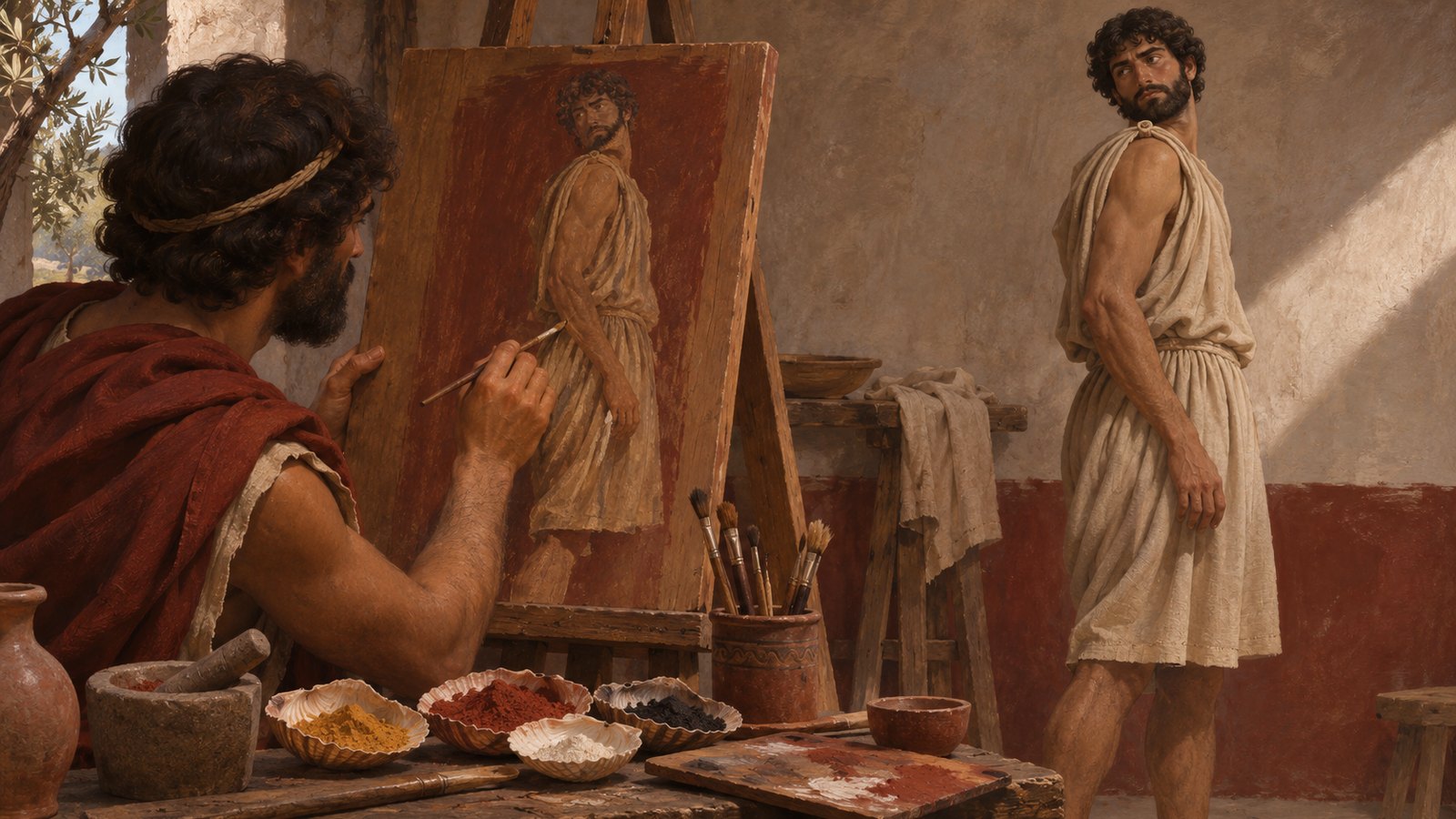
Pliny then becomes unusually concrete. Cimon varied the features by showing figures looking backwards, upwards, or downwards. Those are three different directions, not a generic claim that his faces were expressive.
Looking backward divides the body’s orientation from the face’s attention. A torso may continue one way while the head checks what is behind it. Looking upward raises the features toward something outside the figure’s immediate level. Looking downward lowers the gaze and changes the relationship between brow, eyes, nose, and chin. Pliny does not tell us what any painted person saw, but his list makes direction itself legible.
The result is a figure with an implied world beyond its outline. A backward glance suggests something behind; an upward glance, something above; a downward glance, something below. This is interpretation rather than a quotation from Pliny, but it follows from the spatial choices he names. The painted person’s attention points beyond the painted body.
That differs from a rigid emblem whose importance lies mainly in being recognizable. The change is not simply “more realistic,” a phrase so broad that it explains little. It is more exact to say that the features respond to an angle. Their arrangement depends on what the head is doing. Pliny’s three-direction list turns expression into a problem of position.
Joints and Veins Connected Surface to Structure
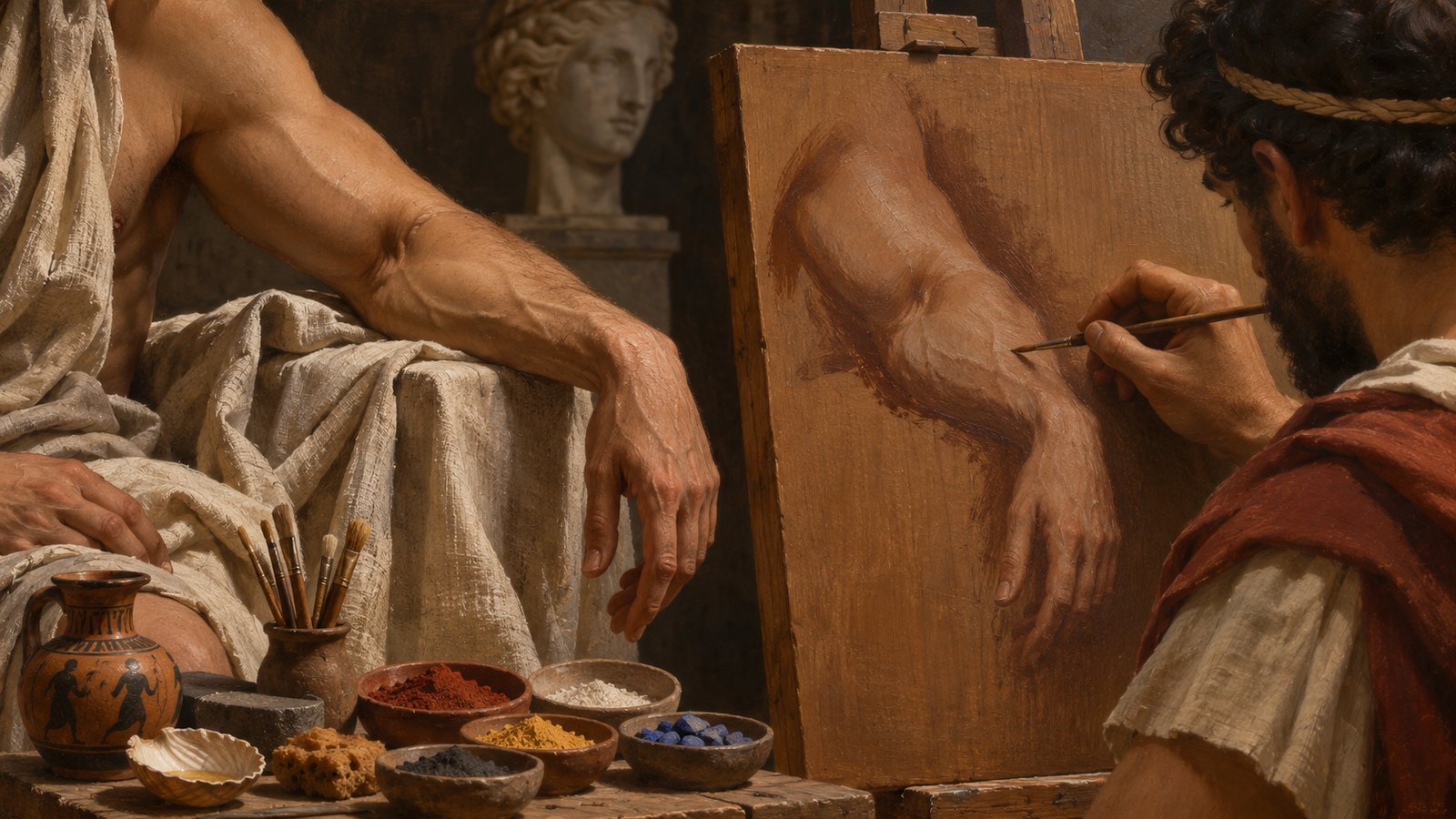
Next come the articulations of the limbs and the indication of veins. An articulation is a joining point: the place where a limb bends and where one section of the body meets another. Marking it helps a viewer understand why an arm or leg changes direction. A joint is not decoration added to a silhouette. It explains motion within that silhouette.
The vein is subtler. It sits close to the surface but implies living tissue beneath it. Pliny offers no anatomical programme and does not say how numerous or prominent Cimon’s veins were. The safe claim is simply the one he makes: Cimon indicated them. Even that small detail expands what a painted surface can report. Skin is no longer an empty boundary; it can carry signs of the body below.
These two details work at different scales. The joint organizes a major turn in the limb. The vein supplies a fine surface trace. Together they move from overall pose to minute observation. That pairing helps explain why Pliny placed them after the oblique view and the redirected face. A convincing turn depends both on the arrangement of large forms and on carefully chosen local signs.
The passage does not claim that Cimon discovered human anatomy. It credits representational decisions. Nor does it preserve his models, sketches, or corrections. Any image of him studying a sitter would therefore be an informed reconstruction, not a surviving scene. What remains firm is the ancient author’s inventory: joints were marked, veins indicated, and those details were worth naming in a history of painting.
Natural Folds Let Drapery Follow the Body Instead of Hiding It
Pliny’s final Cimon detail concerns drapery. He says the painter gave it natural folds and sinuosities. Cloth bends, overlaps, hangs, and changes course. When represented without those changes, it can flatten the body into a patterned block. When its folds answer the body’s pose, it can make the turn easier to read.
Again, Pliny gives the achievement but not the recipe. He does not identify a particular garment, count folds, or describe a named Cimon painting. “Natural” is his evaluative word, while “folds and sinuosities” supplies the visible subject of that evaluation. The important point is not that cloth became busy. It became responsive.
Pliny then moves to Panaenus, the brother of Phidias, and to a painting of the Athenians fighting Persians at Marathon. He says named commanders appeared on both sides: Miltiades, Callimachus, and Cynaegeirus for the Athenians; Datis and Artaphernes for the Persians. That next example widens the scale from Cimon’s catalogue of bodily problems to a populated historical battle.
The sequence does not prove that Cimon caused Panaenus’s accomplishment. It does show how Pliny arranged his story. First come devices that let bodies turn, look, bend, show surface structure, and carry plausible cloth. Then comes a complex scene in which named participants must remain distinguishable. Small representational solutions precede the crowded act of historical narration.
Ancient writers also enjoyed stories in which pictures defeated the eye, such as the contest where painted grapes fooled birds and a painted curtain fooled a painter. Cimon’s notice is quieter. No spectator reaches for the image. No rival concedes defeat. Instead, Pliny preserves a list of adjustments that made a body less frontal, less rigid, and more dependent on the space it seemed to inhabit.
That is the value of his compact account. It does not let us recover Cimon’s lost paintings, and it should not be inflated into a complete origin story for naturalism. It does let us see what an ancient history considered inventively difficult. The decisive changes were not only grand subjects or expensive scale. They included a head that looked back, a joint that bent convincingly, a vein just visible under skin, and cloth that turned with the person wearing it.
Sources
Pliny the Elder, Natural History, Book 35, chapter 34