
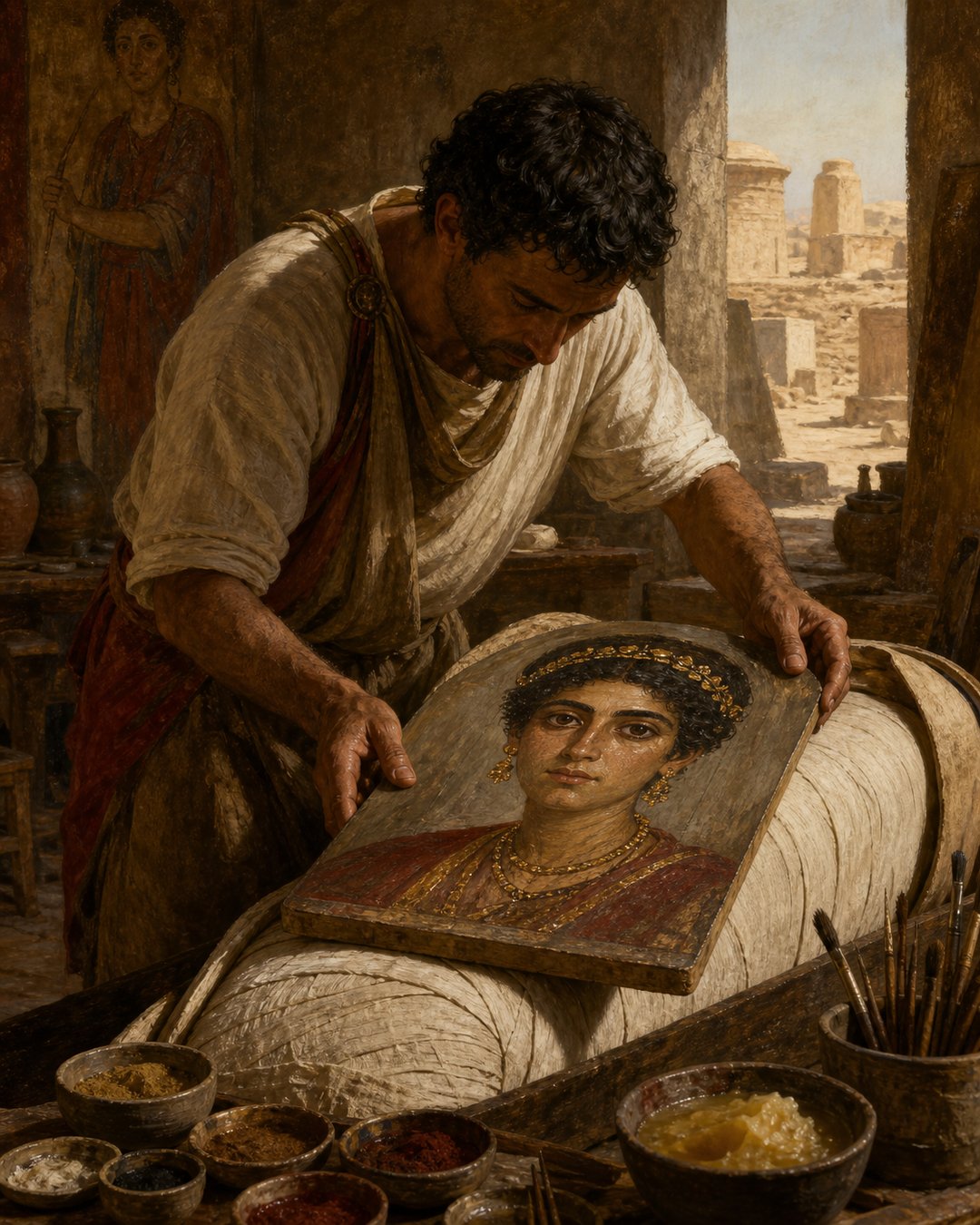
The face looks startlingly present. Dark eyes meet the viewer. A curl falls across the forehead. Gold catches at an earring or wreath. Yet the painted wooden panel was not made to hang alone on a pale museum wall. It was fitted over the wrapped head of a mummy.
These works are commonly called Fayum mummy portraits because many were found in the Fayum Basin, especially around sites such as Hawara. The name is convenient but incomplete: examples have appeared across Egypt. Most belong to the centuries when Egypt was ruled within the Roman world, from around the late first century BC or early first century AD through the third century AD.
The portraits survive because several systems met in one object. A painter used a naturalistic Greco-Roman language of face, hair and dress. A workshop selected and prepared wood, wax or tempera pigment. Embalmers maintained an Egyptian practice of preserving and wrapping the dead. The portrait’s meaning emerges from the joining, not from any one tradition viewed alone.
A wooden face had to fit a wrapped body
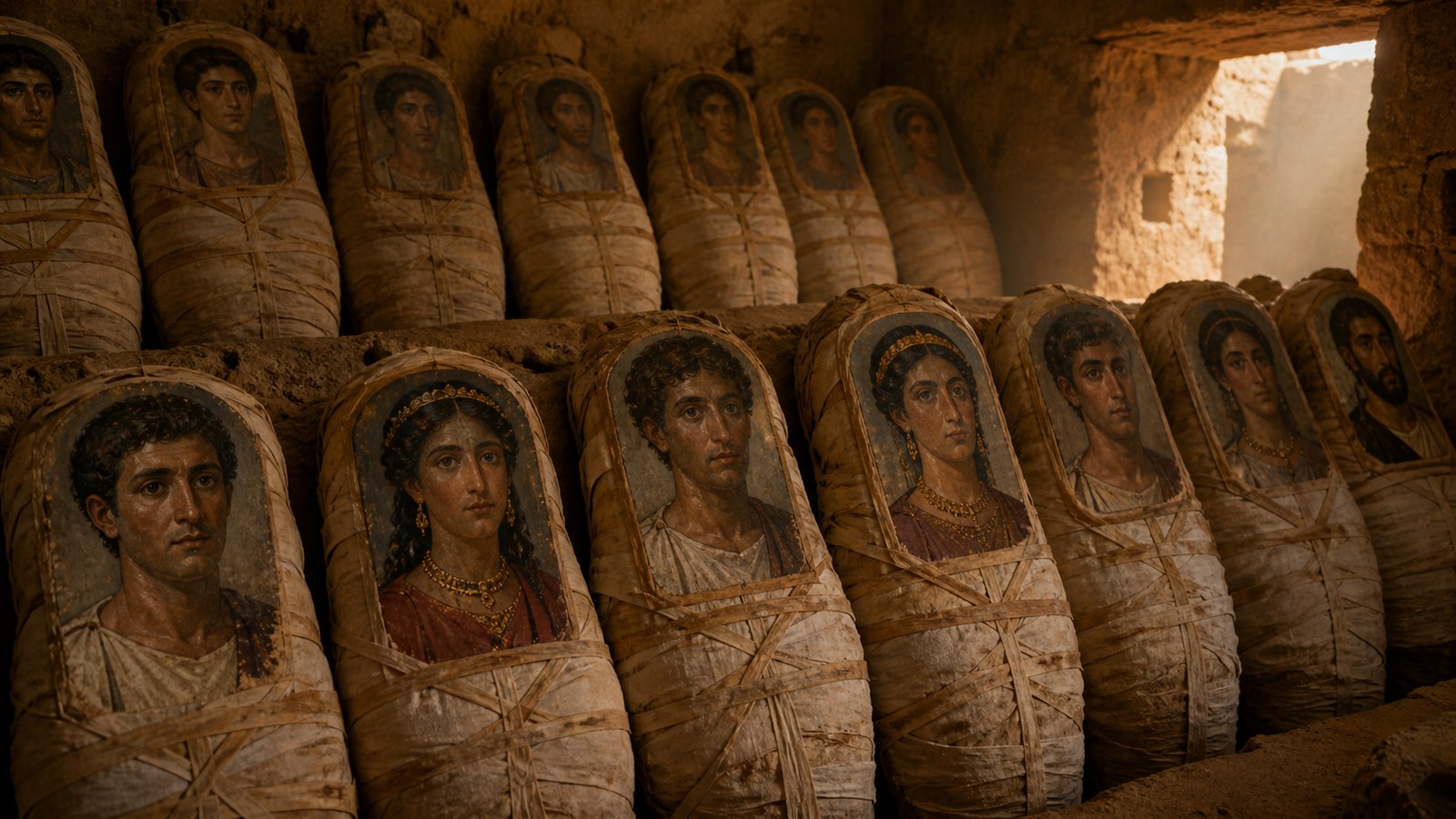
The finished portrait was a physical component of burial. It covered the face area of an upper-class mummy, held among layers of linen or within a decorated arrangement over the upper body. The panel therefore had practical demands. It needed to be thin enough to fit, durable enough to endure handling, and shaped for a place that was not a rectangular frame.
That material fact is easy to lose when museums isolate the panel. Once detached, the face resembles a self-contained European easel painting. Returned mentally to the mummy, it operates differently. Linen establishes the preserved body; the painted board supplies an individualized, socially legible presence. The viewer meets both a portrait and a funerary surface.
Roman Egypt had room for this combination because its inhabitants lived among overlapping visual systems. The Getty’s survey of Egypt and the classical world emphasizes long artistic exchange among Egyptians, Greeks and Romans. Portraits in Egyptian and Greek styles already belonged to that history before Roman patrons and provincial communities added further choices.
The resulting object was not a simple replacement of one culture by another. Compare it with the wax ancestral masks carried at elite Roman funerals. Both practices made a face active in memory, but the materials, ceremony and relationship to the body differed. Roman Egypt created its own solution by placing a painted likeness directly into mummification.
Wax and tempera produced different surfaces
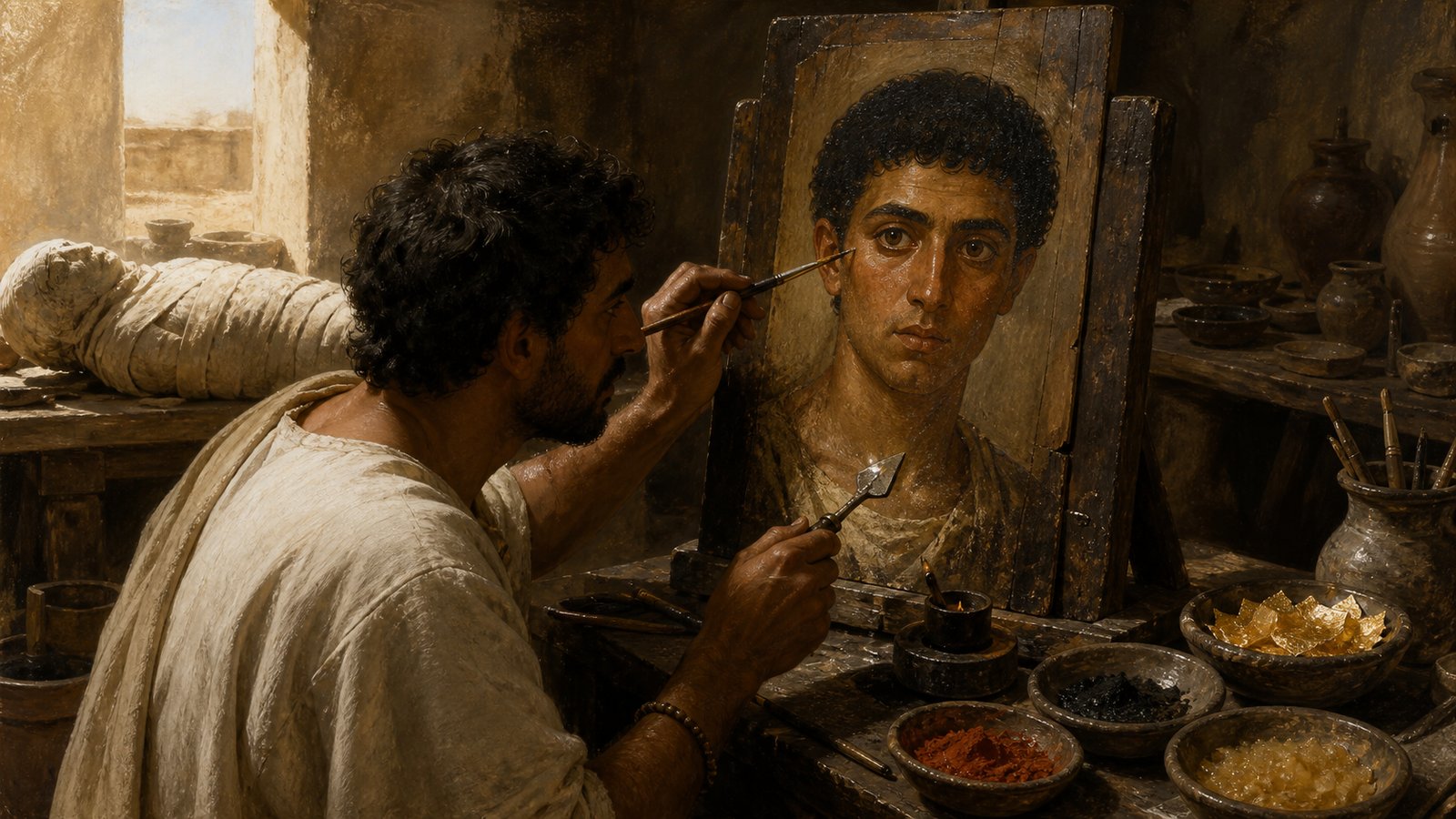
Artists used more than one painting technique. Many portraits were made in encaustic, where heated wax carries pigment. Wax can build luminous, dense passages and hold visible strokes. Other panels used tempera, in which pigments were bound through a different, cooler medium and could produce a flatter or more finely layered surface.
The technique affected the act of painting. Heated wax demanded preparation and pace: pigment had to remain workable, highlights and shadows had to be modelled, and tools left their own texture. Tempera offered another route to skin, cloth and hair. Neither method reduced portraiture to mechanically filling a template.
The board mattered too. Surviving portraits use several woods, both local and imported. A panel begins as timber with grain, thickness and flexibility. Workshop choices connected a human face to supply routes and craft knowledge long before the board reached the embalmer. Even an intimate memorial depended on materials moving through Roman Egypt.
Gilding added another layer. Gold might mark jewellery or a wreath, catching light above the linen. It did more than make the deceased look wealthy. A bright metal detail separated itself from dark hair and warm skin, helping the portrait remain visually forceful within a complex funerary wrapping.
Hair and jewellery put the dead in Roman time
The people on these panels do not wear a timeless costume of “the ancient world.” Their hair is arranged, their garments selected and their jewellery displayed. Those choices belonged to changing fashions. Scholars can compare coiffures and ornaments with other Roman images whose dates are better established, using style as one piece of chronological evidence.
That does not turn every curl into a calendar. Fashion could travel unevenly, older styles could persist, and a painter could idealize. Yet groups of portraits reveal patterns. A high arrangement of hair, a type of earring or a manner of wearing a mantle places the sitter within networks of taste that stretched beyond one oasis.
Clothing and ornament also communicated status. These were not portraits of an undifferentiated population. The use of painted panels on mummies is associated especially with people who could command the labor, timber, pigment and funerary preparation involved. The face speaks of individuality, but the package also speaks of resources.
The evidence can be paired with humbler survivals. A split-toe sock from Roman Egypt records how cloth met a sandal and a foot. A mummy portrait records how hair, garment, jewellery, wood and pigment met a social identity prepared for burial. Both make provincial fashion physical rather than abstract.
Hawara changed paintings into archaeological evidence
Portrait mummies had been encountered before modern scientific archaeology, but Flinders Petrie’s work at Hawara made the site central to their study. He excavated there in 1887 and returned in 1910–1911. The portraits emerged not as anonymous art-market faces alone but as parts of burials that could be recorded, compared and discussed together.
Context changed the questions. Where was the panel positioned? How was it attached? What accompanied the mummy? Did painted and sculpted coverings coexist? A portrait stripped of its burial can still be visually powerful, but excavation allows it to answer questions about practice.
The dry Egyptian environment and sealed funerary setting helped preserve painted wood that would usually disappear. Classical texts mention panel painting, and wall paintings survive in places such as Pompeii, but portable wooden portraits from antiquity are rare. Roman Egypt kept a large and varied body of them because burial protected what ordinary exposure would have destroyed.
Preservation also creates distortion. What survives best can look most typical. The Fayum group is extraordinarily visible today, but it does not represent every Egyptian burial or every Roman provincial portrait. Its abundance reflects environment, funerary choices, excavation and collecting as well as ancient popularity.
The joining mattered more than the label
It is tempting to divide each portrait into neat cultural pieces: Roman face, Greek technique, Egyptian mummy. That shorthand helps orient us, then quickly becomes too rigid. The artisans and families who made these burials did not need to choose one modern museum department. They selected from practices already living beside one another.
The face is naturalistic, but naturalism does not make it a photograph. Painters shaped eyes, skin and age through conventions and skill. The mummy preserves a body, but it is also a constructed sacred and social object. The panel identifies, idealizes and addresses viewers while becoming part of that construction.
Even the term “Fayum portrait” can hide movement. Works come from more than the Fayum. Timber could arrive from elsewhere. Hairstyles participated in imperial fashion. Techniques carried long Mediterranean histories. The finished mummy nevertheless belonged to a local burial decision made in Egypt.
The portraits endure because their gaze feels immediate, but their real achievement is structural. Wood met linen. Heated wax or tempera met a prepared panel. Roman-era fashion met Egyptian treatment of the dead. A person’s face was not merely remembered beside the mummy; it was fastened onto the body’s new form.
Seen that way, these paintings are not exceptions floating outside history. They are compact records of labor and exchange. Every luminous cheek depended on pigment, binder and hand. Every hairstyle depended on a social present. Every surviving panel depended on a burial practice old enough to preserve a new kind of portrait.
Sources
Fayum mummy portraits art-historical and archaeological reference
J. Paul Getty Museum, Beyond the Nile: Egypt and the Classical World