
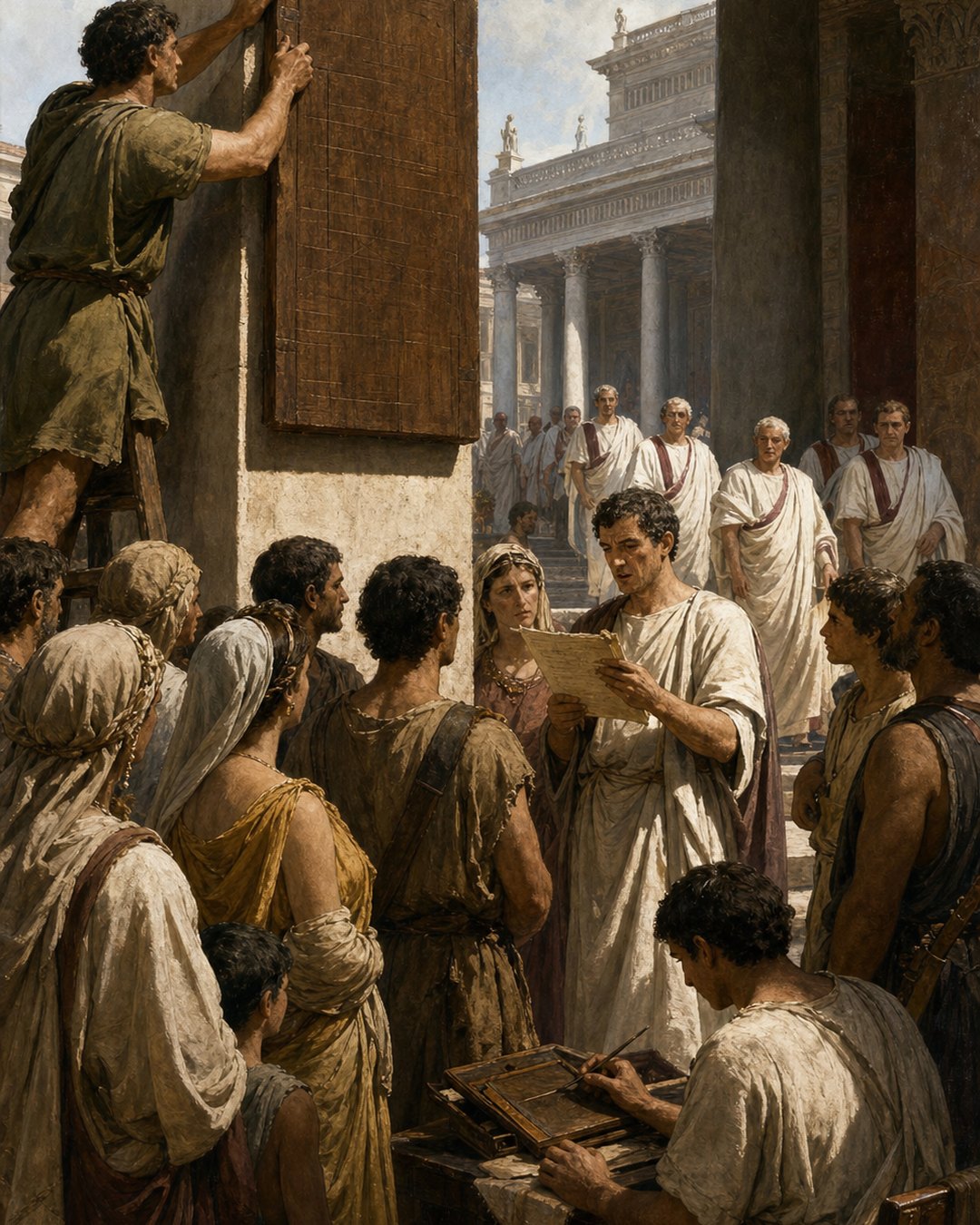
A clerk finishes a notice and fixes it where Rome can encounter it. Some passers-by read. Others listen as a literate stranger works through the lines. A copyist selects what matters to a patron outside the city. By evening, one official text has become many conversations.
The Romans used several kinds of acta, records of things done. The label Acta Diurna is now attached to daily public notices containing official and civic information. They have often been called the first newspaper. The comparison is memorable and dangerous.
These were not independent reporters investigating the state. They were products of the state’s own record-making. Their historical importance comes from the public surface they created: decisions and selected events could be posted, read, copied and repeated. Whoever controlled entry onto that surface controlled the first version of public memory.
A notice needed readers, listeners and copyists
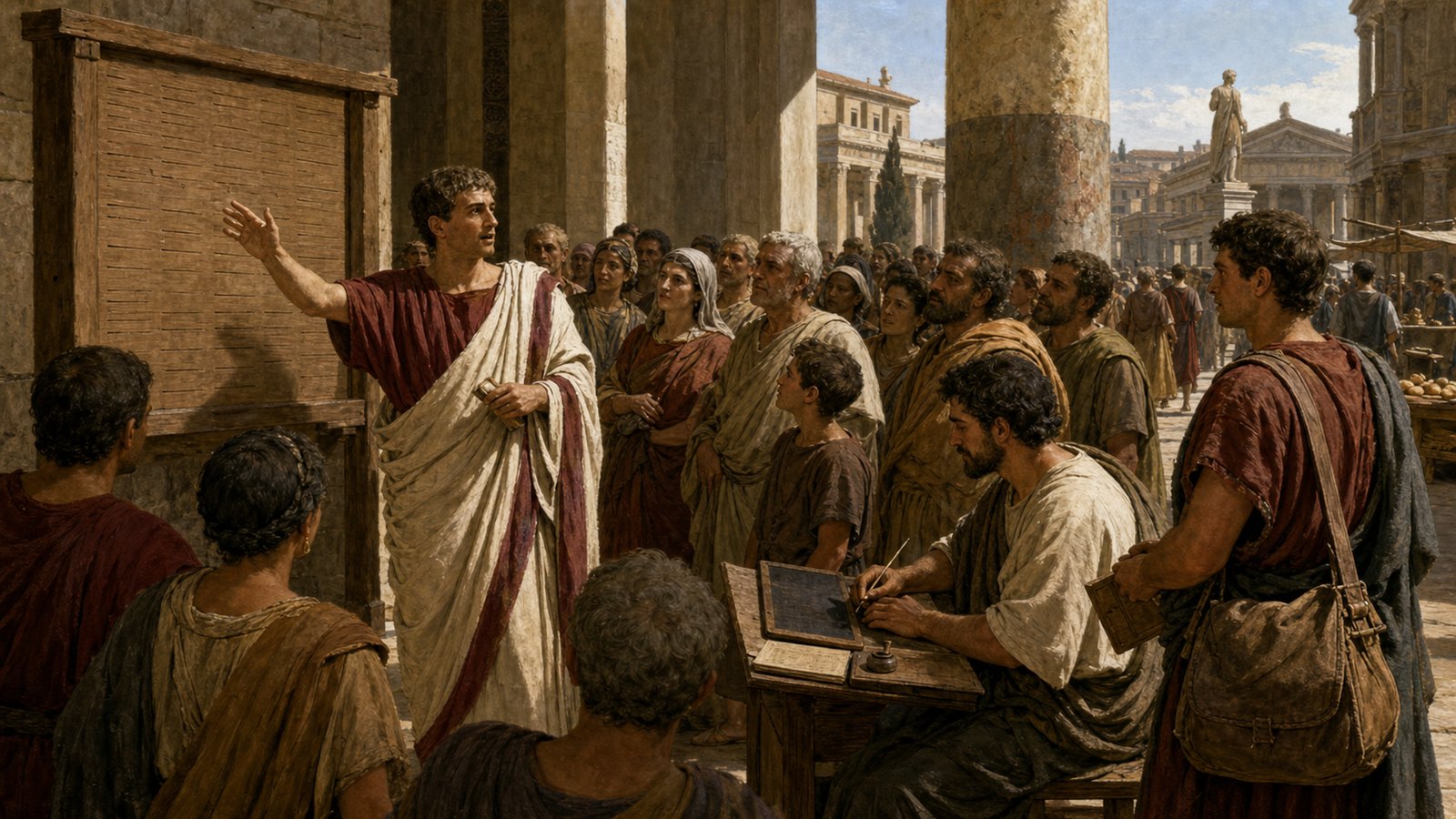
Public posting did not assume universal literacy. Rome contained people with very different reading abilities, from highly trained secretaries to those able to recognize names or standard formulas and those unable to read at all. A board could still reach them through the social act around it.
One person reading aloud multiplied access. A professional copyist could make an extract for an elite household. A messenger could carry a summary to another town. Conversation could strip away qualifications, add opinion and turn the notice into rumor. Official writing entered an information network it could begin but never fully command.
That network distinguishes reach from circulation. A modern paper exists in many produced copies. A posted act could begin as one authorized display and travel through handwritten copies and retellings. Its influence depended on location, attention and the labor of people who transmitted it.
Roman documents often moved by such mixed means. The rapid symbols in Tironian shorthand and Cato’s Senate speech show how trained writing could capture performance for later readers. A daily notice worked in the other direction: a completed record returned official action to a public audience.
Caesar published the business of Senate and people
Suetonius assigns a decisive measure to Julius Caesar’s consulship. Caesar ordered the proceedings of both the Senate and the people to be compiled and published. The pairing matters. It placed senatorial discussion and popular public business within a policy of exposure.
The act can be presented as openness, but Caesar was not a neutral transparency campaigner. His consulship was fiercely contested. Making proceedings public could bypass hostile elite accounts, embarrass opponents and let Caesar claim that the record itself supported him. Publication changed the arena in which political combat continued.
A Senate accustomed to controlling its own prestige had reason to care. Deliberation involves proposals that fail, speeches that offend and compromises that look weaker outside the chamber. Once selected proceedings entered public circulation, senators could no longer rely on the walls of the meeting place to contain the first account.
Compilation remained a form of power. Clerks had to choose wording and sequence. Officials decided what counted as a proceeding worth entering. Publication did not eliminate mediation; it made an authorized mediation visible. Caesar’s innovation exposed politics while also giving his administration a stronger tool for defining it.
The daily record mixed state and city. Later descriptions associate daily acts with a broad range of information: official decisions, legal or civic business, games and notices about births or deaths. We should not imagine a fixed modern layout appearing unchanged every morning. Content, terminology and access developed across centuries.
The mixture is revealing. To a Roman household, a decree, a court development, a public spectacle and a socially important death did not belong to sealed departments called politics, law, sport and society. Each could affect patronage, obligations, travel or the reputation of a family.
Daily form also altered time. A monumental inscription aims to endure. A notice answers the pressure of recent events. Its value falls as the city moves on, yet selected information can be copied into letters, histories and archives. Ephemerality and preservation were not opposites; the short-lived board could feed longer records.
No complete original “issue” survives to let us stand before a normal day’s arrangement. Literary references carry most of the evidence. That absence should make the physical scene more cautious, not less interesting. We know a practice of recording and publication existed; we do not possess a stack of ancient newspapers.
Augustus drew a curtain over Senate proceedings
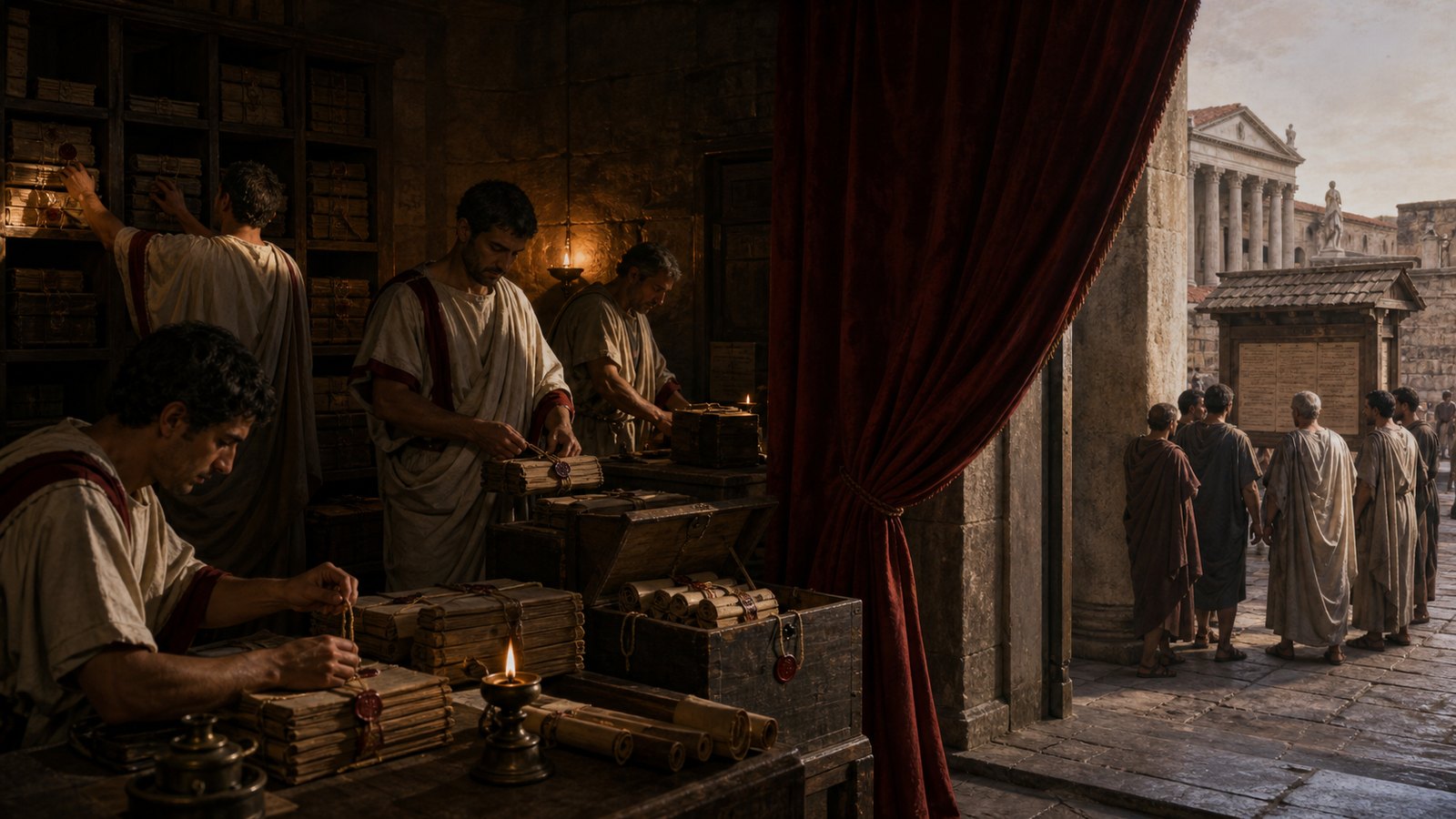
Suetonius says Augustus later stopped publication of the Senate’s proceedings. This reversal is one of the clearest clues to what Caesar’s measure had changed. A harmless civic bulletin would not require selective restriction. Senate records could reveal disagreement, expose individual positions and complicate the image of orderly consensus.
Augustus did not abolish Roman record-keeping. His government depended intensely on documents, lists, laws and reports. The issue was access. Administration could preserve information internally while deciding that a particular stream should no longer be routinely presented to the public.
The restriction fits a regime that maintained republican forms while concentrating power. Senate debate continued and senatorial dignity remained useful. Publishing every proceeding risked showing the negotiations behind unanimity. Closing that window helped political outcomes look smoother than the process that produced them.
The contrast resembles Claudius’s attempt to add letters to the alphabet. Government could intervene not only in what people did but in the systems through which speech and writing became official. Augustus’s intervention targeted circulation rather than letterforms.
An official record could still become hostile evidence
Tacitus treats records as sources with political danger. In his account of the charges around Thrasea Paetus, reference to public and senatorial records belongs to a world where attendance, silence and dissent could be reconstructed. A record preserved facts that later power might weaponize.
That danger cuts both ways. Publication can hold officeholders to their stated positions. It can also supply prosecutors with a sequence of acts. An official text is not automatically liberating. Its effect depends on who can read it, copy it, cite it and impose consequences from it.
The acta therefore occupied an unstable boundary between information and authority. They informed because authority certified them. They controlled because certification excluded alternative versions. Readers might distrust the wording, but they could not ignore the fact that this was the state’s entry.
Calling the system a newspaper can hide that institutional core. There was no protected editorial staff standing outside government. There was an administrative record crossing into public space, then escaping official control through copying and discussion. Its independence began after posting, in what readers did with it.
The missing boards still reveal a politics of access
Because the physical notices are gone, the temptation is to fill the gap with familiar images of headlines and reporters. A better reconstruction begins with the surviving actions. Caesar ordered proceedings compiled and published. Augustus withdrew Senate proceedings from that publicity. Tacitus knew records could preserve charged conduct.
Those actions define the mechanism without pretending to recover a page layout. Clerks produced text. Authority selected content. Public display created access. Readers and intermediaries expanded circulation. A later ruler narrowed one politically sensitive source. Each stage changed who could know what about Roman government.
The daily record made official business present in the city’s ordinary movement. It could be encountered between errands, copied for a patron or recited to a cluster of listeners. That everyday setting did not make it trivial. It made politics harder to confine to the building where the vote occurred.
Caesar’s measure and Augustus’s restriction belong together. The first shows the advantage of exposure; the second shows its cost to a controlled regime. Between them stands the public wall, temporary but consequential, where Roman power wrote a version of itself and discovered that readers could carry it away.
Sources
Suetonius, Julius Caesar 20
Suetonius, Augustus 36
Tacitus, Annals 16.22
Acta Diurna communication-history reference