
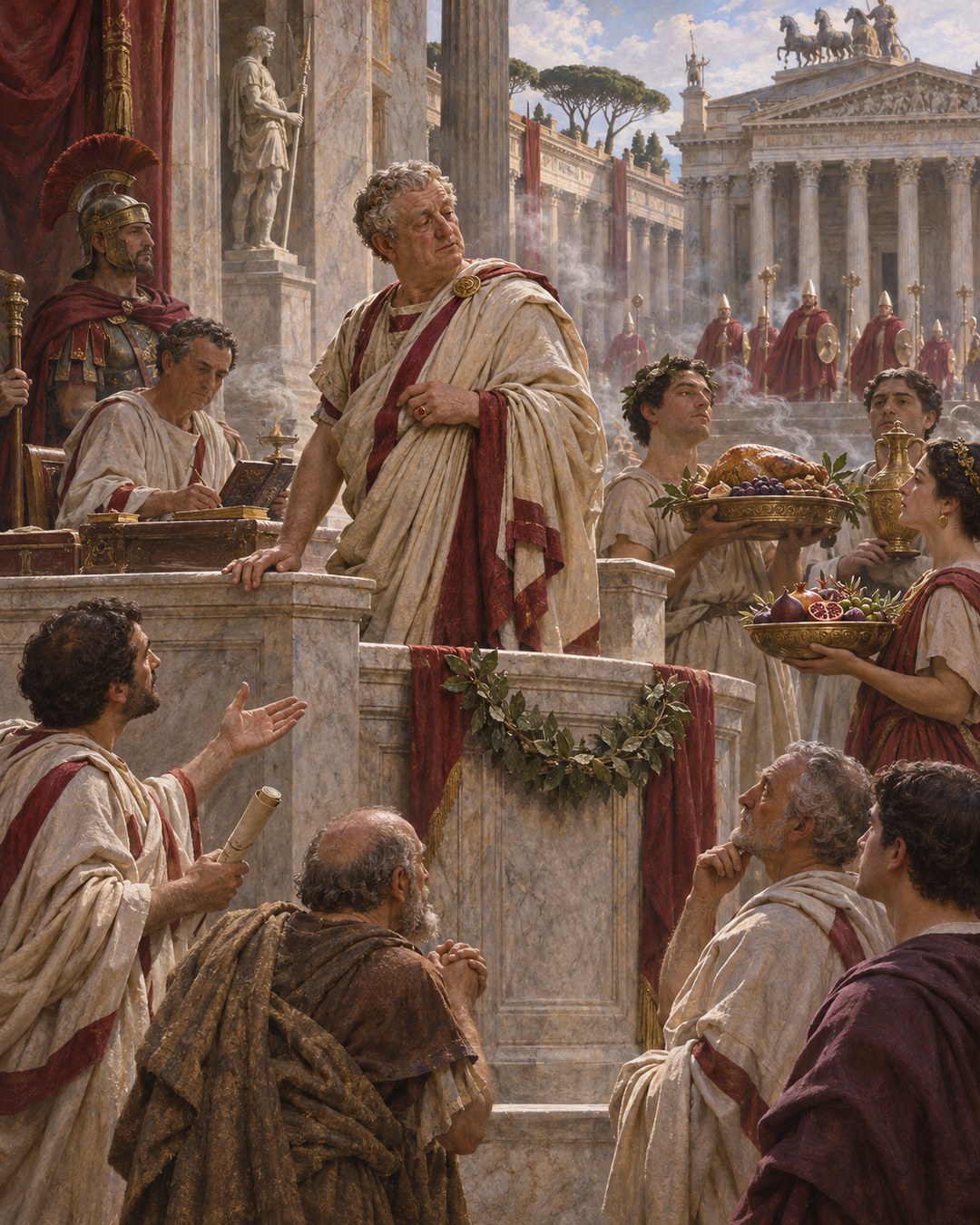
Emperor Claudius was holding court in the Forum of Augustus when another institution of Roman power reached him through the air. Nearby, in the Temple of Mars, a meal was being prepared for the Salii, the ancient priesthood associated with Mars. Claudius caught its savour. According to Suetonius, he left the tribunal, went up to where the priests were, and took his place at their table.
The ancient biographer presents the incident as evidence of Claudius’s appetite. Yet the scene is richer than a joke about hunger. A court session, a temple, a priestly meal, and the emperor’s body occupied the same urban space. Smell crossed the boundary first. Claudius followed it, temporarily moving the centre of attention from legal business to sacred dining.
Two Roman Institutions Stood Close Enough to Smell
Suetonius identifies the judicial setting precisely: Claudius was holding court in the Forum of Augustus. He also locates the meal at the Temple of Mars “hard by”—close at hand. The story depends on proximity. The emperor did not hear a distant report of a banquet. The preparation was near enough for its aroma to reach the place where he sat as judge.
The Forum of Augustus was designed to gather political memory, monumental architecture, and public business into one controlled setting. The Temple of Mars Ultor dominated the complex. Suetonius’s anecdote does not pause to describe columns, statues, or paving. Instead, it gives the space a sensory connection: food prepared near the temple became perceptible at the tribunal.
This matters because modern plans can make Roman buildings look like sealed compartments. In use, boundaries leaked. Sound travelled. Processions crossed open ground. Smoke, heat, and cooking smells drifted. A magistrate hearing advocates could remain physically close to ritual specialists preparing to eat.
The Salii themselves carried an old relationship between Mars, movement, and elite priesthood. Another tradition explained how eleven copies concealed the sacred shield said to have fallen from the sky. Suetonius’s meal episode shows the same priesthood in a less spectacular activity. Sacred offices also had tables, attendants, vessels, and appetites.
The Smell Crossed from Temple to Court
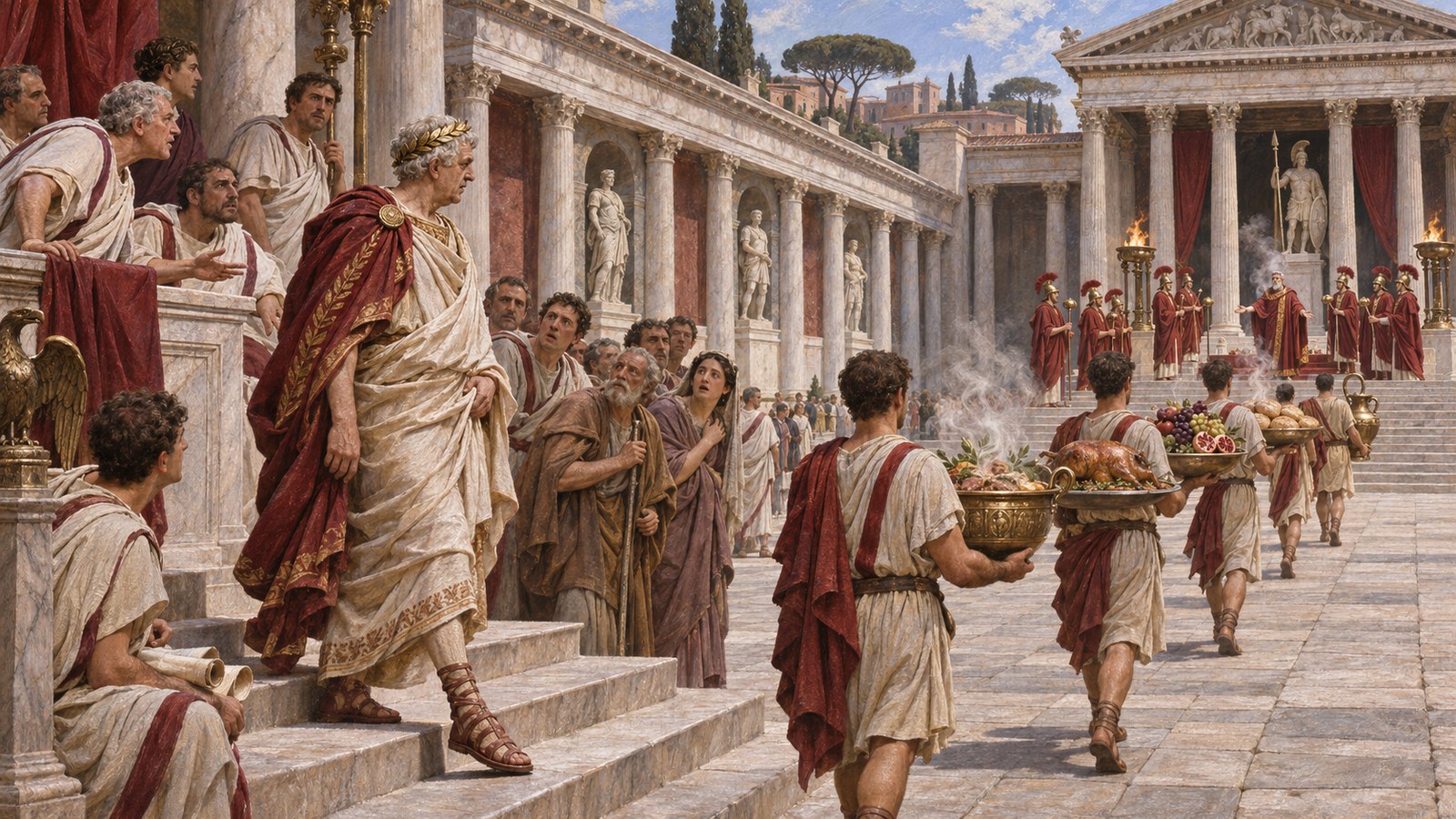
Suetonius does not list the menu. We do not know which dish produced the aroma or how the food was cooked. His wording asks readers to imagine only the effect: Claudius caught the savour of a meal being prepared. Any attempt to specify meat, sauce, bread, or wine would outrun the evidence.
The omission strengthens the anecdote. The meal is defined by its ability to interrupt. Before Claudius moves, food has already crossed the space invisibly. The emperor’s response turns that ordinary sensory event into a public action.
Smell is difficult to confine and difficult to ignore. A visual object can be screened. A voice can be lowered. Cooking announces itself beyond the kitchen through smoke, warmth, and aroma. In Suetonius’s telling, the meal became present in court without being carried onto the tribunal.
The moment also exposes the body inside public office. Claudius sat as emperor and judge, but he could still become hungry when food was nearby. The biographer repeatedly used bodily habits to make rulers legible. Here, appetite did not remain a private sensation. It altered the sequence of public business.
Leaving the Tribunal Reordered the Scene
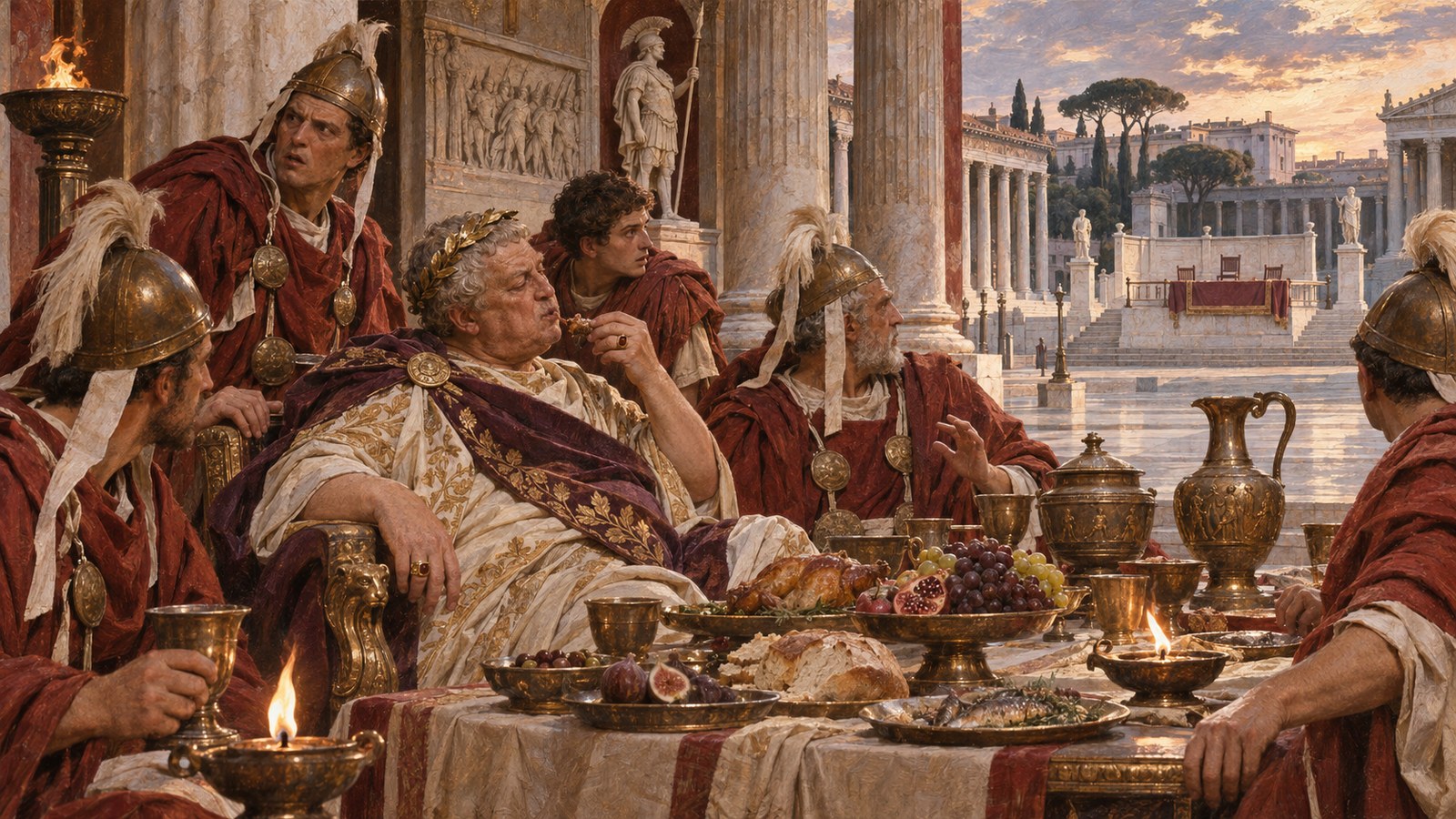
The decisive verb is not “smelled” but “left.” Suetonius says Claudius left the tribunal. A tribunal made judicial rank visible by raising the magistrate above those who approached him. Moving away from it meant abandoning the object and position that structured the hearing.
We should not pretend to know how long the interruption lasted or which case was being heard. Suetonius names no litigant and records no ruling delayed by the meal. What survives is the contrast he wanted: Claudius was engaged in court business, detected food, and physically relocated himself.
That movement would have been legible to everyone present. Advocates could raise their voices when Claudius slept during hearings, as Suetonius reports in the following section. In this scene, however, the emperor did not fade into inattention while remaining seated. He got up and went elsewhere. The judicial gathering lost its central figure because another table had attracted him.
Claudius’s earlier experiences at dinner could be humiliating. Before his accession, guests reportedly pelted him with olive stones and slippers when he slept, a scene examined in the dinner game made from sleeping Claudius. As emperor, his movements at meals affected other people’s time. Appetite now carried institutional consequences.
He Did Not Merely Visit the Priests
Suetonius gives the episode a final physical detail. Claudius went up to where the priests were and took his place at their table. He did not only inspect the preparation or exchange a greeting. The action ended with a seat among those for whom the meal had been made.
That conclusion joins imperial and priestly privilege. The Salii were not anonymous diners in a tavern; they were a specific Roman priesthood associated with Mars. Their meal belonged to an institutional setting. Claudius’s presence at the table could be accommodated because he was emperor, but Suetonius frames the move through appetite rather than ceremony.
We should resist turning the anecdote into proof that Claudius violated a known ritual rule. The passage does not say he was excluded from the meal, that the priests objected, or that his participation was unlawful. Its force comes from abruptness. Court business was underway; food was detected; the emperor changed places.
The priests’ response is absent. That silence keeps Claudius at the centre of the biography. We see what he wanted and what he did, not whether attendants scrambled, advocates protested, or priests welcomed him. The emperor’s movement supplies the whole surviving plot.
Suetonius Turned Appetite into Political Motion
Ancient biography often reduces large reputations to small scenes. Claudius governed an empire, presided over legal business, and occupied major priestly roles. Suetonius made those abstractions tangible by showing one body respond to one smell in one monumental forum.
The anecdote is not a neutral transcript. It belongs to a sequence describing Claudius as eager for food and drink “at all times and in all places.” Suetonius selected and arranged the incident to prove that characterization. The careful reader must preserve that authorial purpose while still noticing the social mechanics inside the story.
Those mechanics are unusually clear. The tribunal organized legal attention. The temple organized sacred attention. The meal activated appetite. Claudius linked all three by walking from the first institution into the second and sitting at its table.
His route also changed which audience could watch him most directly. At the tribunal, petitioners and advocates approached an emperor defined by judgment. At the priests’ table, diners encountered the same emperor as a participant in their meal. Suetonius compresses the transition so tightly that public office appears almost portable: Claudius did not stop being emperor when he left the raised seat, but the activity around him changed from legal pleading to eating.
The nearby Temple of Mars makes that shift especially sharp. Mars was not a decorative backdrop to the forum. The temple and its priesthood placed war, vows, ritual memory, and Augustus’s monumental programme beside ordinary legal business. Yet Suetonius refused the grand register. His Claudius was moved neither by a divine sign nor by solemn music, but by the smell of food prepared for the priests.
That choice of detail turns monumental Rome into an inhabited place. Ceremonial buildings required kitchens or preparation areas, servants and attendants. Priests did not exist only while carrying sacred objects in procession; they also gathered around food. Courts likewise depended on bodies capable of hunger, fatigue, sleep, and distraction. The anecdote lets those routines collide.
No menu survives, no case file names the interrupted litigants, and no schedule tells us how the hearing resumed. What remains is a compact image of Roman power unable—or unwilling—to separate office from appetite. The smell of the Salii’s meal crossed a short distance. The emperor crossed it too, and everyone else’s business had to wait on the other side.
Sources
Suetonius, Life of Claudius, sections 32–33; Loeb Classical Library translation reproduced by LacusCurtius.