
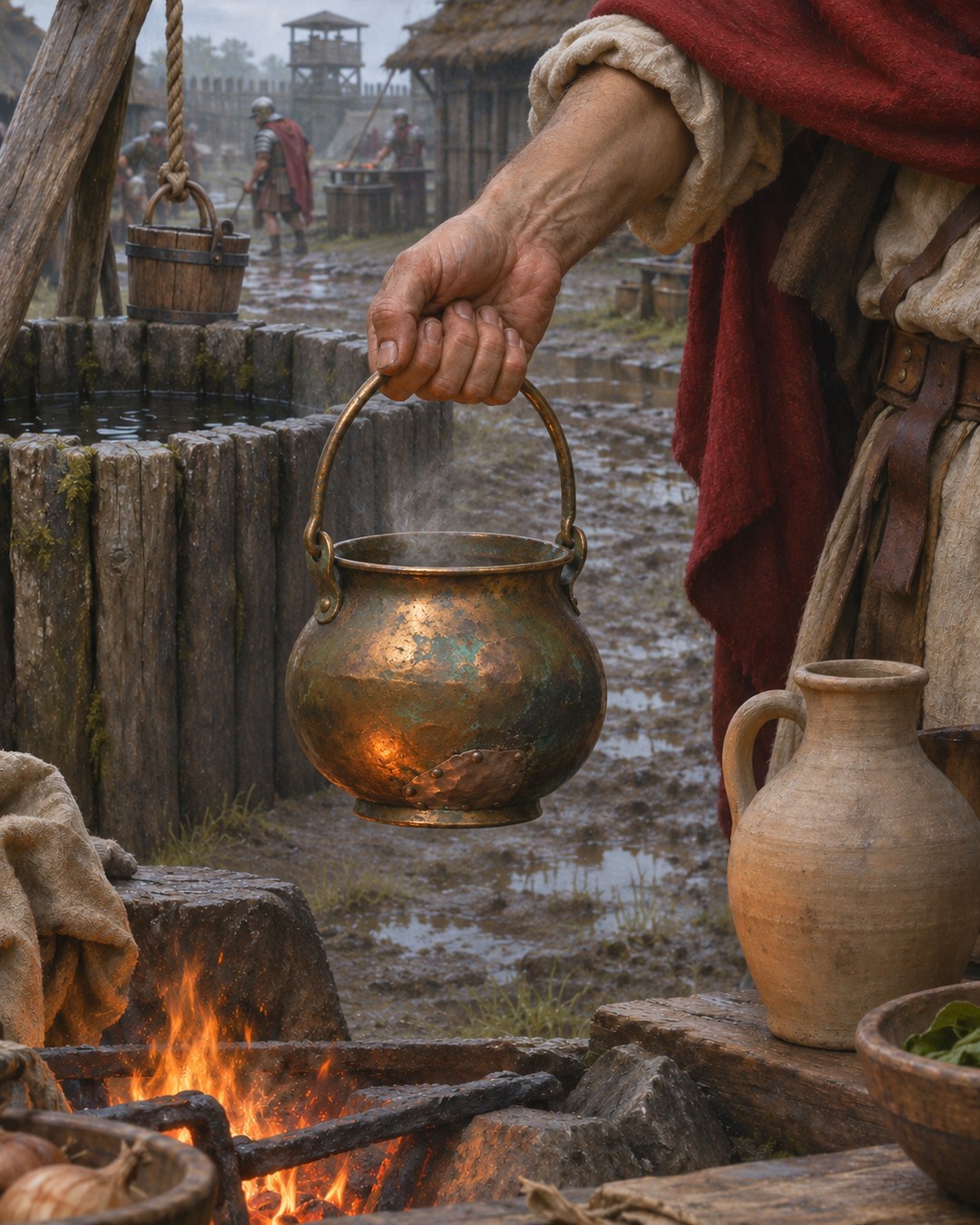
A copper-alloy vessel from Roman London carries evidence of two endings. Its base was damaged and repaired, so someone once decided its working life should continue. Later it reached the bottom of a Roman well, where it was found beside a jug.
The London Museum describes it as a cauldron, bucket or camp kettle. It stands 270 millimetres high and measures 260 millimetres across. Its body is convex, its rim turns outward at an angle, and a small foot ring sits beneath the damaged base.
The handle is missing, but the lugs that received it remain attached to the rim. Those surviving features reconstruct a portable cooking vessel without pretending to recover its owner, contents or exact reason for entering the well.
The Vessel Was Built to Hang, Stand and Pour
A camp kettle had to manage heat, liquid and movement. The convex body created volume without sharp internal corners. The out-turned angled rim gave definition to the opening. The missing handle once met the vessel at lugs fixed to that rim.
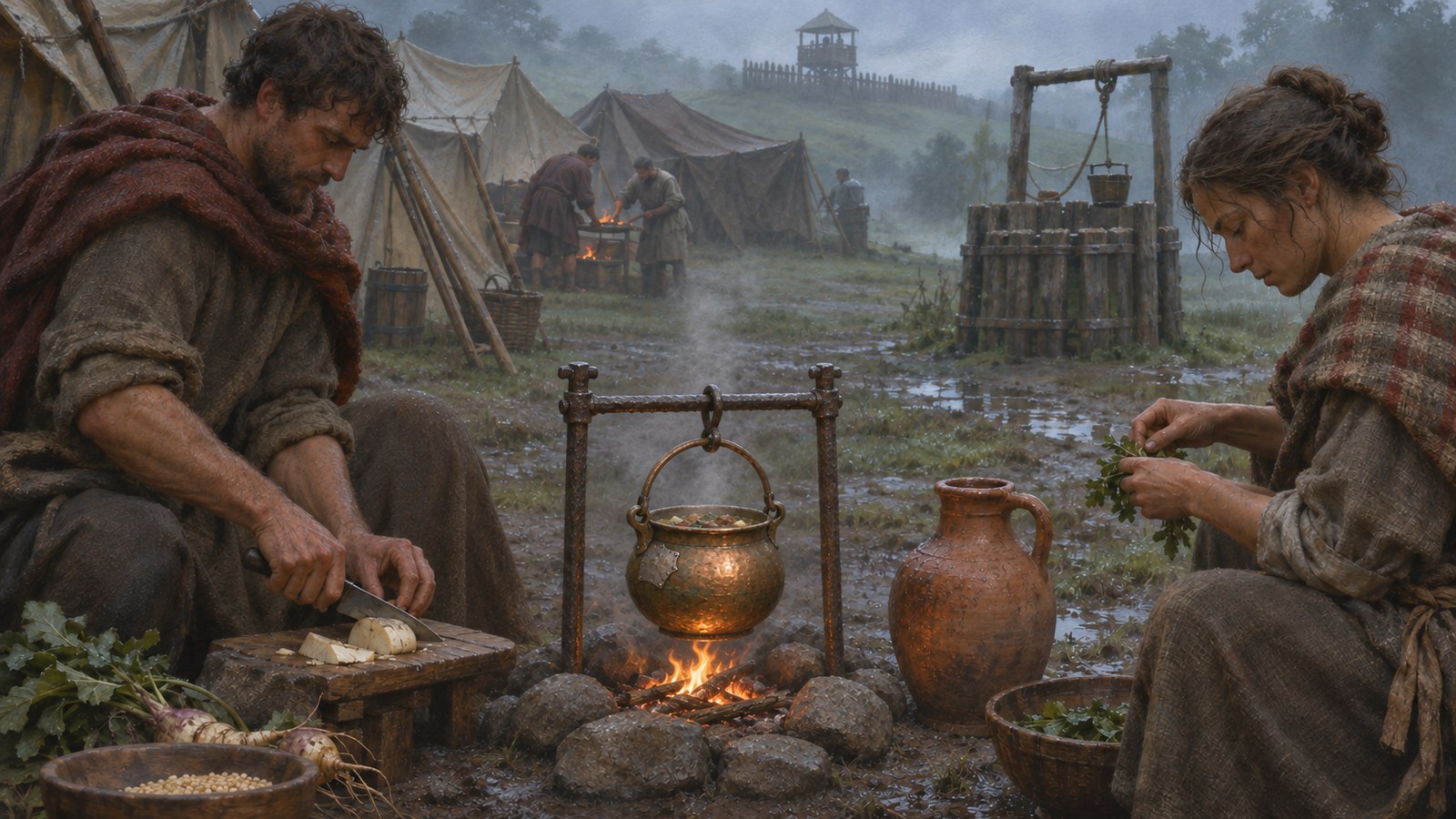
The handle transformed the pot from a container into equipment that could be lifted. A user could move it away from heat, carry it between places or suspend it from a support. The surviving lugs reveal that intended motion even though the handle itself has vanished.
The small foot ring answered a different need. When the kettle was lowered onto a surface, the ring helped the rounded or damaged base meet the ground. Hanging and standing were not mutually exclusive states; the vessel was designed to move between them.
At 270 by 260 millimetres, it was substantial enough for shared preparation yet still within the scale of a portable vessel. The museum’s term “camp kettle” emphasizes mobility, while “cauldron or bucket” preserves uncertainty about the full range of use.
The angled rim could help control the edge while contents were poured or accessed, but the museum does not identify a spout. It is safer to see the rim as part of the vessel’s finished opening than to invent a precise pouring technique.
Copper alloy offered durability and useful heat behaviour, while lead alloy appears in the museum’s material record as well. The record does not specify exactly where the lead alloy occurs, so it should not be assigned to the repair or a particular seam without analysis.
A practical vessel can look simple because every feature has become familiar. This one was a coordinated object: convex walls, defined rim, handle lugs, handle, foot ring and base. Damage to any part changed how the whole could be used.
A Repaired Base Recorded a Decision to Keep Cooking
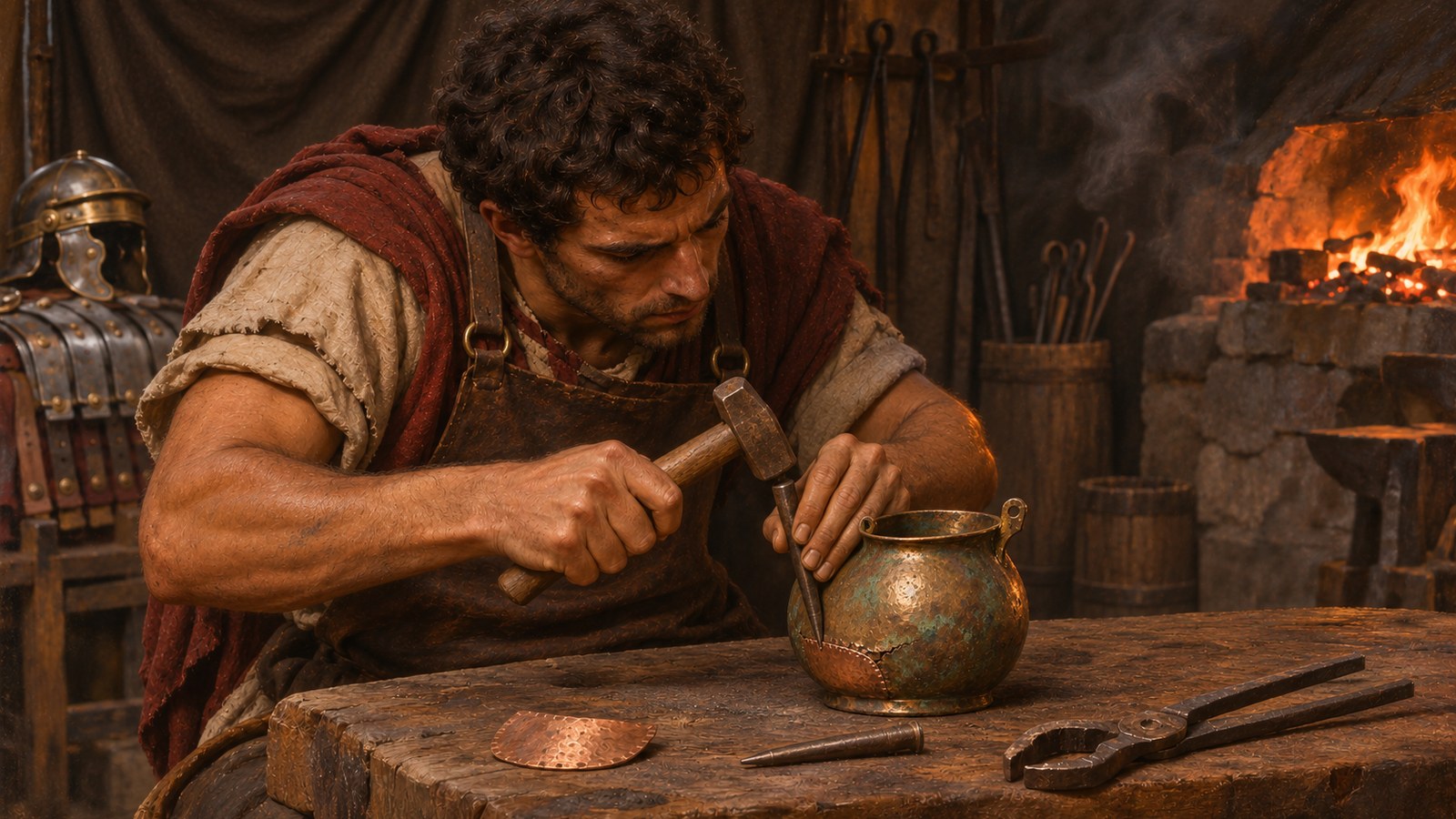
The museum’s brief statement “base repaired” is the object’s strongest evidence for human choice. Damage had occurred, but disposal did not follow immediately. Someone supplied labour and material because the vessel remained worth using.
Repair makes value visible in a way that purchase records cannot. The owner or user could have abandoned the kettle, recycled its metal or sought another container. Instead, the damaged base received attention.
The surviving record does not explain the repair technique. We should not imagine a patch shape, rivet count or solder line unless the object itself is examined. What can be said is that the base passed through at least two states: damaged and repaired.
That sequence places maintenance inside Roman material life. Metal vessels did not move directly from workshop perfection to archaeological discard. They could be dented, cracked, patched, refitted and kept in service.
Repair also changed trust. A kettle holding liquid over heat had to survive pressure from its contents and repeated lifting. After damage, the user had to judge whether the intervention was sound enough for continued work.
The old repair may have remained visible. Function did not require the vessel to look untouched. A scar on the base could mark competence and thrift rather than failure.
A larger heating system appears in the Roman bath installation where one fire fed three cauldrons. This camp kettle belonged to a smaller and more portable scale, but both objects depended on metal vessels repeatedly meeting heat and water.
The choice to repair is especially striking because the handle later disappeared and the kettle eventually entered a well. Continued use was real even though permanence was not.
The Missing Handle Still Explains the Lugs
Archaeological objects are often read through absence. Here the handle is missing, yet the lugs attached to the rim preserve its connection points. The absent component remains mechanically legible because the vessel was shaped to receive it.
A handle would have concentrated the vessel’s loaded weight at those lugs. Their attachment had to resist lifting, swinging and setting down. The body might hold the liquid, but the lugs transferred that burden to the user’s hand or a suspension hook.
The loss could have happened before deposition, during deposition, after burial or during the long history before recovery. The museum record does not choose among those possibilities. It merely distinguishes the surviving vessel from its missing movable part.
This is why reconstructions must be disciplined. A curved carrying handle is plausible for understanding the function, but its exact profile, material and fastening should not be treated as preserved facts for this object.
The lugs nevertheless show that portability was designed in from the beginning. A cauldron without a workable lifting system would be difficult to manage once hot or full. The handle was not decorative; it connected the container to action.
The small foot ring then received the vessel when that action paused. Lift by the handle, settle on the ring, return to heat or storage: the body supported a repeated sequence of movements.
Portable cooking equipment also crossed social settings. A vessel called a camp kettle could serve travel or temporary accommodation, while a cauldron or bucket could operate in more settled work. The museum keeps those names together because the form allows more than one practical reading.
The Well Preserved a Final Context, Not a Motive
The kettle was found at the bottom of a Roman well with a jug identified in the record as 28.6/1. That association is concrete. The reason both objects were there is not.
A well can receive material through accident, deliberate disposal, abandonment, collapse or ritual action. Without further contextual evidence, choosing one motive would turn possibility into story. The safest conclusion is that the bottom of the well became the vessel’s final archaeological context.
The repaired base complicates any simple claim that the kettle was thrown away as soon as it broke. Repair happened first. Deposition happened later. How much time lay between them remains unknown.
The jug beside it creates another relationship without explaining it. Both were containers, and both reached the same feature. They may have entered together or at different moments within the well’s history.
Roman wells could become archives precisely because their damp, enclosed fills trapped objects beyond ordinary surface disturbance. Yet the condition that preserved a context also removed the vessel from its last living arrangement.
The kettle therefore offers two kinds of evidence. Construction explains intended use: convex body, rim, lugs, handle and foot ring. Damage and context explain biography: broken base, repair, lost handle and deposition in a well.
A different preservation decision appears in the five-day process that kept Roman olives black. Food preservation and vessel repair addressed different materials, but both reveal households extending usefulness through controlled intervention.
The camp kettle’s ending should not overshadow its middle. The bottom of the well is where archaeology found it, not where its meaning began. Someone had already handled it, heated it, damaged it and repaired it.
That repaired base is a small refusal to discard. The well is the later fact that ended the refusal. Between them lies the working life of a Roman vessel that mattered enough to mend.
Sources
London Museum, “Cauldron.”