The Point Chisel and the Missing Mass of a Roman Statue

A Roman statue did not begin with a smooth plane or a delicate fold. It began with a large mass that had to disappear. The point chisel, an iron shaft with a pyramidal tip, performed so much of that removal that stone-carving scholar Peter Rockwell called it the workhorse of carving and estimated that it … Read more

The Iron Skeleton Hidden Inside Roman Monuments

A Roman monument could look as if gravity alone had persuaded every block to stay. Inside many joints, however, iron crossed from one stone to the next. The Art of Making project says most blocks in large Roman monuments were fixed to neighbors with metal clamps and pins, usually iron protected and secured with lead. … Read more

Why Roman Stone Saws Needed Slurry, Not Sharp Teeth

A Roman stone saw could be longer than the two people assigned to pull it. The Art of Making project describes blades often more than two metres long yet typically no more than five millimetres wide. That combination looks fragile until the rest of the system appears: the blade was not asked to carry itself, … Read more

Pull, Twist, Reverse: Inside the Roman Bow Drill

A hole looks like an absence, but making one without splitting the surrounding material is a demanding act of control. A chisel enters from one direction and can force a crack ahead of itself. A Roman drill attacked the same small circle again and again, removing material while the tool stayed centered. Its cutting edge … Read more

The Hidden Tension That Kept a Roman Wheel Together

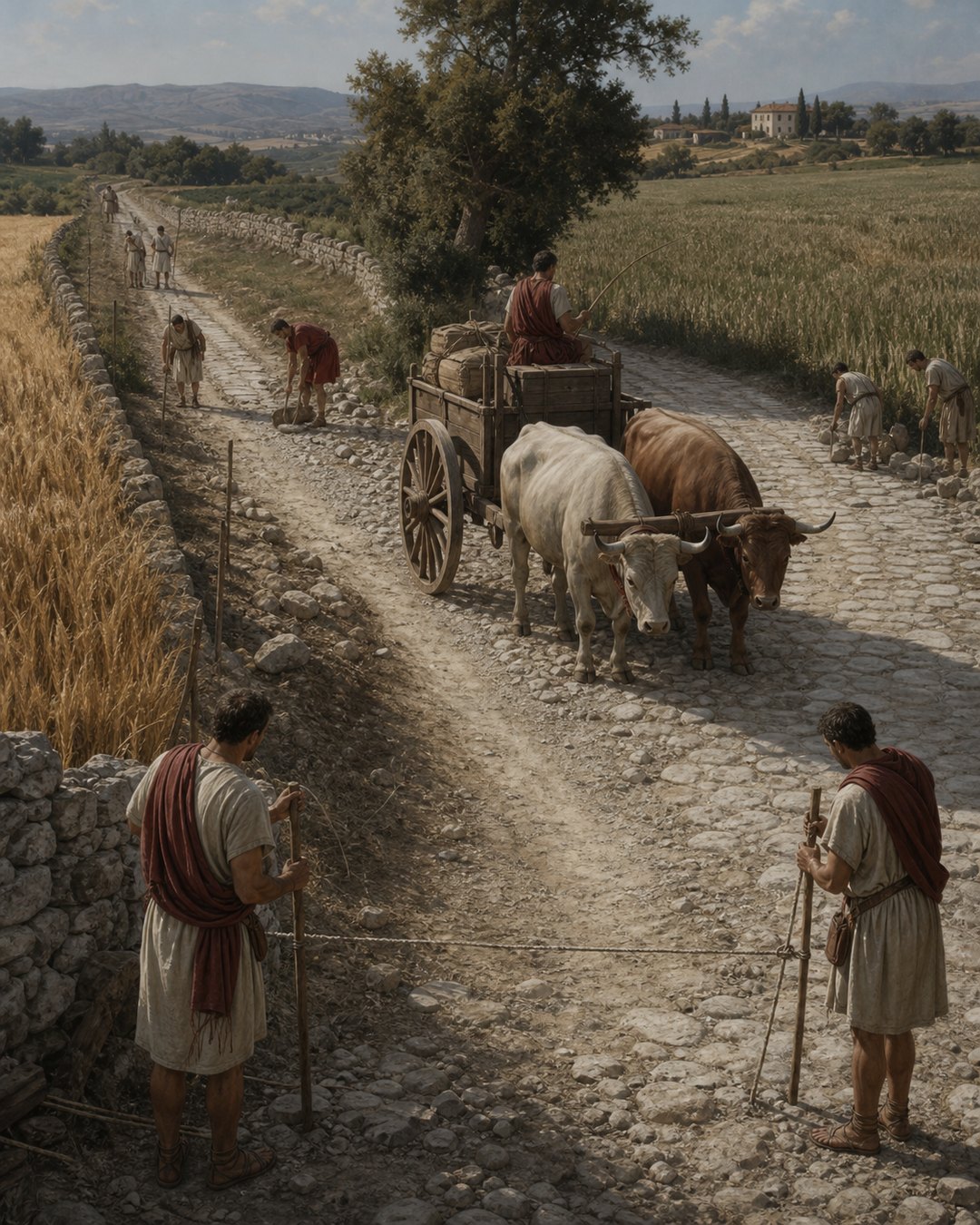
A wheel beside a Roman road looked simple only after the wheelwright had hidden every disagreement inside it. The hub wanted to split around its axle hole. Spokes wanted to loosen when timber dried. Felloe segments wanted to become a polygon instead of a circle. An iron tire had to fit tightly enough to bind … Read more

Soot, Gum and the Ink Behind Roman Writing

A Roman scribe could turn a blank sheet into an order, account, petition or poem only if thousands of black particles behaved. The darkest ingredient in common writing ink was often carbon: soot so fine that a breath could scatter it. Carbon would not dissolve in water. It had to be gathered, ground, bound and … Read more

How Papyrus Became a Page in the Roman World

Before a Roman letter could travel, someone in Egypt had to split a wet green stalk. The triangular stem of papyrus concealed a pale pith that could be cut into long strips. Placed side by side, crossed with another layer and pressed as it dried, those fragile ribbons became a sheet strong enough to carry … Read more

How Lime Kilns Turned Stone into Roman Mortar

A Roman wall could begin with a material that seemed to contradict itself. Hard limestone entered a kiln. After prolonged heat, the pieces emerged lighter, pale and chemically hungry. When workers added water, the burned stone cracked, steamed and collapsed into a soft mass. Only after that violent change could it help bind another wall … Read more