From Coarse Sand to Shine: The Stages of a Roman Polish

Polish looks like something added to stone. In Roman carving it was often the opposite: a long sequence of removals so small that the final surface returned light instead of obvious tool marks. Emery, sandstone and pumice did not paint marble. They ground away its high points and replaced one scale of scratches with another. … Read more

What a Flat Chisel Did That a Point Could Not

A hammer blow seems too blunt to produce a clean letter. Roman stone carvers solved that mismatch by placing a narrow piece of sharpened iron between hand and marble. The hammer supplied energy, but the flat chisel decided where that energy entered, how wide the removal became and whether the next mark joined the last … Read more

Why Roman Stone Saws Needed Slurry, Not Sharp Teeth

A Roman stone saw could be longer than the two people assigned to pull it. The Art of Making project describes blades often more than two metres long yet typically no more than five millimetres wide. That combination looks fragile until the rest of the system appears: the blade was not asked to carry itself, … Read more

Grain Between Two Stones: A Morning at the Hand Quern

Grain does not become flour because it is pressed once. Its hard kernels must be fractured, rubbed and reduced through repeated contact. A Roman rotary quern arranged that repetition inside two stones. The lower stone stayed still. The upper stone turned. Grain entered near the center and emerged finer at the circumference. Museum Wales preserves … Read more

Tweezers, Thorns and the Precision of a Roman Fingertip

A thumb and forefinger can pinch, but they cannot become arbitrarily small. A splinter ends beneath the skin; one hair stands apart from the rest; a fragment lies in a recess too narrow for a nail. Roman tweezers solved those little failures without adding a hinge. The tool was often only a strip of metal … Read more

Pull, Twist, Reverse: Inside the Roman Bow Drill

A hole looks like an absence, but making one without splitting the surrounding material is a demanding act of control. A chisel enters from one direction and can force a crack ahead of itself. A Roman drill attacked the same small circle again and again, removing material while the tool stayed centered. Its cutting edge … Read more

The Curved Blade That Gathered a Harvest in One Pull

A straight blade pushed through a standing field tends to scatter what it meets. Stems bend away, separate and escape around the edge. A sickle changes that encounter. Its blade curves inward toward the hand, so a pulling stroke gathers stalks into the cutting path. The crop is not merely struck; it is collected against … Read more

Why the Anvil Matters as Much as the Hammer

A hammer can strike hot iron in open air, but without support much of the blow merely sends the workpiece away. Forging begins when the metal is caught between two forces: the descending hammer and a surface that refuses to follow it. The anvil is that second participant. It has no handle and makes no … Read more

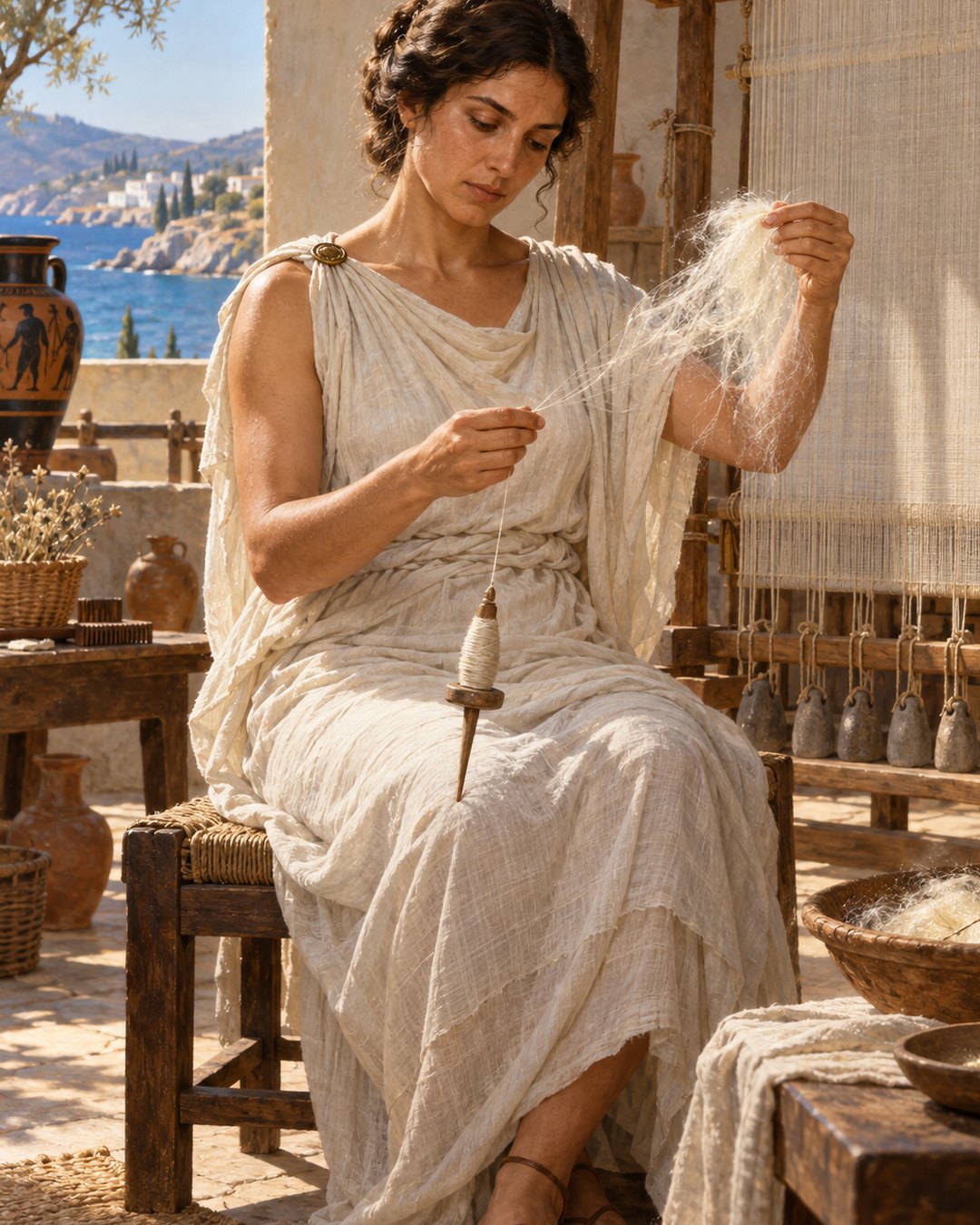
The Tiny Whorl That Kept Roman Thread in Motion

A Roman spinner did not turn a heap of wool into thread by pulling it thinner. Untwisted fibers can slide apart almost as easily as they can be drawn out. The decisive change came when the emerging strand began to rotate. Twist made neighboring fibers press and wind against one another, converting a loose cloud … Read more

Winning by Fractions: How a Roman File Shaped Metal

Forging gets the sparks, but fitting decides whether the object works. A Roman smith could hammer a bar close to shape and still find that a joint bound, an edge stood proud or a pin refused its opening. One more heavy blow might bend the part or undo an hour of work. The remaining error … Read more