Thousands of Scratches: How a Rasp Finished Roman Marble

A Roman marble carver could make a surface smoother by covering it with more marks. The rasp did not polish by erasing every trace at once. Its flattened ends carried fields of sharp points, and every rubbing stroke laid fine scratches across the stone. Later passes crossed and overlapped them until the rougher evidence of … Read more

The Point Chisel and the Missing Mass of a Roman Statue

A Roman statue did not begin with a smooth plane or a delicate fold. It began with a large mass that had to disappear. The point chisel, an iron shaft with a pyramidal tip, performed so much of that removal that stone-carving scholar Peter Rockwell called it the workhorse of carving and estimated that it … Read more

Roundels: The Small Tools Made for Deep Stone Hollows

A flat chisel carries two corners into every cut. On an open surface they help define a clean edge; inside a hollow, either corner can bite before the centre arrives. Roman stone carvers had another option. The roundel replaced the straight cutting edge with a curve, from an obvious semicircle to one so slight that … Read more

The Iron Skeleton Hidden Inside Roman Monuments

A Roman monument could look as if gravity alone had persuaded every block to stay. Inside many joints, however, iron crossed from one stone to the next. The Art of Making project says most blocks in large Roman monuments were fixed to neighbors with metal clamps and pins, usually iron protected and secured with lead. … Read more

How Callipers Carried Human Proportions into Stone

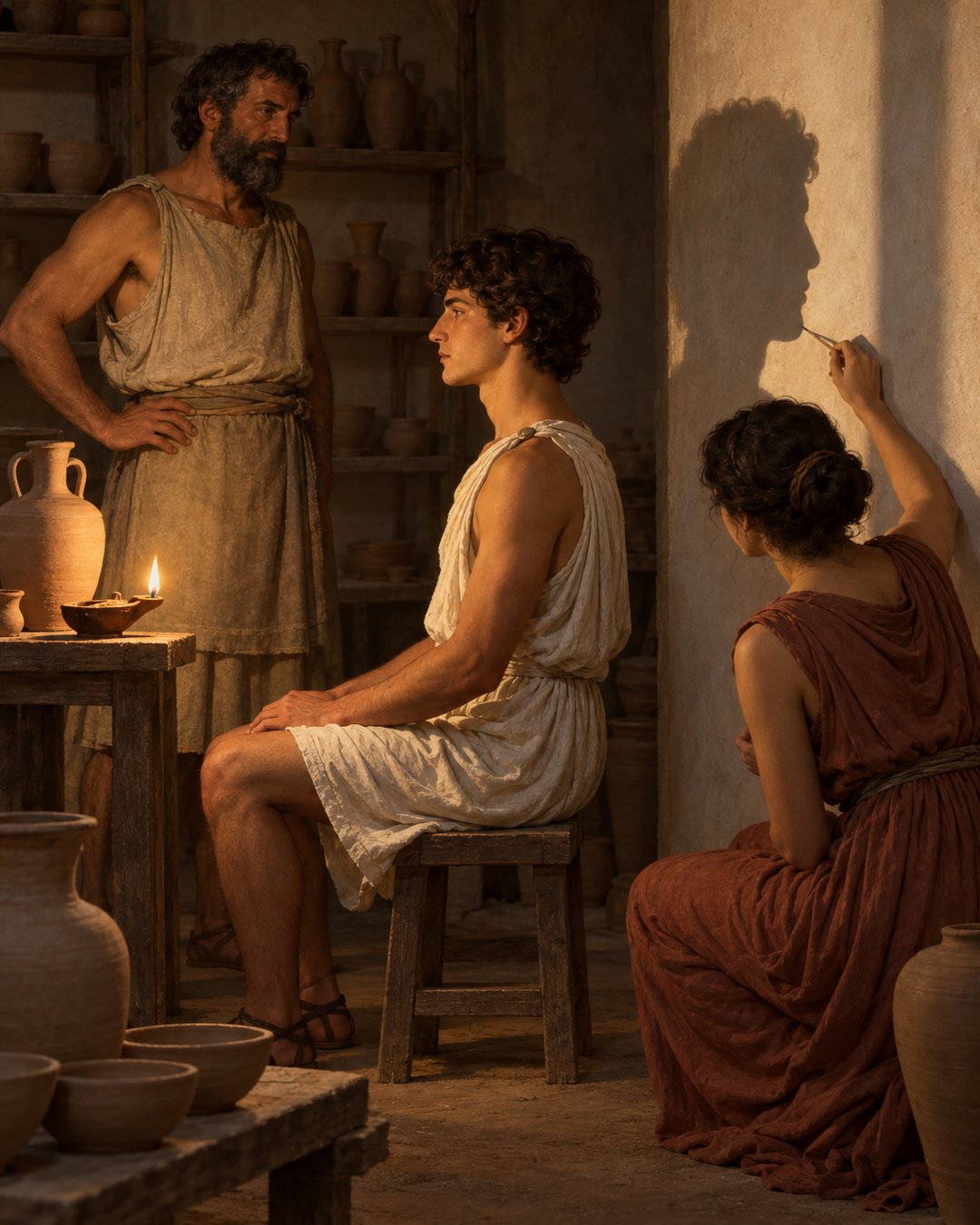
A Roman sculptor could carry a distance without writing it down. Open the callipers across a model’s shoulder, keep the legs fixed, then move the tool to the block: the empty gap between the points had become a portable instruction. Nothing had been marked with a numeral, yet one object could now answer another. The … Read more

From Coarse Sand to Shine: The Stages of a Roman Polish

Polish looks like something added to stone. In Roman carving it was often the opposite: a long sequence of removals so small that the final surface returned light instead of obvious tool marks. Emery, sandstone and pumice did not paint marble. They ground away its high points and replaced one scale of scratches with another. … Read more