From Coarse Sand to Shine: The Stages of a Roman Polish

Polish looks like something added to stone. In Roman carving it was often the opposite: a long sequence of removals so small that the final surface returned light instead of obvious tool marks. Emery, sandstone and pumice did not paint marble. They ground away its high points and replaced one scale of scratches with another. … Read more

Grain Between Two Stones: A Morning at the Hand Quern

Grain does not become flour because it is pressed once. Its hard kernels must be fractured, rubbed and reduced through repeated contact. A Roman rotary quern arranged that repetition inside two stones. The lower stone stayed still. The upper stone turned. Grain entered near the center and emerged finer at the circumference. Museum Wales preserves … Read more

Tweezers, Thorns and the Precision of a Roman Fingertip

A thumb and forefinger can pinch, but they cannot become arbitrarily small. A splinter ends beneath the skin; one hair stands apart from the rest; a fragment lies in a recess too narrow for a nail. Roman tweezers solved those little failures without adding a hinge. The tool was often only a strip of metal … Read more

The Curved Blade That Gathered a Harvest in One Pull

A straight blade pushed through a standing field tends to scatter what it meets. Stems bend away, separate and escape around the edge. A sickle changes that encounter. Its blade curves inward toward the hand, so a pulling stroke gathers stalks into the cutting path. The crop is not merely struck; it is collected against … Read more

The Tiny Whorl That Kept Roman Thread in Motion

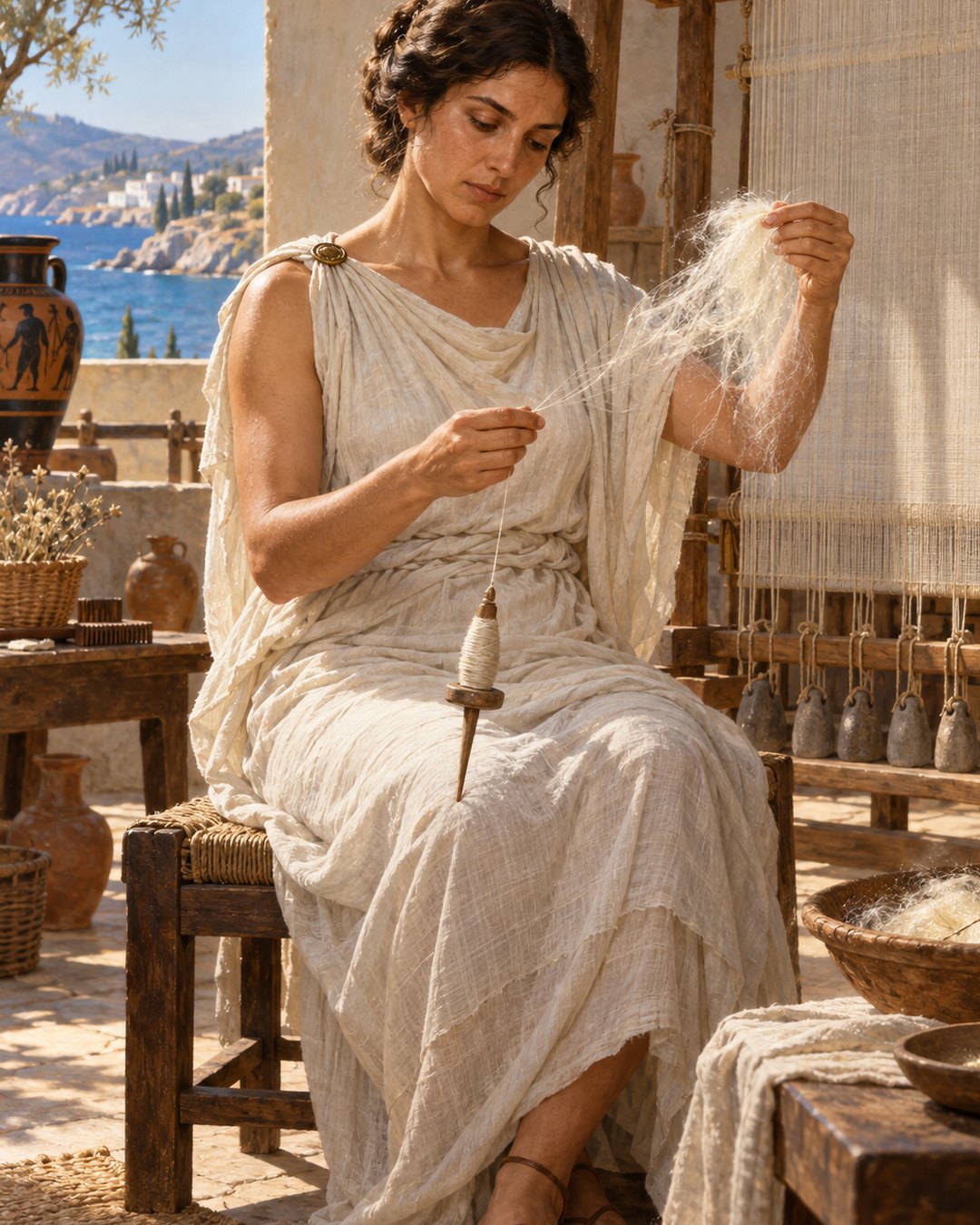
A Roman spinner did not turn a heap of wool into thread by pulling it thinner. Untwisted fibers can slide apart almost as easily as they can be drawn out. The decisive change came when the emerging strand began to rotate. Twist made neighboring fibers press and wind against one another, converting a loose cloud … Read more

How Two Points Preserved a Measurement Across the Workshop

A number is not the only way to remember a distance. A Roman craftsperson could open two pointed arms across the width of a fitting, lift the instrument away and carry that exact span to another piece. Nothing had to be called six fingers or copied from a ruler. The distance survived physically between the … Read more

How Straight Wooden Staves Learned to Hold Roman Wine

A barrel begins with a contradiction. Its wall is made from boards that are mostly straight, yet the finished vessel is curved in two directions and must resist liquid pressing outward at every seam. The cooper cannot hide a broad patch behind plaster or glue. Each narrow stave has to meet its neighbors continuously from … Read more

Why the Fire Never Touched the Pots in a Roman Kiln

A Roman pot could survive shaping, trimming and days of drying, then fail in the last few hours. Trapped moisture burst walls. A vessel placed too near a hot channel warped. Smoke altered a surface. One rushed opening cracked a load that had endured the full fire. The kiln made this risk manageable by separating … Read more

The Long Fight Against Rot in a Roman Tannery

A fresh hide carried the shape of an animal and the certainty of decay. Left wet, it putrefied. Dried too quickly, it hardened into a board. Roman tanners had to keep the useful collagen layer while removing hair, flesh, fat and the conditions that allowed rot to begin. The solution was not one bath. Hides … Read more

Inside the Salt Pans That Fed the Roman Economy

The sea could cover a Roman salt pan in the morning and leave a white mineral crust weeks later. Nothing had been added. Workers had moved water, controlled depth and waited while sun and wind carried most of the liquid away. The harvest looked simple only after an entire coastal landscape had been organized to … Read more